AI-Augmented Prediction of Hypertensive Emergency Outcomes Using National Inpatient Data: A Machine Learning Approach to Risk Stratification
Abstract Body: Background Hypertensive crises are life-threatening episodes of elevated blood pressure that coincide with acute target organ damage. Early detection of those at risk of poor outcomes is critical for tailoring treatments and lowering mortality. Artificial intelligence (AI) provides unique capabilities in real-time risk assessment by harnessing enormous amounts of clinical data. This research applies machine learning to national inpatient data to predict important outcomes in hypertensive crisis patients.
Methods We extracted adult inpatient data from the National Inpatient Sample (NIS, 2016-2021) for admissions with a primary diagnosis of hypertensive emergency, identified using validated ICD-10-CM codes such as I16.0 (hypertensive urgency), I16.1 (hypertensive emergency), and I16.9 (unspecified hypertensive crisis). Demographics, comorbidities (Charlson Comorbidity Index), hospital characteristics, and socioeconomic indicators were also considered predictive variables. Key outcomes were in-hospital mortality, increased length of stay (LOS > 4 days), and 30-day readmission (via the Nationwide Readmissions Database). Machine learning models, such as random forest, XGBoost, and logistic regression, were trained on 80% of the dataset and graded on 20%. Performance was tested using the area under the ROC curve (AUC), F1-score, and calibration plots.
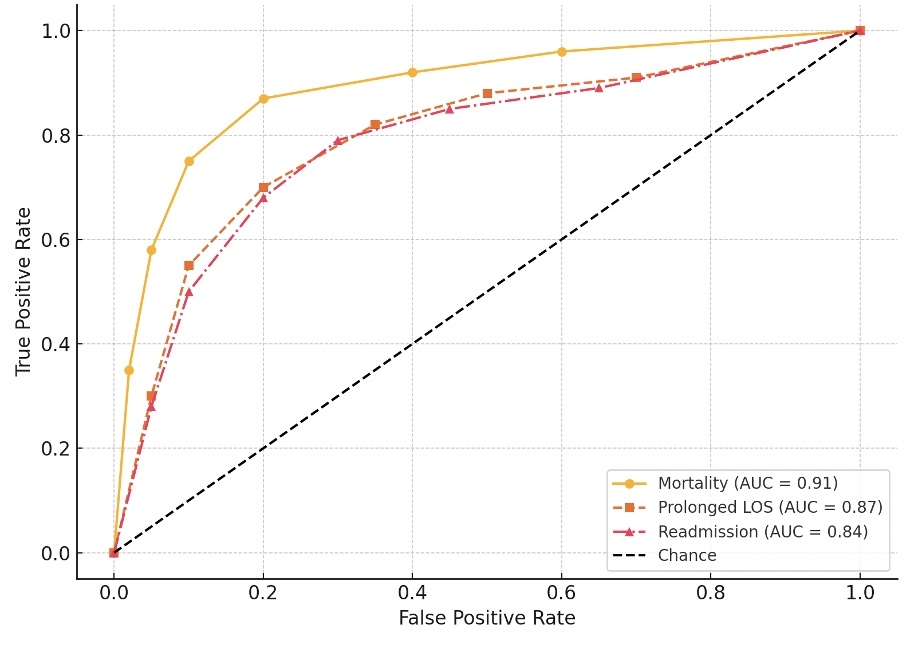
Results Among 82,614 weighted hospitalizations for hypertensive episodes, 3.4% died in the hospital, 38.2% had a longer length of stay, and 15.1% were readmitted within 30 days. The XGBoost model had the best predictive performance, with an AUC of 0.91 and an F1-score of 0.79 for death prediction, an AUC of 0.87 for extended LOS, and an AUC of 0.84 for readmission. The SHAP research revealed acute kidney damage, age over 65, low-income quartile, and congestive heart failure as major contributions to model predictions. Calibration plots revealed significant agreement between anticipated probability and observed occurrences. Figure 1 displays the ROC curves for all three outcome models, which demonstrate model differences across clinical endpoints.
Conclusion Using real-world inpatient data, AI-based models can reliably predict important outcomes in patients admitted with hypertensive crises. These techniques allow risk-based triage, discharge planning, and focused follow-up, especially in high-risk, resource-constrained populations.
Kumar, Harendra
(
Dow University of Health Sciences
, Karachi , Pakistan )
Sharma, Ashish
(
University of Connecticut
, Hartford , Connecticut , United States )
Tiwari, Angad
(
Maharani Laxmi Bai Medical College
, Jhansi , Uttar Pradesh , India )
Author Disclosures:
Harendra Kumar:DO NOT have relevant financial relationships
| Ashish Sharma:DO NOT have relevant financial relationships
| Angad Tiwari:DO NOT have relevant financial relationships