
Logo

American Heart Association

  62
  0


Final ID: FR526

A machine learning model for individualized risk prediction of ischemic heart disease in people with hypertension in Thailand

Abstract Body: Background: Ischemic heart disease (IHD) is the major cardiovascular complication among individuals with hypertension (HTN) and is the leading cause of death in Thailand. To help accurately determine who is at risk of IHD, we developed an internally and externally validated model comprising multi-level factors that can help to predict the individualized risk of IHD among Thai people with HTN.
Methods: We used data from a sample of 62,333 people with HTN of the Thailand DM/HT study for the training and testing dataset (33,966:28,367). We developed the model using the Least Absolute Shrinkage and Selection Operator (LASSO) penalized regression to select the best subset of multi-level predictors (individual and healthcare-related factors) of IHD using 10-fold cross-validation. Twelve potential predictors included in the model were assessed at baseline, and IHD was assessed at one-year follow-up. We evaluated model performance using calibration and discrimination measures.
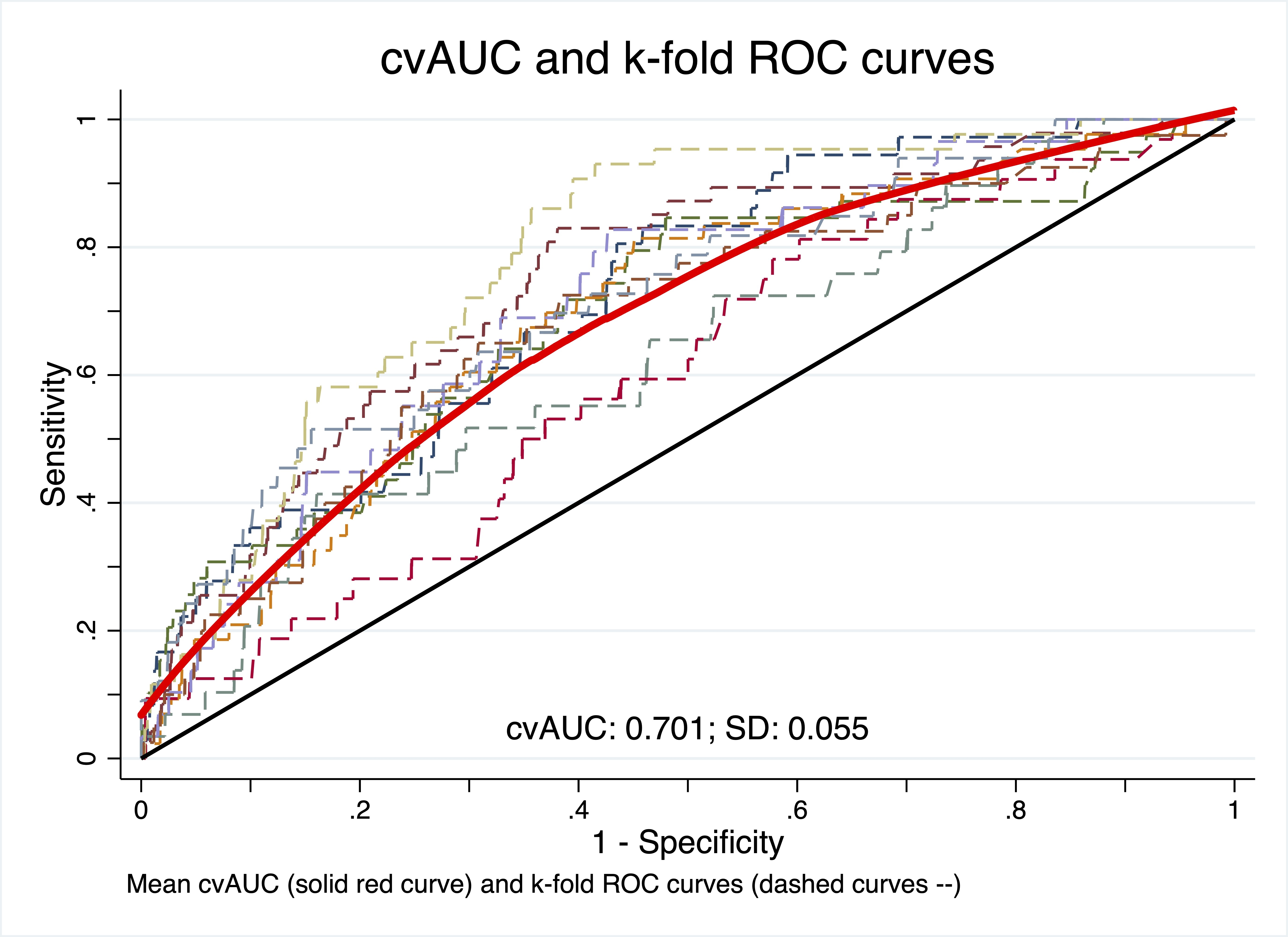
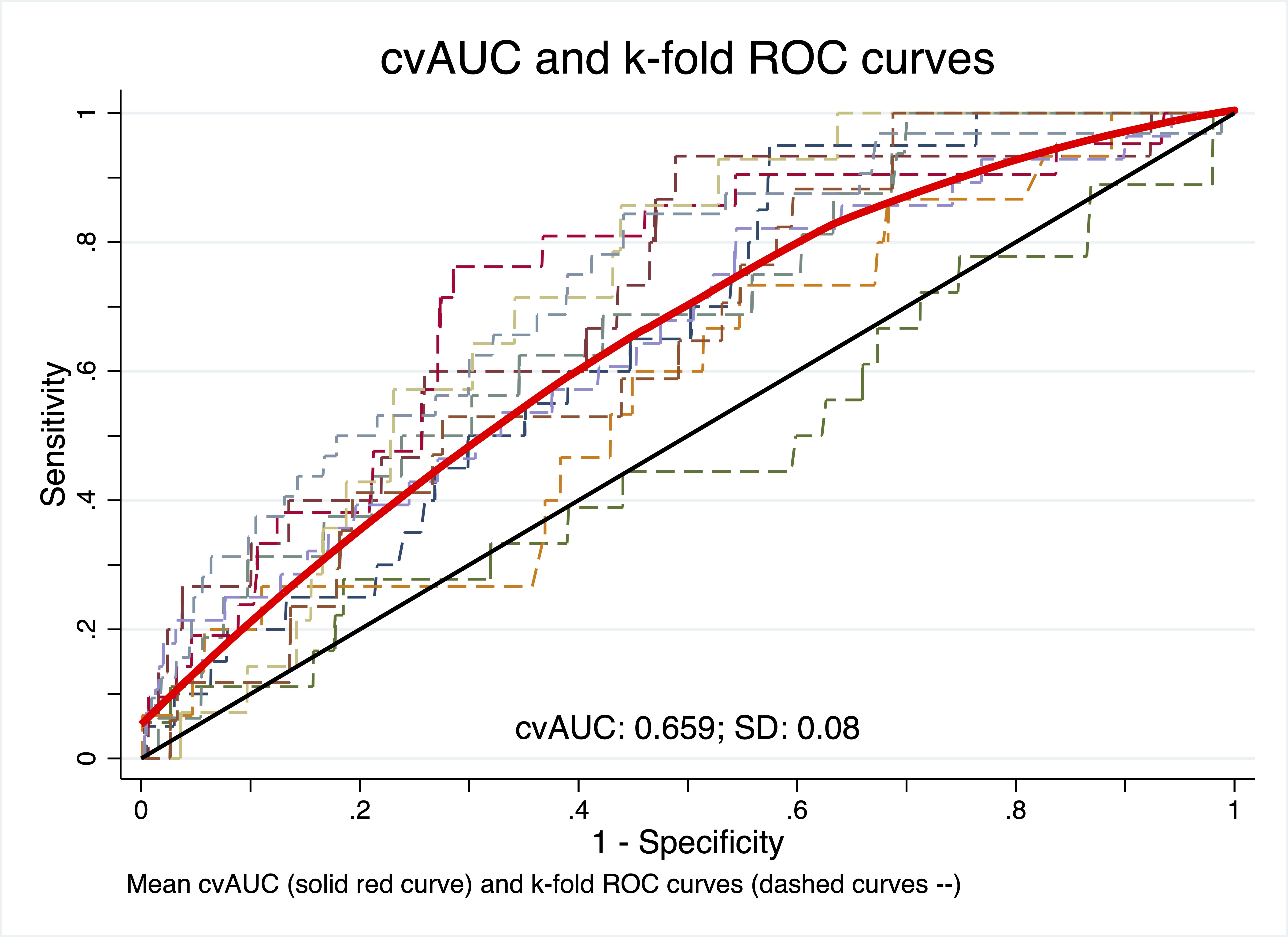
Results: For the model predicting IHD, 12 of the 12 predictors (age, sex, occupation, smoking, diabetes, chronic kidney disease, dyslipidemia, systolic blood pressure, body mass index, health scheme, hospital level, and health region) were retained. The model’s internal calibration is acceptable. Its ability to discriminate between individuals with and without IHD was acceptable; area under the curve (AUC) = 70.0 (95% CI: 67.4-73.0) (Figure 1). The overall performance of the model was good. For the external validation, the model slightly overestimates the IHD rates for high predicted probabilities, and the AUC = 65.9 (95% CI: 60.3-68.5) (Figure 2).
Conclusion: Our findings indicate that prediction modeling can be an effective tool for improving health outcomes for Thai individuals with HTN. This tool may assist in identifying and providing early interventions for those with HTN who are at the highest risk for IHD. Nonetheless, further fine-tuning may be necessary before widespread implementation.
  • Sakboonyarat, Boonsub  ( Phramongkutklao College of Medicine , Bangkok , Thailand )
  • Poovieng, Jaturon  ( Phramongkutklao College of Medicine , Bangkok , Thailand )
  • Rangsin, Ram  ( Phramongkutklao College of Medicine , Bangkok , Thailand )
  • Author Disclosures:
    Boonsub Sakboonyarat: DO have relevant financial relationships ; Research Funding (PI or named investigator):University of Minnesota:Past (completed) | Jaturon Poovieng: No Answer | Ram Rangsin: No Answer
Meeting Info:
Session Info:

Poster Session 2 with Breakfast Reception

Friday, 09/05/2025 , 09:00AM - 10:30AM

Poster Session

More abstracts on this topic:
Ablation versus Anti-arrhythmic Drug Therapy for Ventricular Tachycardia in Patients with Ischemic Heart Disease: A Systematic Review and Meta-analysis of Randomized Controlled Trials

Khan Ubaid, Chaudhry Kashif, Amin Ahmed Mazen, A. Ibrahim Ahmed, Imran Muhammad, Rakab Mohamed, Iltaf Arej, M. Albarakat Majd, Ranabhat Chet, Brilliant Justin

A Multi-Tier, Natural-Language Processing Framework to Automate Labeling of Acute Cerebrovascular Events From Radiology Reports and Diagnosis Codes

Erekat Asala, Stein Laura, Delman Bradley, Karp Adam, Kupersmith Mark, Kummer Benjamin

More abstracts from these authors:
Computer-based Technology Enhancing Cardiovascular Disease Risk Assessment by Health Workers in Rural Communities in Thailand: A Preliminary Analysis

Sakboonyarat Boonsub, Poovieng Jaturon, Jongcherdchutrakul Kanlaya, Mungthin Mathirut, Rangsin Ram, Pongpinigpinyo Sunee, Sakboonyarat Boonnarin, Srisawat Kanwara

Blood pressure control, cardiovascular complications, cardiovascular risk profile, and cardiovascular health among people with hypertension in rural communities in Thailand: a nationwide cross-sectional study

Sakboonyarat Boonsub, Lakshminarayan Kamakshi, Rangsin Ram, Mungthin Mathirut, Jongcherdchootrakul Kanlaya, Poovieng Jaturon

You have to be authorized to contact abstract author. Please, Login
Not Available