
Logo

American Heart Association

  58
  0


Final ID: TAC119

Artificial Intelligence–Enhanced Diagnosis of HFpEF in Hypertensive Populations: A Meta-Analysis of Clinical and Imaging-Based Models

Abstract Body: Background
Heart failure with preserved ejection fraction (HFpEF) is presently the most common kind of heart failure among people with chronic hypertension. Its clinical diagnosis remains challenging because of unclear symptoms, concomitant illnesses, and comorbidity with other cardiovascular issues. Traditional diagnostic procedures generally cause delays, especially in hypertensive patients. Emerging artificial intelligence (AI) technologies show promise for improving diagnostic accuracy by integrating challenging clinical and imaging data.

Objective
To evaluate the diagnostic performance of AI models in identifying HFpEF in predominantly hypertensive populations and assess the added value of multimodal (clinical + imaging) data integration.

Methods
A systematic review and meta-analysis were conducted in accordance with PRISMA criteria. We searched the PubMed, Embase, and Cochrane databases for research that developed or validated AI algorithms for HFpEF diagnosis, using invasive hemodynamic criteria or expert clinical adjudication as the reference standard. A bivariate random-effects model was used to calculate pooled sensitivity, specificity, and diagnostic odds ratios (DOR). Subgroup analyses were conducted depending on data input type (clinical vs. clinical + imaging), and heterogeneity was assessed using the I square statistic in accordance with PRISMA guidelines.

Results
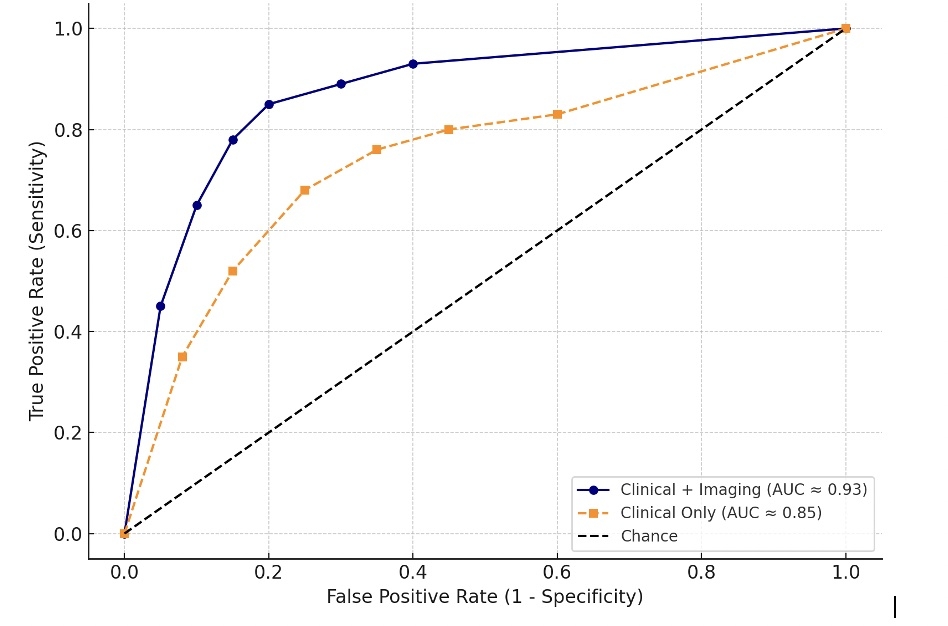
Eight studies (with 3,250 participants) were included. AI models' pooled sensitivity and specificity for diagnosing HFpEF were 0.87 (95% CI: 0.82-0.91) and 0.85 (95% CI: 0.80-0.89), respectively, with a DOR of 45.2 (95% CI: 22.1-93.0). Models that used clinical and imaging data outperformed those that just used clinical data (sensitivity 0.90 vs. 0.80; specificity 0.88 vs. 0.82). Moderate heterogeneity was observed (I square = 55% for sensitivity and 62% for specificity).

Conclusion
AI-based diagnostic models are very accurate in diagnosing HFpEF, especially in hypertensive populations where early detection is crucial for preventing progression and improving outcomes. Multimodal data integration significantly improves diagnostic performance. These results support the incorporation of AI into hypertension treatment pathways and call for further validation of these tools in real-world clinical settings to allow for rapid, customized management of HFpEF.
  • Sharma, Ashish  ( University of Connecticut , Hartford , Connecticut , United States )
  • Kumar, Harendra  ( Dow University of Health Sciences , Hyderabad , Pakistan )
  • Tiwari, Angad  ( Maharani Laxmi Bai Medical College , Jhansi , India )
  • Author Disclosures:
    Ashish Sharma: DO NOT have relevant financial relationships | Harendra Kumar: DO NOT have relevant financial relationships | Angad Tiwari: DO NOT have relevant financial relationships
Meeting Info:
Session Info:

Poster Session 1 and Reception (includes TAC Poster Competition)

Thursday, 09/04/2025 , 05:30PM - 07:00PM

Poster Session

More abstracts on this topic:
A cerebrovascular longitudinal atlas: different rates of morphological change in aneurysm patients associated with hypertension and diabetes

Chien Aichi, Salamon Noriko, Vinuela Fernando, Szeder Viktor, Colby Geoffrey, Jahan Reza, Boyle Noel, Villablanca Juan, Duckwiler Gary

A Simple One-Item Nursing Falls Assessment Predicts Outcomes For Patients With Stage D Heart Failure Undergoing Surgical Advanced Therapies

Salvador Vincent, Perez Jaime Abraham, Hudec Paige, Gorodeski Eiran, Oneill Thomas

You have to be authorized to contact abstract author. Please, Login
Not Available