Prediabetes in U.S. Adolescents: National Prevalence and Disparities in Hospitalized Populations, 2022
Abstract Body:
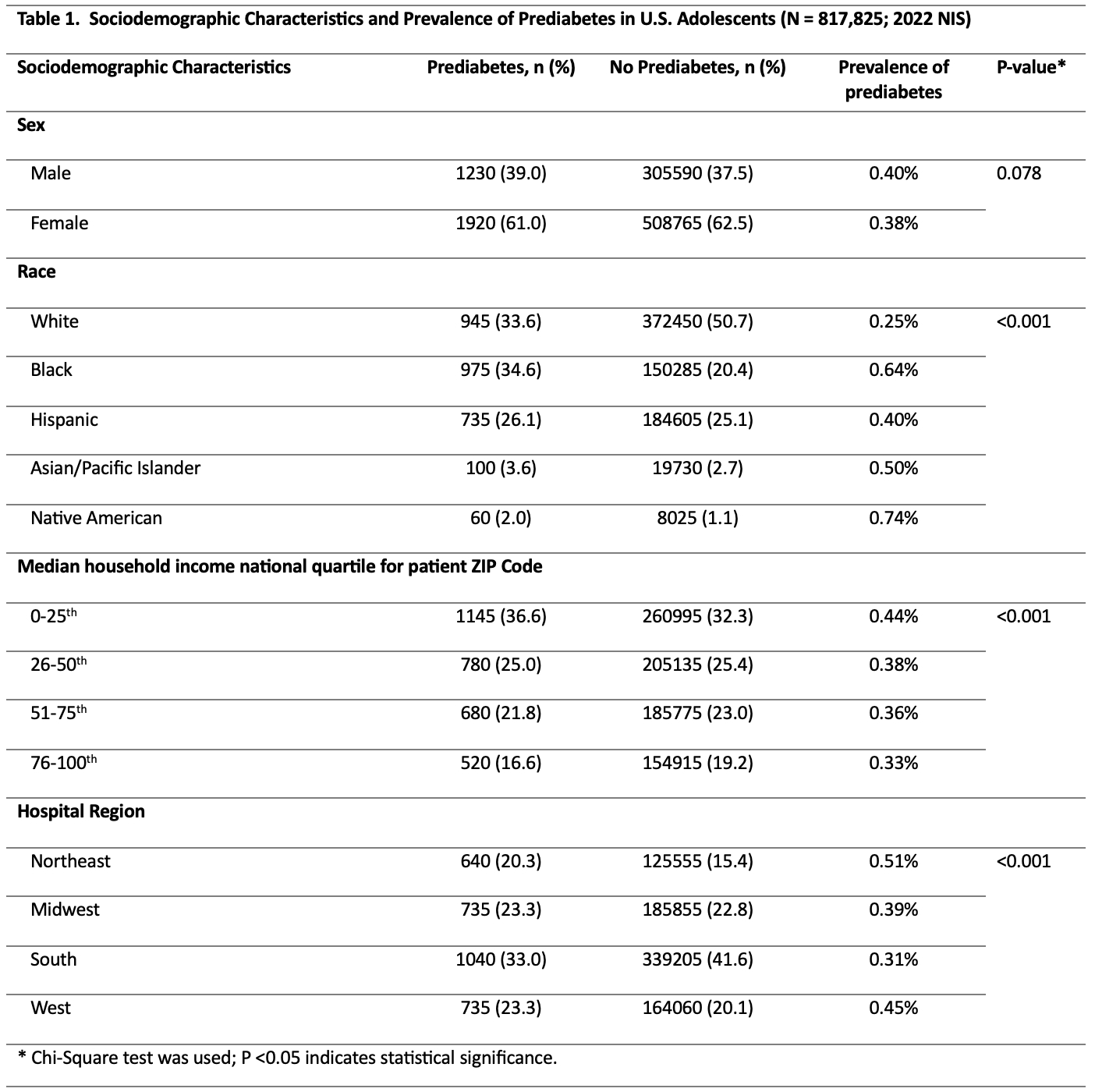
Background: With the global rise of pediatric obesity, prediabetes has emerged as a growing public health concern with the increased risk of early microvascular complications and metabolic disorders. Yet, data on national prevalence and socioeconomic disparities among hospitalised adolescents remain limited. Understanding these differences is essential for developing targeted interventions to mitigate clinical and economic burden of prediabetes in this vulnerable patient population. Method: We analyzed data from the 2022 National Inpatient Sample (NIS), identifying hospitalizations among adolescents aged 11-19 years, excluding those with diabetes. Prediabetes was defined using ICD-10 CM codes. Prevalence was calculated overall and stratified by sex, race/ethnicity, income quartile, and hospital region. Chi-square tests were used to assess differences across subgroups, with p<0.05 considered statistically significant. Result: Among 817,825 hospitalizations, 3150 cases with prediabetes were identified, yielding the prevalence of 0.4%. Significant disparities were evident across demographic and socioeconomic groups. When stratified by race, the prevalence of prediabetes was highest among Native Americans (0.74%) and Black adolescents (0.64%), compared to White adolescents (0.25%; p <0.001). Adolescents from the lowest household income quartile had a higher prevalence compared to the highest income quartile (0.44% vs 0.33%; p <0.001). Regional variation was notable, with the Northeast showing the highest prevalence and the South showing the lowest prevalence (0.51% vs 0.31%; p <0.001). However, the prevalence did not differ significantly by sex (0.40% in males vs 0.38% in females; p = 0.078). Conclusion: In 2022, prediabetes affected 0.4% of hospitalized U.S. adolescents, with significant disparities by race, socioeconomic status, and hospital region, but not by sex. These differences reflect the structural inequities apart from nutrition or preventive care access. Identifying prediabetes during hospitalization offers an opportunity for early intervention, especially in disproportionately affected populations. Our study highlights the need for targeted screening for high-risk groups during hospitalization which may serve as a step towards more equitable and preventive healthcare.
Vanani, Samir
(
Surat Institute of Digestive Scienc
, Surat , India )
Kanisetti, Vaishnavi
(
Bhaskar Medical College
, Hyderabad , India )
Patel, Dhruvin
(
Government Medical College, Surat
, Surendranagar , India )
Mohnani, Priyanka
(
Parkview Health, Indiana
, Fort Wayne , Indiana , United States )
Joshi, Jetal
(
Government Medical College, Surat
, Surat , India )
Patel, Heer
(
Independent Researcher
, Jersey City , New Jersey , United States )
Kapadia, Vatsal
(
Government Medical College Surat
, Surat , India )
Sonera, Sonali
(
Government Medical College, Surat
, Vadodara , India )
Mishra, Tanisha
(
University of Connecticut
, Farmington , Connecticut , United States )
Shah, Swetang J
(
Bay Area Community Health
, San Jose , California , United States )
Desai, Rupak
(
Independent Researcher
, Atlanta , Georgia , United States )