
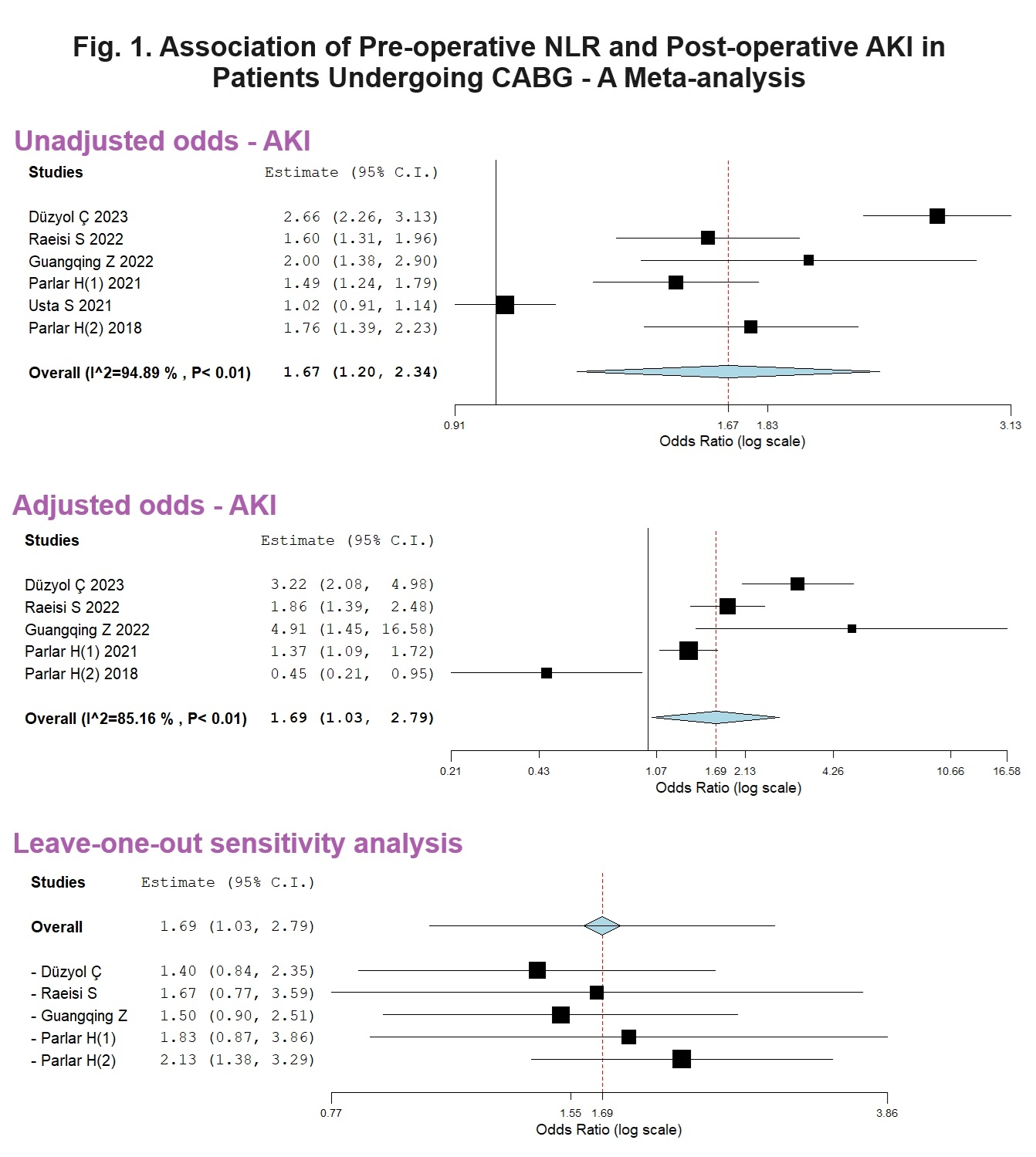
Association of Pre-operative Neutrophil to Lymphocyte Ratio (NLR) and Post-operative AKI in Patients Undergoing CABG: A Meta-Analysis
Abstract Body (Do not enter title and authors here): Objective: Inflammation is associated with pathologies including post operative acute kidney injury (AKI). AKI is one of the common post operative conditions which prolongs hospitalization, intensive care unit stay and causes higher health costs and mortality. Pre-operative neutrophil to lymphocyte ratio (NLR) has predictive value for post-operative AKI after coronary artery bypass grafting (CABG). Hence, we aimed to evaluate the association of pre-operative NLR and post-operative AKI in patients undergoing CABG. Methods: A comprehensive literature review was conducted using PubMed, Google Scholar and SCOPUS databases from 2000 until 2024 using related keywords to identify studies reporting association of pre-operative NLR and post-operative AKI in patients undergoing CABG. The data was extracted and independently reviewed by four authors using standard forms. A random-effects model was used to calculate odds ratios (OR) and heterogeneity was assessed using I2 statistics. The sensitivity analysis was performed using the leave-one-out method. Results: Our final analysis included 6 retrospective studies which included 1757 patients with CABG. The mean age of the included patients was 64 years and 63.4% were males. Initial unadjusted analysis showed higher odds of post-operative AKI in patients having higher pre-operative NLR values with unadjusted OR 1.67, 95% CI 1.20-2.34, p <0.001 with high heterogeneity (I2=94.89%). After adjusting for baseline characteristics and comorbidities, odds for post-operative AKI increased to aOR 1.69, 95% CI 1.03-2.79, p <0.001 with high heterogeneity (I2=85.16%), which indicates stronger association after adjusting for confounders. Leave-one-out sensitivity analysis confirmed the robustness of these findings. Conclusion: Our meta-analysis suggests that higher pre-operative NLR is associated with 69% higher risk of post-operative AKI in patients undergoing CABG. This warrants more prospective studies to validate these findings. Moreover, better prediction of AKI can help to establish preventive measures to avoid adverse outcomes including the need for renal replacement therapy or hemodialysis in high-risk patients.
Patel, Bhavin
( Trinity Health Oakland Hospital
, Pontiac
, Michigan
, United States
)
Lapsiwala, Boney
( Government Medical college Surat
, Surat
, India
)
Jariwala, Prayag
( Government Medical College, Surat
, Surat
, India
)
Suresh, Aditya
( Sri Ramachandra Institute of Higher Education and Research
, Chennai
, Tamil Nadu
, India
)
Vanani, Samir
( Government Medical college Surat
, Surat
, India
)
Patel, Shaurya
( Government Medical college Surat
, Surat
, India
)
Rajani, Aayushi
( Medical College Baroda
, Baroda
, Gujarat
, India
)
Desai, Rupak
( Independent Researcher
, Atlanta
, Georgia
, United States
)
Author Disclosures:
Bhavin Patel:DO NOT have relevant financial relationships
| Boney Lapsiwala:DO NOT have relevant financial relationships
| Prayag Jariwala:DO NOT have relevant financial relationships
| Aditya Suresh:DO NOT have relevant financial relationships
| Samir Vanani:DO NOT have relevant financial relationships
| Shaurya Patel:DO NOT have relevant financial relationships
| Aayushi Rajani:DO NOT have relevant financial relationships
| Rupak Desai:DO NOT have relevant financial relationships