
Cardioembolic Stroke in MELAS Treated with Thrombolysis
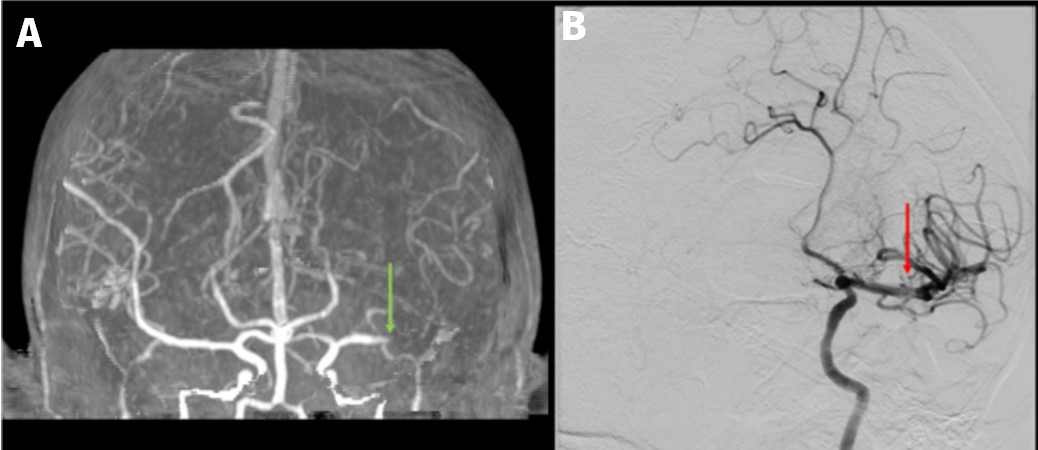
Abstract Body (Do not enter title and authors here): Background: MELAS is a rare mitochondrial disorder characterized by multisystem involvement, including stroke-like episodes, seizures, and cardiomyopathy. Cardiac involvement in MELAS may include left ventricular dysfunction, arrhythmias, and structural abnormalities, yet the occurrence of cardioembolic stroke as a direct consequence of these manifestations is exceedingly rare. To date, no literature has clearly described this association. Case Presentation: A male in his twenties with known MELAS syndrome, epilepsy, and heart failure with reduced ejection fraction (EF 25%) presented with acute right hemiparesis and aphasia. Investigations: CT angiography and CT perfusion revealed reduced opacification in the left MCA bifurcation and a left M2 thrombus (Figure 1A). The contrast echocardiogram showed a normal-sized left ventricle with severely reduced ejection fraction (25%, down from 30% six months prior), diffuse hypokinesis, grade III diastolic dysfunction, and a left ventricular thrombus, with no patent foramen ovale. Treatment: Given the high suspicion for cardioembolic stroke, the patient received intravenous tenecteplase within the 3-hour window. Mechanical thrombectomy was planned but aborted due to spontaneous recanalization. Post-thrombolytic angiography confirmed reperfusion of the left MCA with residual distal M3 thrombus (Figure 1B).MRI confirmed infarcts in the left MCA distribution and right precentral gyrus, with no evidence of hemorrhagic transformation. Anticoagulation was initiated for secondary prevention. Statins were withheld due to concerns about mitochondrial toxicity. Follow-up: On a 3-month follow-up, the patient remained neurologically stable and continued oral anticoagulation without recurrent events. Discussion: The clinical scenario posed a diagnostic challenge—stroke-like episodes in MELAS are metabolic and typically non-territorial. However, an LV thrombus, territorial infarction, and perfusion mismatch pointed to an ischemic etiology. Timely thrombolysis led to significant neurological recovery. This case highlights the importance of distinguishing cardioembolic stroke from mitochondrial stroke-like events, especially in patients with known cardiac involvement. Conclusion: In MELAS patients with cardiac dysfunction, cardioembolic stroke must be considered when clinical and imaging findings suggest a vascular event. Early recognition and intervention, including thrombolysis, can lead to favorable outcomes.
Trivedi, Yash Vardhan
( Leonard M. Miller School of Medicine
, Miami
, Florida
, United States
)
Chalia, Papul
( Hershey Medical Center
, Hummelstown
, Pennsylvania
, United States
)
Aggarwal, Kanishk
( Dayanand Medical College and Hospital, Ludhiana, IN
, Ludhiana
, India
)
Banker, Himanshi
( Mayo Clinic Florida
, Jacksonville
, Florida
, United States
)
Ruhela, Namita
( Aureus University School of Medicine, AW
, Oranjestad
, Aruba
)
Jain, Rohit
( Hershey Medical Center
, Hummelstown
, Pennsylvania
, United States
)
Author Disclosures:
Yash Vardhan Trivedi:DO NOT have relevant financial relationships
| Papul Chalia:DO NOT have relevant financial relationships
| kanishk aggarwal:No Answer
| Himanshi Banker:DO NOT have relevant financial relationships
| Namita Ruhela:No Answer
| Rohit Jain:DO NOT have relevant financial relationships