Demographic and Socioeconomic Disparities in the Co-Occurrence of Hypertension and Depression – A Population-Based Study
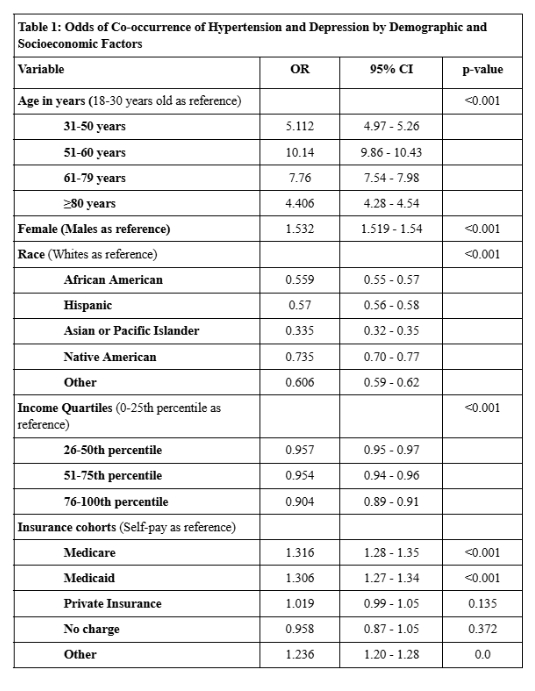
Abstract Body: Introduction Hypertension (HTN) remains a major public health concern and a key contributor to cardiovascular morbidity and mortality. Patients with HTN represent a particularly vulnerable population as they are at higher risk of developing depression. It is well known that both HTN and depression emerge from a complex interaction of social, biological, and behavioral factors. This study aims to analyze the demographic and socioeconomic disparities in the co-occurrence of HTN and depression in the United States. Methods We performed a cross-sectional study using the NIS 2022 data. Adult patients with a concurrent diagnosis of HTN and depression were identified using ICD-10 codes. A chi-square analysis was conducted to determine the variables to include. A multivariable logistic regression analysis examined demographic and social variables, with a significance level of p < 0.05. All analyses were done using Stata 18.0. Results: We identified 282,968 patients with concurrent HTN and depression. Compared to those aged 18–30, patients aged 31–50 (OR 5.11, 95% CI 4.97–5.26) and 51–60 (OR 10.14, 95% CI 9.86–10.43) had higher odds of having both conditions (p<0.001). Females had greater odds of having both HTN and depression than males (OR 1.53, 95% CI 1.52–1.54, p<0.001). Compared to White patients, odds were lower among African American (OR 0.56, 95% CI 0.55–0.57), Hispanic (OR 0.57, 95% CI 0.56–0.58), Asian/Pacific Islander (OR 0.34, 95% CI 0.32–0.35), Native American (OR 0.73, 95% CI 0.70–0.77), and Other race (OR 0.61, 95% CI 0.59–0.62) (all p<0.001). Higher income had lower odds, with the 76th–100th percentile showing OR 0.90 (95% CI: 0.89–0.91, p<0.001). Compared to self-pay, odds were higher for Medicare (OR 1.32, 95% CI 1.28–1.35), Medicaid (OR 1.31, 95% CI 1.27–1.34), and Other insurance (OR 1.24, 95% CI 1.20–1.28) (p<0.001), with no difference for uninsured patients (OR 0.96, 95% CI 0.87–1.05, p=0.372). Conclusion This study highlights significant demographic and socioeconomic disparities in the co-occurrence of depression and HTN. Older age, females, and lower income levels are associated with a higher likelihood of having both depression and HTN. Conversely, non-whites and individuals in the highest income quartile are less likely to have both conditions. These findings underscore the need for targeted interventions and strategies to address the increased risk of depression and HTN co-occurrence among certain demographic and socioeconomic groups.
Arora, Komal
(
NYMC-St Clare and St Mary
, Wallington , New Jersey , United States )
Shah, Anand
(
Rutgers NJMS
, Newark , New Jersey , United States )
Bhat, Rakshita Ramesh
(
University of Miami
, Miami , Florida , United States )
Trivedi, Yash Vardhan
(
University of Miami
, Miami , Florida , United States )
Cheriyath, Pramil
(
NYMC-St Clare and St Mary
, Wallington , New Jersey , United States )
Author Disclosures:
Komal Arora:DO NOT have relevant financial relationships
| Anand Shah:DO NOT have relevant financial relationships
| Rakshita Ramesh Bhat:No Answer
| Yash Vardhan Trivedi:No Answer
| Pramil Cheriyath:DO NOT have relevant financial relationships