Logo

American Heart Association

  13
  0


Final ID: HCM22

Real-World Sudden Cardiac Death Risk Prediction in Hypertrophic Cardiomyopathy Using State-of-the-Art Thinking Models

Abstract Body (Do not enter title and authors here): Background: Sudden cardiac death (SCD) is a leading cause of mortality in patients with hypertrophic cardiomyopathy (HCM). Currently, calculating the 5-year SCD risk score is manual and time-consuming, limiting dynamic risk reassessment and timely monitoring. Recent advances in chain-of-thought large language models (LLMs) have the potential to provide accurate, automated risk stratification.
Hypothesis: Local, open-source LLMs can efficiently calculate SCD risk from routine clinical documentation and echo reports, enabling accurate risk stratification of patients with HCM within the hospital environment.
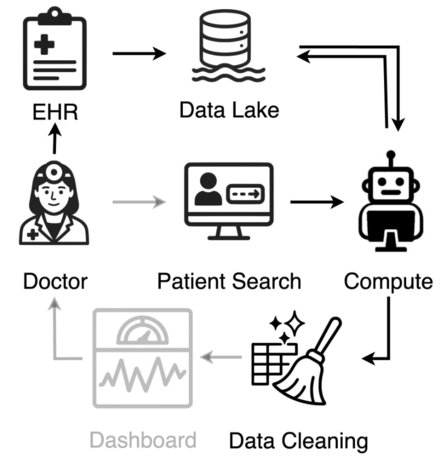
Methods: Clinical documentation and echo reports for 200 adult patients with HCM, managed between 2011 and 2023, were systematically extracted (Figure 1). Two medical professionals independently annotated each document (mean Cohen’s κ = 0.80; mean intraclass correlation coefficient = 0.96). Five DeepSeek-R1 models (1.5B–70B; 4-bit quantized) were deployed locally on GPUs and prompted in a zero-shot manner to extract all variables required for SCD risk stratification. Numeric annotations were considered correct if within ±2 mm or ±10 mmHg. Categorical annotations were scored as ‘present’, ‘absent’, or ‘not documented’. The primary endpoint was concordance between model predictions and the adjudicated SCD risk classification.
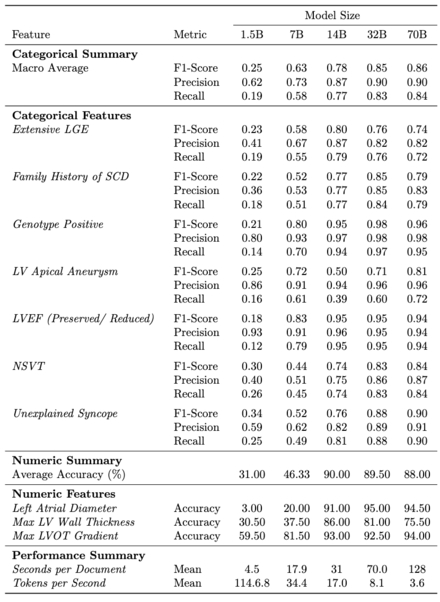
Results: Model metrics for each variable assessed are summarized in Table 1. Of the patients studied, 86.5% were classified as low-risk, 8% as intermediate-risk, and 5.5% as high-risk.
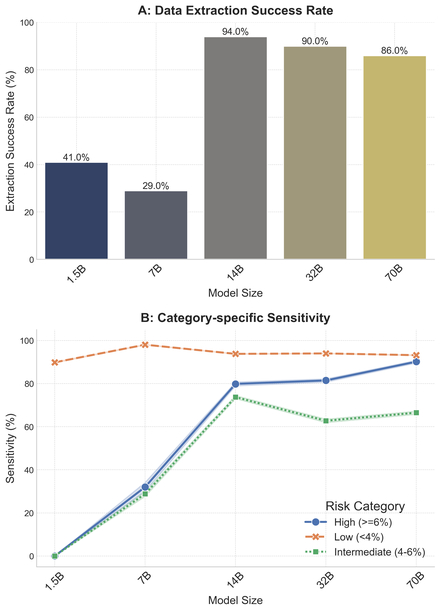
Successful extraction of all variables required for SCD risk calculation improved markedly with increasing model size, rising sharply from 41% at 1.5B parameters to 94% at 14B (Figure 1). Sensitivity showed a similar dependence on model size, especially for intermediate and high-risk categories. Models with 14B parameters or larger correctly identified about 80% of high-risk patients, whereas sensitivity for intermediate-risk patients plateaued around 70%. Notably, the 14B model had only one critical error (high- to low-risk misclassification), while the 32B and 70B models had none. Processing time per document increased with model size.
Conclusion: The 14B DeepSeek-R1 model hits the optimal trade-off between accuracy and latency, making it well-suited for real-time clinical workflows. It provides an excellent foundation for further fine-tuning and the development of a fully automated, agentic workflow, enabling dynamic longitudinal risk stratification.
  • Schweitzer, Ronny  ( Imperial College London , London , United Kingdom )
  • Pemmasani, Praveena  ( Imperial College London , London , United Kingdom )
  • De Marvao, Antonio  ( Imperial College London , London , United Kingdom )
  • Author Disclosures:
    Ronny Schweitzer: DO NOT have relevant financial relationships | Praveena Pemmasani: DO NOT have relevant financial relationships | Antonio de Marvao: No Answer
Meeting Info:

Scientific Sessions 2025

2025

New Orleans, Louisiana

Session Info:

Hypertrophic Cardiomyopathy Medical Society Posters

Friday, 11/07/2025 , 06:30PM - 07:30PM

Abstract Poster Board Session

More abstracts on this topic:
AI-enhanced Electrocardiographic Evaluation of Left Ventricular Ejection Fraction and Outflow Tract Gradient in Hypertrophic Cardiomyopathy

Sangha Veer, Aminorroaya Arya, Dhingra Lovedeep, Pedroso Aline, Oikonomou Evangelos, Khera Rohan

Aficamten is safe and effective in oHCM with comorbidities obesity, hypertension, and diabetes: a SEQUOIA-HCM sub-study

Lee Matthew, Malik Fady, Kupfer Stuart, Wohltman Amy, Coats Caroline, Abraham Theodore, Claggett Brian, Maron Martin, Miao Zi, Meder Benjamin, Olivotto Iacopo, Heitner Stephen, Jacoby Daniel

More abstracts from these authors:
Redefining the phenotypic continuum of cardiovascular disease using machine learning

Curran Lara, Halliday Brian, Tayal Upasana, De Marvao Antonio, Ware James, Prasad Sanjay, O'regan Declan, Inglese Paolo, Rjoob Khaled, Mcgurk Kathryn, Lu Chang, Zheng Sean, Tahasildar Shamin, Kalaie Soodeh, Bai Wenjia

Genetically-Estimated Ancestry is Associated with Risk of Pre-eclampsia: A Multi-Ethnic Case-Control Study

Conti-ramsden Frances, De Marvao Antonio, Nicolaides Kypros, Syngelaki Argyro, Dixon Peter, Williamson Catherine, Escobar M Maria, Wright Alan, Chappell Lucy, Hysi Pirro

You have to be authorized to contact abstract author. Please, Login
Not Available