Advanced Diagnosis of Hypertrophic Cardiomyopathy with AI-ECG and Differences Based on Race and Subtype
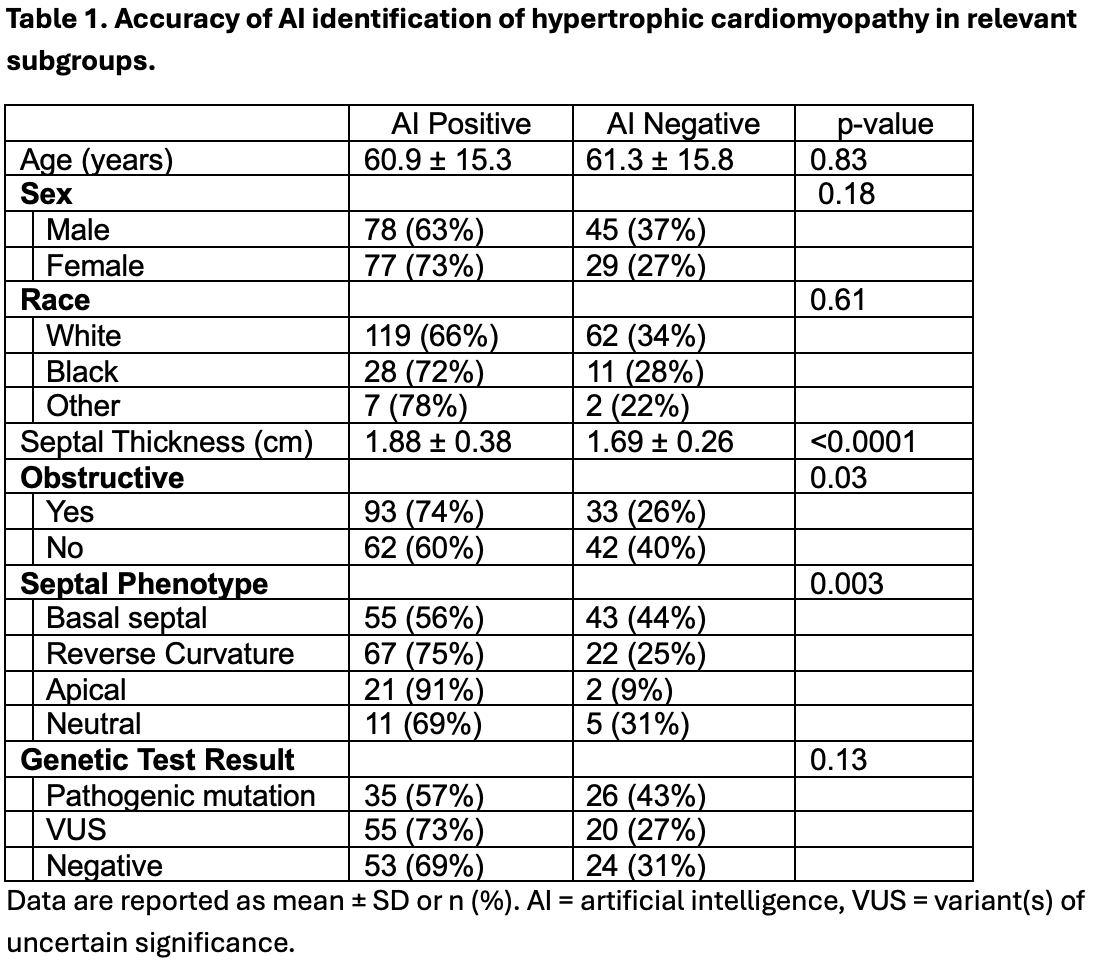
Abstract Body (Do not enter title and authors here): Background: Hypertrophic cardiomyopathy (HCM) often presents later in the disease course, with frequent delays in diagnoses, high rates of misdiagnoses, and underdiagnosis on a population level. Diagnosis often requires access to specialty care, meaning that underserved patients based on race and socioeconomic status may have even more marked delays in diagnosis. Objective: To retrospectively test the hypothesis that artificial intelligence applied to ECG analysis (AI-ECG) could have afforded the opportunity for earlier diagnosis of hypertrophic cardiomyopathy in one health system. Methods: We collected all available ECGs from all patients referred for possible HCM in an HCM Center of Excellence over a period of 15 years, both before and after their HCM clinical diagnosis. An AI-ECG algorithm was applied to each ECG in blinded fashion to predict the probability of a diagnosis of HCM. Lead time, the time between the first AI-ECG diagnosis and the clinical diagnosis, was calculated for each patient. The sensitivity and specificity of the AI-ECG tool was examined for all patients with HCM. These metrics, along with lead time, were evaluated by subgroups including sex, race, obstruction, genetic test result, and septal subtype as seen on cardiac MRI. Results: 3,499 ECGs were analyzed in 404 patients (age 56 ± 18 years, 52% female) between 2010 and 2024. Of these patients, 230 have an HCM diagnosis. AI-ECG correctly identified HCM in 155 patients with a sensitivity of 67%, a specificity of 95%, a positive predictive value of 94%, and a negative predictive value of 69%. Accuracy was highest for apical and reverse curvature septal compared with the basal septal morphology (p=0.003) (Table 1). HCM was diagnosed at least a year prior to the clinical diagnosis in 27 patients with the longest lead time being 16.3 years for a single patient. Black patients were more likely than white patients to have AI-ECG diagnosis before clinical diagnosis (p=0.005) (Table 2), with significantly greater overall lead time (p=0.005) (Figure 1). Accuracy was higher for obstructive patients (p=0.03), while lead time for AI-ECG diagnosis was greater for non-obstructive patients (p=0.02). Conclusions: AI-ECG offers the potential for advanced diagnosis of HCM before disease progression. Differences in identification timing between subgroups highlight inequities in current care and show the potential of AI diagnosis for greatest benefit in underserved racial groups.
Lewontin, Myra
(
Univ. of Virginia Health System
, Charlottesville , Virginia , United States )
Kaplan, Emily
(
Univ. of Virginia Health System
, Charlottesville , Virginia , United States )
Bilchick, Kenneth
(
Univ. of Virginia Health System
, Charlottesville , Virginia , United States )
Barber, Anita
(
Univ. of Virginia Health System
, Charlottesville , Virginia , United States )
Bivona, Derek
(
Univ. of Virginia Health System
, Charlottesville , Virginia , United States )
Kramer, Christopher
(
Univ. of Virginia Health System
, Charlottesville , Virginia , United States )
Parrish, Anna
(
Univ. of Virginia Health System
, Charlottesville , Virginia , United States )
Mcclean, Karen
(
Univ. of Virginia Health System
, Charlottesville , Virginia , United States )
Thomas, Matthew
(
Univ. of Virginia Health System
, Charlottesville , Virginia , United States )
Perry, Allison
(
Univ. of Virginia Health System
, Charlottesville , Virginia , United States )
Amos, Kaitlyn
(
Univ. of Virginia Health System
, Charlottesville , Virginia , United States )
Ayers, Michael
(
Univ. of Virginia Health System
, Charlottesville , Virginia , United States )
Author Disclosures:
Myra Lewontin:DO NOT have relevant financial relationships
| Allison Perry:No Answer
| Kaitlyn Amos:No Answer
| Michael Ayers:No Answer
| Emily Kaplan:DO NOT have relevant financial relationships
| Kenneth Bilchick:No Answer
| Anita Barber:No Answer
| Derek Bivona:No Answer
| Christopher Kramer:DO have relevant financial relationships
;
Researcher:Cytokinetics:Active (exists now)
; Consultant:Sanofi:Past (completed)
; Consultant:Eli Lilly:Active (exists now)
; Researcher:Eli Lilly:Active (exists now)
; Researcher:BMS:Active (exists now)
| Anna Parrish:DO NOT have relevant financial relationships
| Karen McClean:No Answer
| Matthew Thomas:DO NOT have relevant financial relationships