
Logo

American Heart Association

  14
  0


Final ID: MP1430

Generalizability of AI-based Cardiomyopathy Risk Prediction among Childhood Cancer Survivors

Abstract Body (Do not enter title and authors here): Background. Children whose cancer is treated with anthracycline chemotherapy and/or chest directed radiation (RT) are at risk for premature cardiovascular disease including cardiomyopathy. Echocardiography screening is recommended every 2 to 5 years, depending on the cumulative dose of cardiotoxic treatment and modalities received. We previously developed and validated an AI model using ECG as a sole input (ECG-AI) that can predict 5-year risk for cardiomyopathy with moderate accuracy.
Goal. The goal of this study was to compare ECG-AI accuracy to a baseline clinical model and assess whether incorporation of clinical variables increase accuracy.
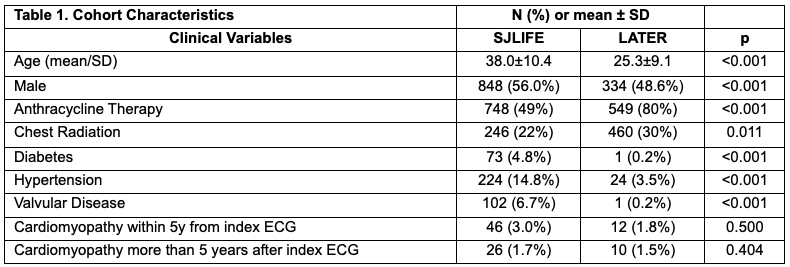
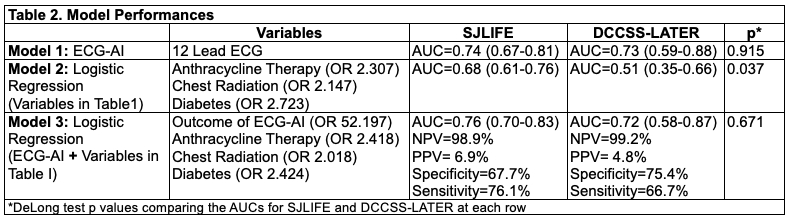
Methods. The original ECG-AI model (Model 1) was an attention-based encoder-decoder deep neural network using 10 second 12-lead ECGs as an input to predict 5-year cardiomyopathy risk. It was trained and validated on 80% of data from the St Jude Lifetime Cohort Study (SJLIFE) then it was tested internally on 20% holdout of SJLIFE and externally on the Dutch Childhood Cancer Survivor Study (DCCSS-LATER) cohort. Both SJLIFE and DCCSS are prospective cohorts of five-year survivors of childhood cancer. Most participants had exposure to prior cardiotoxic treatments such as anthracycline chemotherapy and/or chest RT. We built two additional models on the 20% SJLIFE holdout data of the previous study and validated models in DCCSS-LATER including clinical variables available in both cohorts. Model 2 used stepwise logistic regression including variables listed in Table 1. Model 3 used stepwise logistic regression incorporating the ECG-AI (Model 1) outcomes and the clinical variables in Table 1.
Results. SJLIFE holdout data included 1,515 ECGs from 959 participants and DCCSS-LATER included 667 ECGs from 330 participants (Table 1). Results obtained from the models are reported in Table 2. Model 1 (ECG-AI) outperforms Model 2 (clinical model) in SJLIFE derivation cohort while Model 2 is failing to generalize to DCCSS-LATER cohort. Combining ECG-AI results with other clinical data result only in a marginal increase in accuracy.
Conclusions. ECG-AI provides generalizable cardiomyopathy risk prediction relying solely on electrocardiogram as an input while additional clinical data resulted in marginal increase in accuracy. Future studies are needed to incorporate more comprehensive clinical and genetic risk factors to obtain higher accuracy.
  • Patterson, Luke  ( Wake Forest School of Medicine , Lewisville , North Carolina , United States )
  • Kremer, Leontien  ( Prinses Maxima Centrum , Utrecht , Netherlands )
  • Davis, Robert  ( University of Tennessee Health Science Center , Memphis , Tennessee , United States )
  • Hudson, Melissa  ( St. Jude Children's Research Hosp , Memphis , Tennessee , United States )
  • Akbilgic, Oguz  ( Wake Forest School of Medicine , Lewisville , North Carolina , United States )
  • Mulrooney, Daniel  ( St. Jude Children's Research Hosp , Memphis , Tennessee , United States )
  • Feijen, Lieke  ( Prinses Maxima Centrum , Utrecht , Netherlands )
  • Dixon, Stephanie  ( St. Jude Children's Research Hosp , Memphis , Tennessee , United States )
  • Karabayir, Ibrahim  ( Wake Forest School of Medicine , Lewisville , North Carolina , United States )
  • Soliman, Elsayed  ( Wake Forest School of Medicine , Lewisville , North Carolina , United States )
  • Ness, Kirsten  ( St. Jude Children's Research Hosp , Memphis , Tennessee , United States )
  • Jefferies, John  ( University of Memphis , Memphis , Tennessee , United States )
  • Leerink, Jan  ( Prinses Maxima Centrum , Utrecht , Netherlands )
  • Author Disclosures:
    Luke Patterson: DO NOT have relevant financial relationships | Leontien Kremer: No Answer | Robert Davis: DO have relevant financial relationships ; Ownership Interest:9plus1ai:Active (exists now) | Melissa Hudson: DO NOT have relevant financial relationships | Oguz Akbilgic: DO NOT have relevant financial relationships | Daniel Mulrooney: DO NOT have relevant financial relationships | Lieke Feijen: No Answer | Stephanie Dixon: DO have relevant financial relationships ; Individual Stocks/Stock Options:Pacemate, LLC:Active (exists now) ; Other (please indicate in the box next to the company name):Pacemate, LLC (spouse employment):Active (exists now) | Ibrahim Karabayir: DO NOT have relevant financial relationships | Elsayed Soliman: DO NOT have relevant financial relationships | Kirsten Ness: DO NOT have relevant financial relationships | John Jefferies: DO NOT have relevant financial relationships | Jan Leerink: No Answer
Meeting Info:

Scientific Sessions 2025

2025

New Orleans, Louisiana

Session Info:
More abstracts on this topic:
9-Year Longitudinal Assessment of the 12-lead Electrocardiogram of Volunteer Firefighters

Bae Alexander, Dzikowicz Dillon, Lai Chi-ju, Brunner Wendy, Krupa Nicole, Carey Mary, Tam Wai Cheong, Yu Yichen

A Competency-Based Screening Echocardiography Curriculum Designed for Rural American Indian Community Health Representatives

Thoroughman Rose, Riley Alan, De Loizaga Sarah, Adams David, Beaton Andrea, Buonfiglio Samantha, Danforth Kristen, Masyuko Sarah, Miller Mccall, Yadava Mrinal

More abstracts from these authors:
Towards Apple Watch-based Remote Monitoring of Stroke Patients for New Onset Atrial Fibrillation

Taneja Arti, Davis Robert, Akbilgic Oguz, Dixon Stephanie, Mulrooney Daniel, Patterson Luke, Karabayir Ibrahim, Ness Kirsten, Armstrong Gregory, Elkind Mitchell, Hudson Melissa

Multi-Task Deep Learning for Noninvasive Rapid BNP and NT-proBNP Estimation and Classification

Karabayir Ibrahim, Patterson Luke, Chinthala Lokesh, Davis Robert, Akbilgic Oguz

You have to be authorized to contact abstract author. Please, Login
Not Available