Towards Apple Watch-based Remote Monitoring of Stroke Patients for New Onset Atrial Fibrillation
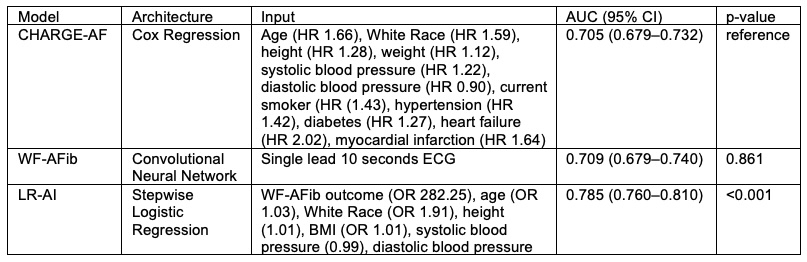
Abstract Body (Do not enter title and authors here): Background. New-onset atrial fibrillation (AFib) increases the risk of recurrent stroke. Early identification of stroke survivors at short-term risk may guide monitoring and prevention. Single-lead ECG data from consumer wearables, such as the Apple Watch, interpreted via artificial intelligence (AI), could offer a novel, scalable AFib risk-monitoring approach. Goal. To evaluate the performance of the Wake Forest 1-Year AFib Risk Prediction Model (WF-AFib) in stroke survivors with no prior AFib history and assess feasibility of remote AFib risk monitoring via Apple Watch ECGs. Methods. WF-AFib is a deep learning model (modified ResNet) trained on over 3 million lead I ECGs from more than 600,000 patients at Wake Forest Baptist Health, achieving an AUC of 0.77 in the general population. We externally validated WF-AFib using data from stroke survivors at the University of Tennessee Health Science Center (UTHSC), Memphis, TN. Performance was compared with CHARGE-AF and with a logistic regression model (LR-AI) combining WF-AFib predictions with clinical risk factors. We also assessed agreement between WF-AFib results from clinical ECGs and Apple Watch ECGs in a convenience sample of 243 adult participants from the St. Jude Lifetime Cohort (SJLIFE), all childhood cancer survivors. Results. The UTHSC cohort included 3,086 ECGs from stroke survivors (mean age 63±14 years; 48.7% male; 29.2% White, 68.3% Black) without prior AFib. Stroke was defined by ICD-10 codes I60–I63, I69. Within one year, 350 ECGs (11.3%) were linked to new onset incident AFib. CHARGE-AF and WF-AFib both yielded AUCs of 0.71 (p=0.861). LR-AI significantly outperformed both (AUC=0.79; p<0.001), with 87% specificity, 93% NPV, and 33% PPV at 50% sensitivity. In the SJLIFE sample (mean age 35±10 years; 49.6% male; 83.1% White, 13.7% Black), WF-AFib categorized 88% of participants similarly using clinical and Apple Watch ECGs (Spearman ρ=0.61, p<0.001). Conclusions. AI-based ECG analysis shows promise for predicting AFib risk in stroke survivors. We found high concordance between clinical and wearable ECGs in a non-stroke population, but larger, representative wearable ECG datasets from stroke patients are needed to confirm feasibility of scalable remote monitoring.
Taneja, Arti
(
Wake Forest School of Medicine
, Lewisville , North Carolina , United States )
Dixon, Stephanie
(
St. Jude Children's Research Hosp
, Memphis , Tennessee , United States )
Mulrooney, Daniel
(
St. Jude Children's Research Hosp
, Memphis , Tennessee , United States )
Patterson, Luke
(
Wake Forest School of Medicine
, Lewisville , North Carolina , United States )
Karabayir, Ibrahim
(
Wake Forest School of Medicine
, Lewisville , North Carolina , United States )
Ness, Kirsten
(
St. Jude Children's Research Hosp
, Memphis , Tennessee , United States )
Armstrong, Gregory
(
St. Jude Children's Research Hosp
, Memphis , Tennessee , United States )
Elkind, Mitchell
(
Columbia University
, New York City , New York , United States )
Hudson, Melissa
(
St. Jude Children's Research Hosp
, Memphis , Tennessee , United States )
Davis, Robert
(
University of Tennessee Health Science Center
, Memphis , Tennessee , United States )
Akbilgic, Oguz
(
Wake Forest School of Medicine
, Lewisville , North Carolina , United States )
Author Disclosures:
Arti Taneja:No Answer
| Robert Davis:DO have relevant financial relationships
;
Ownership Interest:9plus1ai:Active (exists now)
| Oguz Akbilgic:DO NOT have relevant financial relationships
| Stephanie Dixon:DO have relevant financial relationships
;
Individual Stocks/Stock Options:Pacemate, LLC:Active (exists now)
; Other (please indicate in the box next to the company name):Pacemate, LLC (spouse employment):Active (exists now)
| Daniel Mulrooney:DO NOT have relevant financial relationships
| Luke Patterson:DO NOT have relevant financial relationships
| Ibrahim Karabayir:DO NOT have relevant financial relationships
| Kirsten Ness:DO NOT have relevant financial relationships
| Gregory Armstrong:DO NOT have relevant financial relationships
| Mitchell Elkind:DO have relevant financial relationships
;
Employee:American Heart Association:Active (exists now)
| Melissa Hudson:DO NOT have relevant financial relationships