Multi-Task Deep Learning for Noninvasive Rapid BNP and NT-proBNP Estimation and Classification
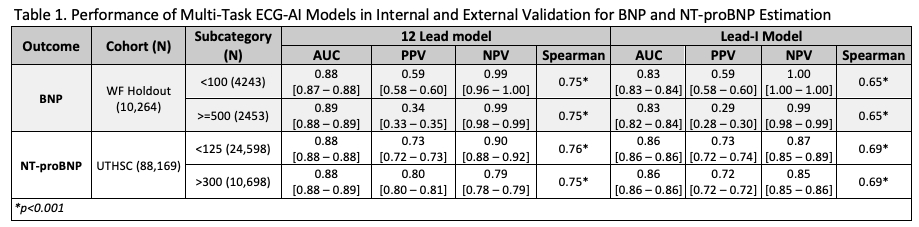
Abstract Body (Do not enter title and authors here): Background: Natriuretic peptides such as BNP and NT-proBNP remain cornerstone biomarkers for diagnosing and management of heart failure (HF). However, their measurement is done mainly when HF is suspected or requires monitoring, posing a missed opportunity for early HF detection and proactive intervention in at-risk patients. This gap highlights the need for accessible, non-invasive tools that can support earlier screening and continuous assessment. Aim: To develop and validate multi-task deep learning models that simultaneously estimate natriuretic peptide values and classify clinically relevant strata directly from raw 12-lead and Lead I ECG waveforms. Methods: Two distinct one-dimensional residual convolutional neural network architectures were separately trained on 12-lead and Lead I ECG inputs, using paired ECG and BNP measurements within a ±2-hour window to ensure rigorous label alignment. The models performed both BNP regression and classification into clinically meaningful low (<100 pg/mL) and elevated (>500 pg/mL) strata. Internal validation used a holdout cohort from Wake Forest Baptist Health (WF) (Winston-Salem, NC), while external validation employed an independent cohort from the University of Tennessee Health Science Center (UTHSC) (Memphis, TN), which included NT-proBNP data and specific clinical thresholds (low <125 pg/mL and elevated >300 pg/mL). Performance was evaluated using AUC, PPV, and NPV for classification and Spearman correlation for regression. Results: The internal dataset (WF) included 102,311 paired ECG–BNP samples from 54,526 patients, with a holdout set of 10,264 samples for validation. The external cohort (UTHSC) comprised 88,179 same day ECG–NT-proBNP pairs. The multi-task models demonstrated strong classification accuracy and regression correlation across both datasets. Specifically, the 12-lead model achieved AUCs of 0.88–0.89 and Spearman correlations of 0.75 in internal BNP strata, with similar performance in the external NT-proBNP cohort (AUC 0.88, Spearman 0.75–0.76). The Lead I model showed slightly lower but robust performance. Detailed metrics with 95% confidence intervals are summarized in Table 1. Conclusion: This multi-task models provide accurate, simultaneous estimation and classification of natriuretic peptides from ECGs. This approach offers a rapid, non-invasive tool for HF biomarker assessment that may improve clinical workflows, enable ambulatory monitoring, and enhance timely clinical decision-making.
Karabayir, Ibrahim
( Wake Forest School of Medicine
, Lewisville
, North Carolina
, United States
)
Patterson, Luke
( Wake Forest School of Medicine
, Lewisville
, North Carolina
, United States
)
Chinthala, Lokesh
( University of Tennessee Health Science Center
, Memphis
, Tennessee
, United States
)
Davis, Robert
( University of Tennessee Health Science Center
, Memphis
, Tennessee
, United States
)
Akbilgic, Oguz
( Wake Forest School of Medicine
, Lewisville
, North Carolina
, United States
)
Author Disclosures:
Ibrahim Karabayir:DO NOT have relevant financial relationships
| Luke Patterson:DO NOT have relevant financial relationships
| Lokesh Chinthala:No Answer
| Robert Davis:DO have relevant financial relationships
;
Ownership Interest:9plus1ai:Active (exists now)
| Oguz Akbilgic:DO NOT have relevant financial relationships
Khan Muhammad Aslam, Haider Taimoor, Bhattarai Shraddha, Afzal Hafsa, Khan Bilal, Muhammad Anza, Shafique Nouman, Bhatia Hitesh, Aafreen Asna, Adil Abid Nawaz Khan, Akbar Usman, Khan Alamzaib, Haider Muhammad Adnan