Investigating the Peculiar Trends in Mortality due to Heart Failure and Pulmonary Edema; A Retrospective Study During 1999-2023
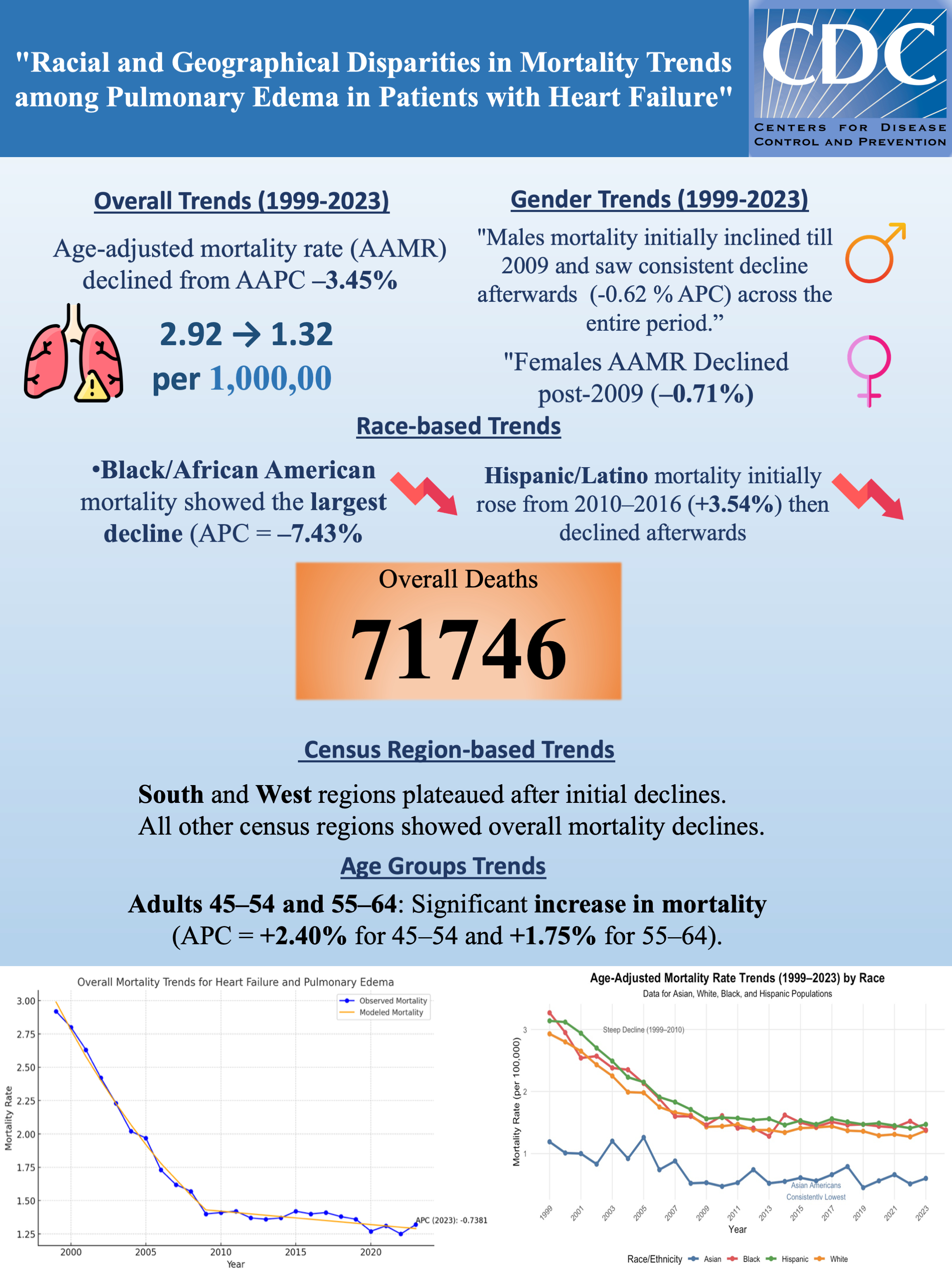
Abstract Body (Do not enter title and authors here): Background: Heart failure (HF) is a rapidly growing public health issue. Although the incidence of HF has stabilized globally, its prevalence continues to increase due to the ageing of the population, improved survival following myocardial infarction, and advances in HF treatment. Pulmonary edema, a common complication of heart failure, has been associated with poorer clinical outcomes. In this study we have integrated temporal trends, racial and ethnic disparities, and geographic variation in heart failure related mortality associated with pulmonary edema. Methods: We analyzed national mortality data from 1999-2023 using the CDC WONDER database, including adults aged 35 years and older. Deaths were identified with heart failure (ICD-10 code: I50.0, I50.1, I50.9) as the underlying cause of death and pulmonary edema (ICD-10 code: J81) as contributing cause of death. Age-adjusted mortality rates (AAMR) calculated per 100,000 individuals were stratified by sex, race, census region, and 10-year age groups. Temporal trends were assessed using Joinpoint regression models. Annual percentage changes (APC) in AAMR were estimated and their statistical significance was measured using two-tailed t-test. Results We identified 71,746 deaths due to pulmonary edema and heart failure from 1999–2023. Overall, mortality declined significantly, with an AAPC of –3.45% (95% CI: –3.67 to –3.25, p < 0.000001). A sharp decrease was observed from 1999–2009 (APC = –7.13%), followed by a modest decline through 2023 (APC = –0.74%). Among racial groups, the largest decline occurred in Black or African American individuals (APC = –7.43% in 1999–2009). Hispanic/Latino mortality showed a non-significant rise from 2010–2016 (APC = +3.54%), surrounded by significant declines before and after. Female mortality declined slightly post-2009 (APC = –0.71%, p = 0.056), and male mortality also declined, though at a slower rate (APC = –0.62%, p = 0.0008). Regionally, all census areas declined initially, with subsequent plateauing in the South and West. Adults aged ≥65 had continued declines, whereas mortality increased significantly in younger adults aged 45–54 (APC = +2.40%) and 55–64 (APC = +1.75%). Conclusion Although overall the mortality rate from heart failure and pulmonary edema has decreased, the rise in mortality among the younger adults is concerning and calls for public health attention and preventive health measures.
Saif, Pakeeza
(
King Edward Medical University
, Lahore , Pakistan )
Ahmed, Ali
(
Bahria university medical and dental college
, Karachi , Pakistan )
Nawaz, Ayeza
(
King Edward Medical University
, Lahore , Pakistan )
Sial, Fatima
(
King Edward Medical University
, Lahore , Pakistan )
Anwar, Shanza
(
Khawaja Muhammad Safdar Medical College
, Sialkot , Pakistan )
Muaz, Muhammad
(
Akhtar Saeed Medical and Dental College
, Lahore , Pakistan )
Ijaz, Hassan
(
King Edward Medical University
, Lahore , Pakistan )
Cheema, Shamikha
(
King Edward Medical University
, Lahore , Pakistan )
Shahzaib, Muhammad
(
King Edward Medical University
, Sialkot , Pakistan )
Faheem, Muhammad Shaheer Bin
(
Karachi Institute of Medical Sciences
, Karachi , Pakistan )
Naintara, Fnu
(
WellSpan York Hospital
, York , Pennsylvania , United States )
Tahir, Maliha
(
Infirmary Health
, Mobile , Alabama , United States )
Author Disclosures:
Pakeeza Saif:DO NOT have relevant financial relationships
| Muhammad Shaheer Bin Faheem:DO NOT have relevant financial relationships
| FNU Naintara:DO NOT have relevant financial relationships
| Maliha Tahir:DO NOT have relevant financial relationships
| Ali Ahmed:DO NOT have relevant financial relationships
| Ayeza Nawaz:DO NOT have relevant financial relationships
| Fatima Sial:DO NOT have relevant financial relationships
| Shanza Anwar:No Answer
| Muhammad Muaz:No Answer
| Hassan Ijaz:DO NOT have relevant financial relationships
| Shamikha Cheema:DO NOT have relevant financial relationships
| Muhammad Shahzaib:DO NOT have relevant financial relationships