Sex-stratified trends and segmental breakpoints in age-standardized death rates for ischemic heart disease: a multi-country analysis
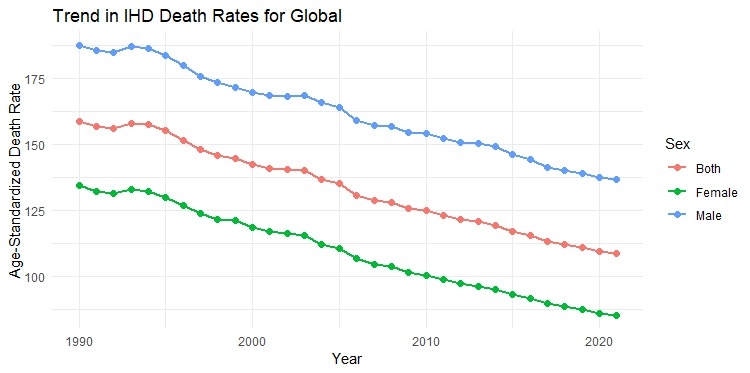
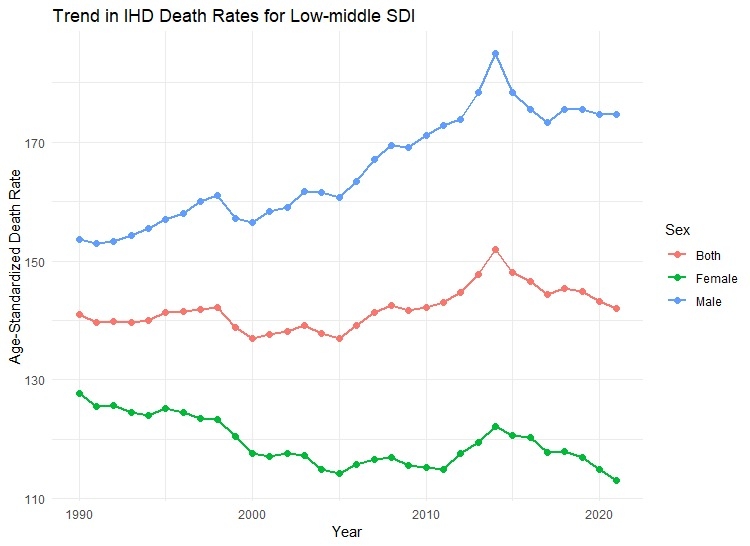
Abstract Body (Do not enter title and authors here): Background: Ischemic heart disease (IHD) is one of the most significant health challenges in the world, affecting millions of lives each year. Purpose:This study aims to analyze sex-stratified trends and segmental breakpoints in age-standardized death rates for ischemic heart disease across multiple countries from 1990 to 2021. Method: Using Global Burden of Disease (GBD) data, this study analyzed sex-stratified trends in ischemic heart disease (IHD) mortality from 1990 to 2021. Joinpoint regression identified segmental breakpoints and calculated Annual Percentage Change (APC) and Average Annual Percentage Change (AAPC), stratified by sex and Socio-demographic Index (SDI) regions. Results: Globally, IHD age-standardized death rates (ASDR) dropped significantly from 1990 to 2021, with males falling from 187.66 to 136.84 and females from 134.50 to 85.32 (p < 0.001). The overall ASDR for both sexes combined fell from 158.90 to 108.73, with females showing a steeper decline (AAPC: -1.56%, p < 0.001) compared to males (AAPC: -1.06%, p < 0.001). High SDI regions saw the largest drops, with males falling from 212.44 to 80.02 and females from 118.68 to 40.64 (AAPC: -3.43%, p < 0.001). In contrast, low SDI regions experienced minimal declines, with males increasing slightly from 129.50 to 139.53 (AAPC: 0.35%, p < 0.001) and females decreasing from 108.99 to 95.23 (AAPC: -0.37%, p < 0.001). Sex disparities persisted, with males consistently having higher ASDRs, though the gap narrowed, particularly in high SDI regions. Significant breakpoints in trends occurred in the early 2000s, with accelerated declines in high and middle SDI regions but slower progress in low SDI areas. Middle SDI males saw an increase until 2014 (slope: 0.0038127, p = 0.0030801), followed by a decline, while females consistently declined. High-middle SDI regions also showed sharper declines post-2005 for males (slope: -0.023981, p < 0.001) and post-2003 for females (slope: -0.025827, p < 0.001). Overall, global IHD mortality improved, but disparities across SDI levels and sexes remain. Conclusion: Our study shows significant global declines in IHD mortality from 1990 to 2021, with females seeing greater improvements, especially in high SDI regions. However, ongoing differences between genders and across income levels highlight the urgent need for tailored strategies, particularly in lower-income regions where advancements have been slower and more uneven.
Rath, Shree
(
All India Institute of Medical Sc.
, Bhubaneswar , India )
Naintara, Fnu
(
WellSpan York Hospital
, York , Pennsylvania , United States )
Author Disclosures:
Shree Rath:DO NOT have relevant financial relationships
| FNU Naintara:DO NOT have relevant financial relationships