Toxic Heavy Metal Exposure and Heart Health: A Systematic Review and Meta-analysis of 324,331 Patients
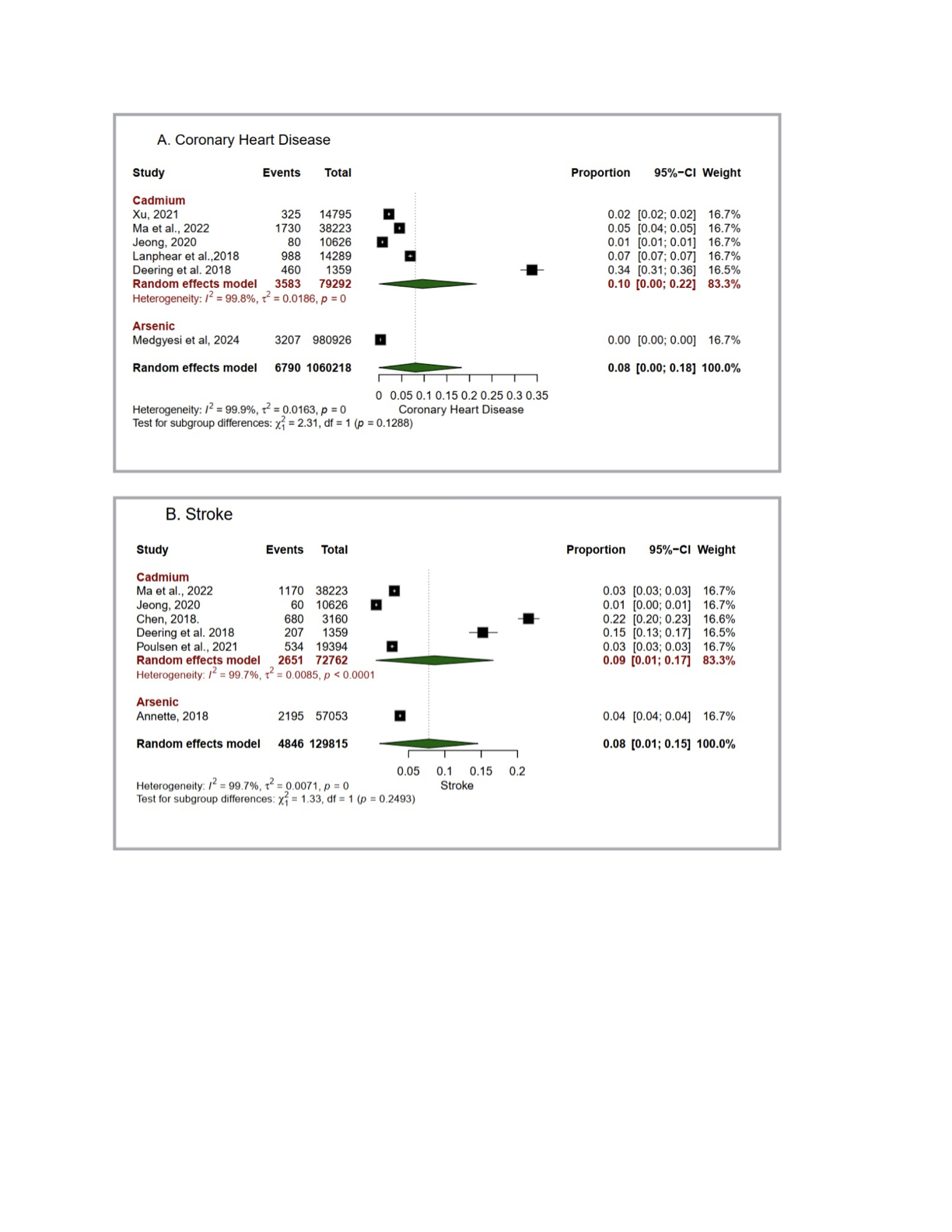
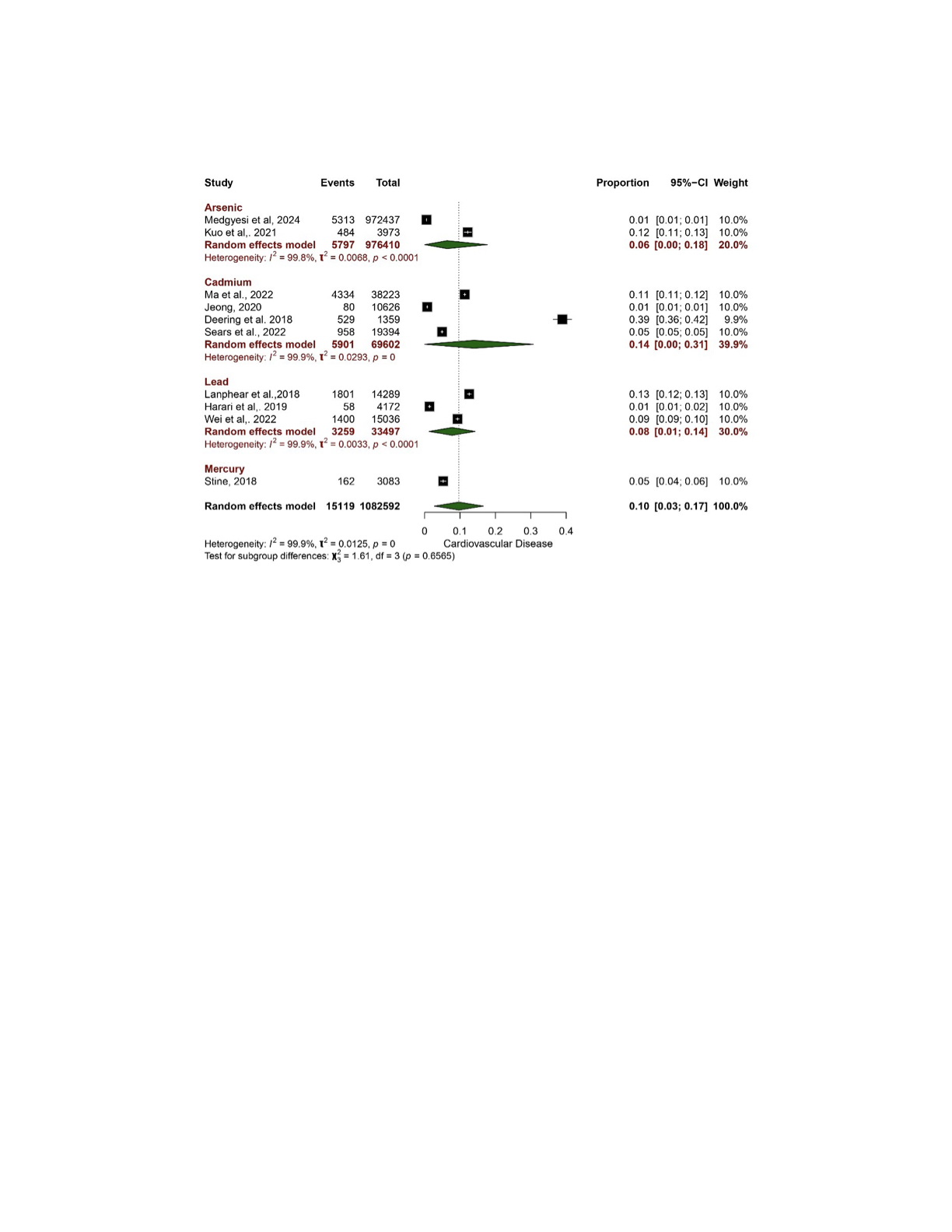
Abstract Body (Do not enter title and authors here): Introduction: Heavy metal pollution, which contaminates water, soil, and food, particularly from arsenic, cadmium, lead, copper, and mercury, is a concerning cardiovascular risk factor and a major public health concern. These metals are linked to chronic conditions through inflammation, oxidative stress, and endothelial dysfunction. Whereas traditional cardiovascular disease (CVD) risk factors are well established, environmental exposures are less recognized despite their growing significance. Objective: To find the association between heavy metal exposure and risk of CVD, coronary heart disease (CHD), and stroke through epidemiological studies Methods: Adhering to PROSPERO and PRISMA guidelines, search was conducted across PubMed, Cochrane CENTRAL, and Google Scholar till April 2025 for studies involving heart disease patients or stroke patients exposed to heavy metals. Primary outcomes were the events of CVD, CHD, and stroke. Proportions of events within populations with 95% confidence intervals were pooled. Analysis was conducted by R software and p < 0.05 was considered statistically significant. Results: We included 17 studies involving 324,331 populations. Six studies assessed stroke proportions in cadmium- and arsenic-exposed populations. The cadmium subgroup showed a pooled proportion of 0.09 (95% CI: 0.01–0.17), with individual values ranging from 0.01 to 0.22; the arsenic subgroup showed a pooled proportion of 0.04 (95% CI: 0.04–0.04). The overall pooled proportion was 0.08 (95% CI: 0.01–0.15). Six studies found cases of CHD in groups exposed to cadmium and arsenic, with combined rates of 0.10 (95% CI: 0.00–0.22) for cadmium and 0.00 (95% CI: 0.00–0.00) for arsenic. The overall pooled proportion was 0.08 (95% CI: 0.00–0.18). Ten studies assessed CVD proportions by metal exposure. Arsenic showed a pooled proportion of 0.06 (95% CI: 0.00–0.18), cadmium 0.14 (95% CI: 0.00–0.31), lead 0.08 (95% CI: 0.01–0.14), and mercury 0.05 (95% CI: 0.04–0.06). The overall pooled proportion was 0.10 (95% CI: 0.03–0.17). All outcomes showed high heterogeneity despite sensitivity analysis. Conclusion: Our findings align with prior research showing that cadmium and arsenic exposure significantly increase cardiovascular risk, while lead and mercury are linked mainly to CVD. These results underscore environmental toxic metals' relevance in cardiovascular risk beyond behavioural risk factors.
Cheema, Shamikha
(
King Edward Medical University
, Lahore , Pakistan )
Naintara, Fnu
(
WellSpan York Hospital
, York , Pennsylvania , United States )
Hussain, Syed Ibad
(
Jinnah sindh medical university
, Karachi , Pakistan )
Tanveer, Esha
(
King Edward Medical University
, Lahore , Pakistan )
Shahid, Areeba
(
Jinnah sindh medical university
, Karachi , Pakistan )
Rifai, Mohamed
(
Faculty of Medicine, Menoufia University,
, Shebin El Kom , Egypt )
Anwar, Amna
(
Federal medical college
, Islamabad , Pakistan )
Jalal, Amna
(
Jinnah sindh medical university
, Karachi , Pakistan )
Burhan, Muhammad
(
Dow University Of Health Sciences
, Karachi , Pakistan )
Faheem, Muhammad Shaheer Bin
(
Karachi Institute of Medical Scienc
, Karachi , Pakistan )
Neha, Fnu
(
Ghulam Muhammad Mahar Medical College
, Sukkur , Pakistan )
Author Disclosures:
Shamikha Cheema:DO NOT have relevant financial relationships
| Muhammad Burhan:DO NOT have relevant financial relationships
| Muhammad Shaheer Bin Faheem:DO NOT have relevant financial relationships
| FNU Neha:No Answer
| FNU Naintara:DO NOT have relevant financial relationships
| Syed ibad Hussain:DO NOT have relevant financial relationships
| Areej Dar:DO NOT have relevant financial relationships
| Esha Tanveer:No Answer
| Areeba Shahid:No Answer
| Mohamed Rifai:DO NOT have relevant financial relationships
| Amna Anwar:No Answer
| Amna Jalal:DO NOT have relevant financial relationships