
Logo

American Heart Association

  23
  0


Final ID: MP1075

Trimethylamine N-oxide Promotes Atrial Arrhythmia Susceptibility via Neuroglial IL-1β-Driven Inflammatory Activation of the Left Stellate Ganglion

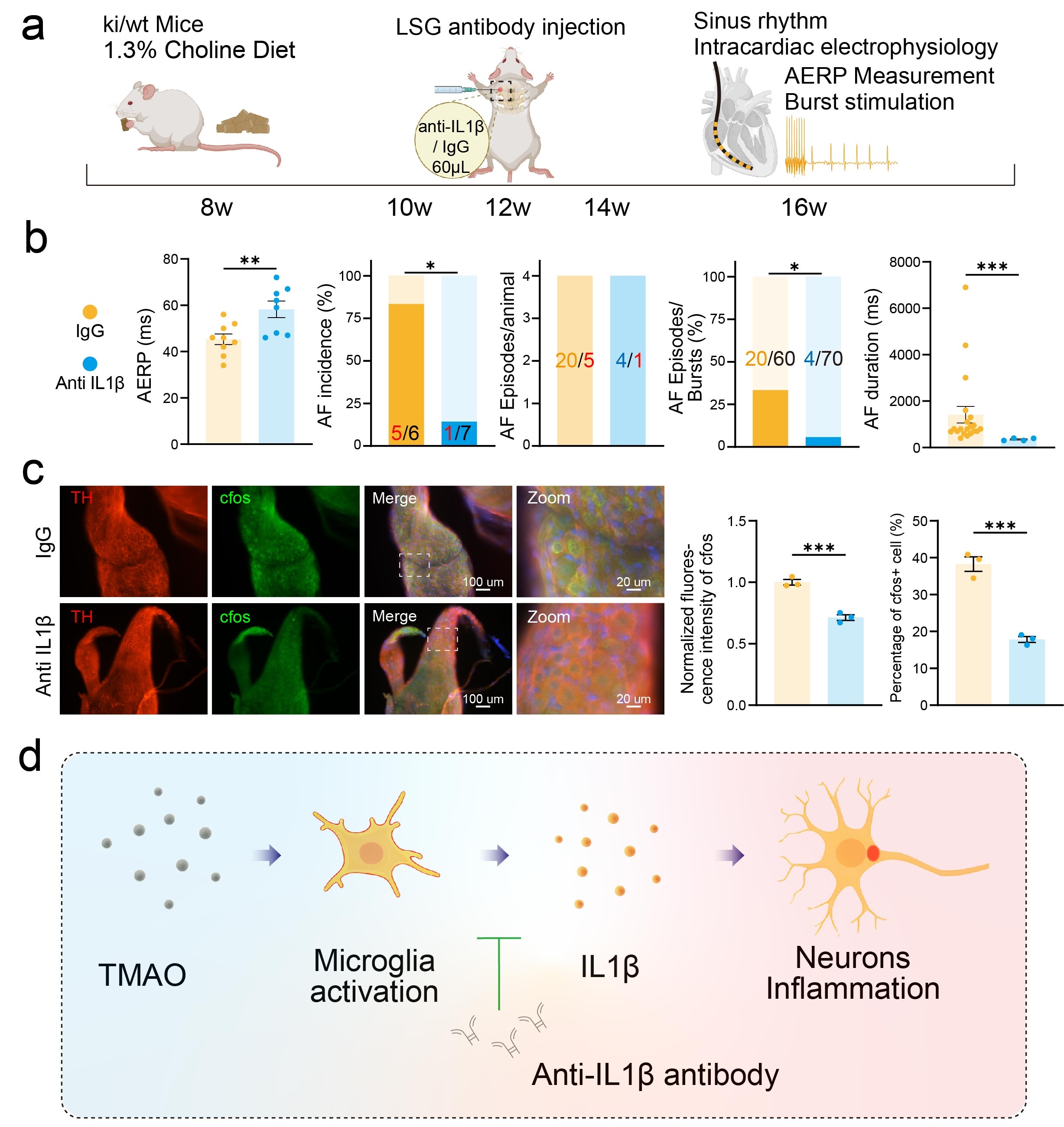
Abstract Body (Do not enter title and authors here): Dietary choline intake has been epidemiologically linked to an increased risk of atrial fibrillation (AF); however, the mechanistic underpinnings of this association remain poorly understood. Among the metabolites derived from choline, trimethylamine N-oxide (TMAO) has emerged as a key pro-arrhythmic molecule, implicated in a variety of cardiovascular pathologies. In this study, we utilized a cardiac-specific CREM-IbΔC-X transgenic mouse model, which spontaneously develops AF, to explore the impact of chronic choline supplementation and subacute TMAO exposure on atrial electrophysiological stability. Chronic administration of a high-choline diet significantly accelerated the onset of spontaneous AF, increased the frequency of atrial premature beats, and exacerbated overall AF burden. In a parallel model, intraperitoneal injection of TMAO heightened AF susceptibility, an effect mediated through activation of the left stellate ganglion (LSG). This pro-arrhythmic effect was effectively abrogated by local LSG blockade with hexamethonium bromide, suggesting that autonomic modulation plays a central role. To further elucidate the molecular mechanisms, we performed bulk RNA sequencing of LSG tissue and observed a marked upregulation of inflammatory signaling pathways, with interleukin-1 (IL-1) signaling emerging as a dominant feature in TMAO-treated mice. In vitro studies confirmed that TMAO selectively induced IL-1β expression in neuroglial cells, which in turn activated co-cultured hippocampal neurons, highlighting a neuron–glia crosstalk mechanism. Critically, in vivo microinjection of an IL-1β monoclonal antibody into the LSG significantly attenuated high-choline diet-induced ganglionic activation and reduced AF susceptibility. These findings identify neuroglial IL-1β–mediated inflammation within the LSG as a novel mechanistic link between dietary choline metabolism and atrial arrhythmogenesis. In conclusion, our results demonstrate that TMAO enhances atrial arrhythmia vulnerability in a spontaneous AF mouse model via neuroglial IL-1β–driven inflammatory activation of the left stellate ganglion, providing new insights into the diet–gut–brain–heart axis in AF pathophysiology.
  • Cheng, Hongyi  ( The First Affiliated Hospital with Nanjing Medical University , Nanjing , China )
  • Xu, Zhou  ( The First Affiliated Hospital with Nanjing Medical University , Nanjing , China )
  • Zhang, Yike  ( The First Affiliated Hospital with Nanjing Medical University , Nanjing , China )
  • Zhu, Yue  ( The First Affiliated Hospital with Nanjing Medical University , Nanjing , China )
  • Chen, Minglong  ( The First Affiliated Hospital with Nanjing Medical University , Nanjing , China )
  • Cui, Chang  ( The First Affiliated Hospital with Nanjing Medical University , Nanjing , China )
  • Author Disclosures:
    Hongyi Cheng: No Answer | Zhou Xu: No Answer | YIKE ZHANG: No Answer | Yue Zhu: No Answer | Minglong Chen: No Answer | Chang Cui: DO NOT have relevant financial relationships
Meeting Info:

Scientific Sessions 2025

2025

New Orleans, Louisiana

Session Info:

Electropathogenesis: Cellular Mechanisms Driving Arrhythmogenic Cardiomyopathies

Saturday, 11/08/2025 , 09:15AM - 10:30AM

Moderated Digital Poster Session

More abstracts on this topic:
A Mast Cell-Specific Receptor Mediates Post-Stroke Brain Inflammation Via a Dural-Brain Axis

Kothari Ruchita, Caplan Justin, Gonzalez L. Fernando, Jackson Christopher, Bettegowda Chetan, Huang Judy, Koehler Raymond, Tamargo Rafael, Xu Risheng, Dong Xinzhong, Abdulrahim Mostafa, Oh Hyun Jong, Capuzzi Daniel, Nair Sumil, Zhang Yaowu, Limjunyawong Nathachit, Saini Sarbjit, Kim Jennifer

A comparison of the efficacy of initial high energy versus initial low energy biphasic shocks for cardioversion of atrial fibrillation and atrial flutter – a real-life experience

Alampoondi Venkataramanan Sai Vikram, Vunnam Ramarao, Voruganti Dinesh, Tsai Shane

More abstracts from these authors:
Endothelial-Mesenchymal Transition Mediated by Mechanical Stress Prompts Atrial Fibrogenesis

Cui Chang, Qin Huiyuan, Zhu Yue, Zhang Yike, Shen Youmei, Liu Hailei, Chen Minglong

AI-Assisted Transseptal Puncture: Visual-Prompt Fine-Tuning of Foundation Models on Low-Dose X-RAY Images

Qi Xiuyu, Wang Xingyao, Cui Chang, Ju Weizhu, Chen Minglong

You have to be authorized to contact abstract author. Please, Login
Not Available