
Logo

American Heart Association

  22
  0


Final ID: Su2058

A Delayed Diagnosis of Anti-HMG-CoA Reductase Immune-Mediated Necrotizing Myopathy

Abstract Body (Do not enter title and authors here): Description of Case

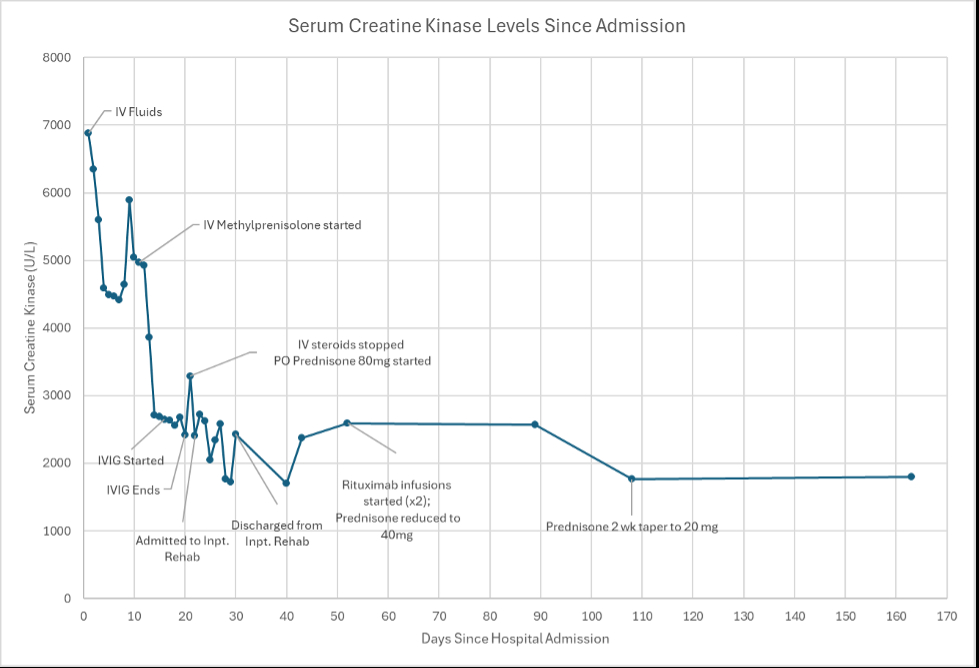
A 62-year-old male with a past medical history of chronic kidney disease stage 4, hyperlipidemia, and lacunar stroke presented with a 1-month history of worsening painless proximal muscle weakness. Patient had been taking atorvastatin 40 mg daily for 3 years. On physical examination, he had symmetrical proximal muscle weakness with 3/5 strength in upper proximal muscles and 2/5 in lower proximal muscle with intact distal muscle strength. Initial labs were significant for creatinine kinase (CK) of 6832 U/L. Urinalysis was positive for 3+ blood and no RBCs. Patient was initially treated with intravenous (IV) fluids for rhabdomyolysis. Patient did not clinically improve with IV fluids and statin cessation, and CK continued to be elevated. Upon further investigation, bilateral MRI of femur was concerning for myositis. Polymyositis/dermatomyositis panel and autoimmune work-up were negative. 3-hydroxy-3-methylglutaryl-coenzyme A reductase (HMGCR) antibody was positive, and muscle biopsy was consistent with statin-induced immune-mediated necrotizing myopathy (IMNM). Patient was started on high dose IV steroids with minimal improvement in symptoms, but with CK down-trending to 2500 U/L. Patient was concomitantly started on IVIG for 5 days with minimal improvement in symptoms and CK plateauing at 2500 U/L. Patient was transferred to inpatient rehab for 3 weeks and transitioned to oral steroids. Over the next 6 months while outpatient, the patient participated in physical therapy and completed two rituximab infusions with an oral steroid taper with only modest improvement in strength with 4/5 strength in upper proximal muscles and 3/5 in lower proximal muscles (Figure 1).

Discussion

Anti-HMGCR IMNM is an autoimmune condition that is a rare complication of statin medications where there is painless progressive muscle strength loss despite statin discontinuation due to myofiber necrosis. The incidence of statin induced IMNM is 2-3 per 100,000 people. Patients who are on a statin who present with a painless proximal myopathy warrant a IMNM work-up. Physicians should keep anti-HMGCR IMNM in the differential with a patient with suspected myopathy and on a statin, even if the statin was tolerated with no observable side effects for several years. Our case highlights a delayed diagnosis of anti-HMGCR IMNM requiring aggressive treatment with ultimately a modest clinical improvement and the risk of long-term debilitation without early detection.
  • Jadhav, Reshma  ( UT Health San Antonio , San Antonio , Texas , United States )
  • Shekar, Arush  ( Long School of Medicine , San Antonio , Texas , United States )
  • Westenhaver, Zack  ( UT Health San Antonio , San Antonio , Texas , United States )
  • Skandhan, Amith  ( UT Health San Antonio , San Antonio , Texas , United States )
  • Author Disclosures:
    Reshma Jadhav: DO NOT have relevant financial relationships | Arush Shekar: DO NOT have relevant financial relationships | Zack Westenhaver: DO NOT have relevant financial relationships | Amith Skandhan: No Answer
Meeting Info:

Scientific Sessions 2025

2025

New Orleans, Louisiana

Session Info:

Interesting Cases Across Cardiovascular Disease Prevention and CKM

Sunday, 11/09/2025 , 03:15PM - 04:15PM

Abstract Poster Board Session

More abstracts on this topic:
Burden of Hyperlipidemia, Cardiovascular Mortality, and COVID-19: A Retrospective-Cohort Analysis of US Data

Pham Hoang Nhat, Khanji Mohammed, Chahal Anwar, Mamas Mamas, Sainbayar Enkhtsogt, Ramzi Ibrahim, Olson April, Alabagi Abdulla, Soin Sabrina, Aiti Danny, Tran Phillip, Lee Justin

A Focus for Improvement - Factors for Lab Adherence in a Pediatric Preventive Cardiology Program

Holsinger Hunter, Porterfield Ronna, Taylor Makenna, Dresbach Bethany, Seipel Brittany, Igwe Chukwuemeka, Alvarado Chance, Tran Andrew

You have to be authorized to contact abstract author. Please, Login
Not Available