
Logo

American Heart Association

  18
  0


Final ID: MP1504

Aspirin Use for Primary Prevention of Cardiovascular Events in High Risk Patients with Diabetes: A Propensity Matched Analysis

Abstract Body (Do not enter title and authors here): Background
Aspirin (ASA) use for primary prevention of ASCVD events is no longer regularly recommended. However, little is known about how ASA adherence influences cardiovascular outcomes in diabetic patients based on their glycemic control and ASCVD risk. We investigated the impact of ASA use and adherence frequency on ASCVD outcomes in patients with diabetes, stratified by hemoglobin A1c (HbA1c).
Methods
Using an EHR generated primary prevention registry across a large healthcare network (>400+ sites), ASA use (no use, <30% of the time, 30% - < 70% of the time and ≥ 70% of the time) was assessed in patients with moderate or high 10-year ASCVD risk score. Propensity score matching (PSM) (1:2 ratio) was performed to balance baseline characteristics between ASA users and non-users. Cumulative Incidence Function (CIF) and Kaplan-Meier (KM) analyses were conducted on the PSM cohort to compare outcomes between ASA treatment groups. Multivariable-adjusted hazard ratios (HR) were calculated using Cox proportional hazards models. Subgroup analyses evaluated effect modification by HbA1c categories (6.5–7%, 7–9%, >9%)
Results
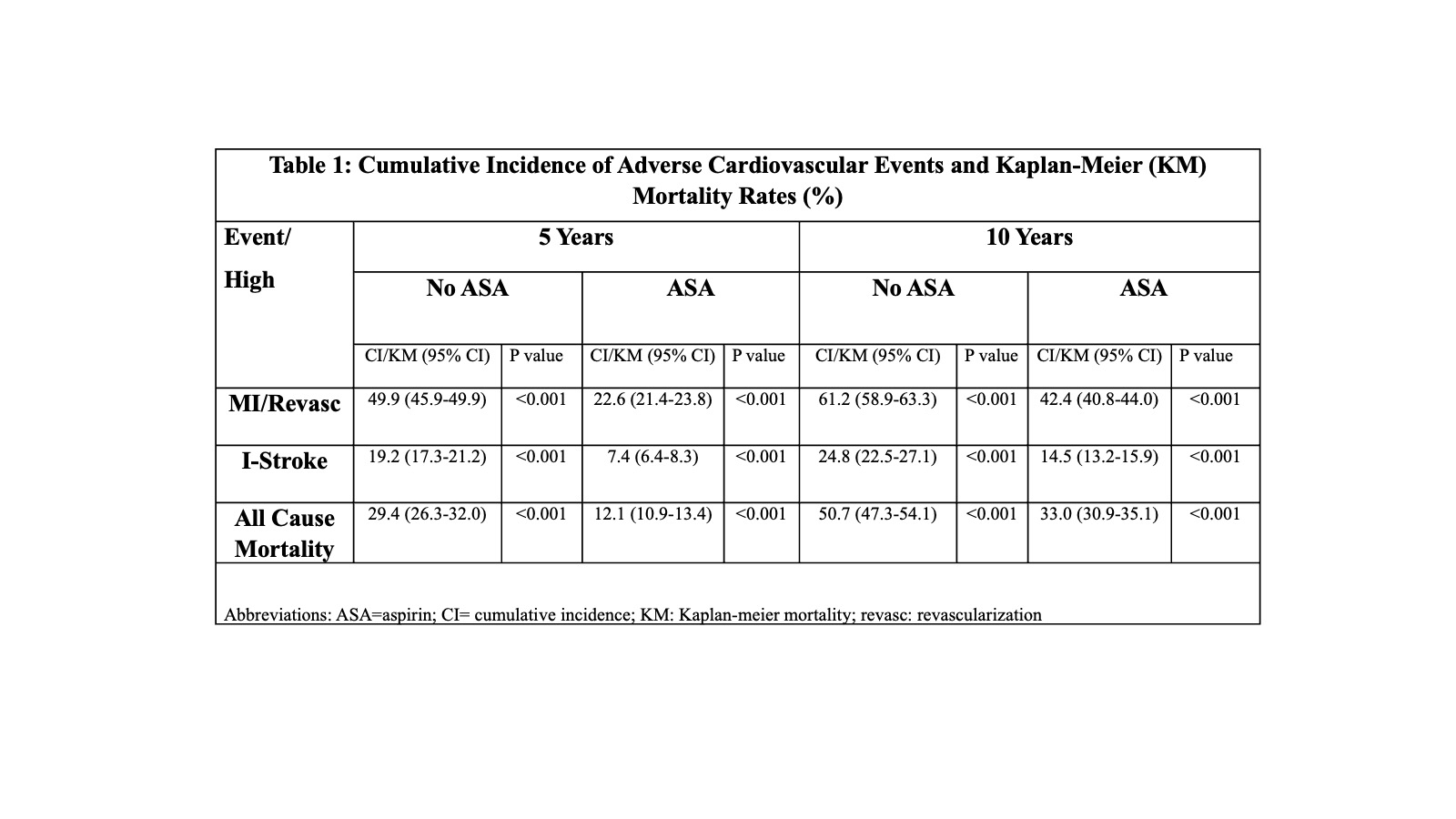
In 11,681patients (61.6 ± 9.79 years, 46.24% female), 88.6% were ASA and 53.15% were statin users at anytime during 10-year follow up. Cumulative incidence of MI (42.4% vs 61.2%), Stroke (14.5% vs 24.8%), 10-year all-cause mortality (33.0% vs 50.7%), all p<0.001 was significantly lower in PSM ASA group compared to No ASA group. [Table 1]. Any ASA use was associated with significantly lower hazards of MI and ischemic stroke compared to no ASA use with greater benefit observed in the high frequency use group (HRMI: 0.54 [0.50–0.58]; HRSTROKE: 0.47 [0.41–0.53]; both p<0.001) [Table 2]. Subgroup analysis by HbA1c showed consistent benefit of ASA (with statin use) across glycemic strata, though the magnitude of benefit declined with worse glycemic control. [Table 3]. Mortality reduction was also more pronounced in better-controlled groups.
Conclusion
Aspirin use is associated with significant reductions in MI, stroke, and mortality among high-risk patients with diabetes, with greater frequency conferring more benefit.
  • Kainat, Aleesha  ( University of Pittsburgh Medical Center , Pittsburgh , Pennsylvania , United States )
  • Muluk, Pallavi  ( University of Pittsburgh Medical Center , Pittsburgh , Pennsylvania , United States )
  • Zhu, Jianhui  ( University of Pittsburgh Medical Center , Pittsburgh , Pennsylvania , United States )
  • Thoma, Floyd  ( University of Pittsburgh Medical Center , Pittsburgh , Pennsylvania , United States )
  • Marroquin, Oscar  ( University of Pittsburgh Medical Center , Pittsburgh , Pennsylvania , United States )
  • Mulukutla, Suresh  ( University of Pittsburgh Medical Center , Pittsburgh , Pennsylvania , United States )
  • Saeed, Anum  ( University of Pittsburgh Medical Center , Pittsburgh , Pennsylvania , United States )
  • Author Disclosures:
    Aleesha Kainat: DO NOT have relevant financial relationships | Pallavi Muluk: DO NOT have relevant financial relationships | Jianhui Zhu: DO NOT have relevant financial relationships | Floyd Thoma: DO NOT have relevant financial relationships | Oscar Marroquin: No Answer | Suresh Mulukutla: DO NOT have relevant financial relationships | Anum Saeed: DO NOT have relevant financial relationships
Meeting Info:

Scientific Sessions 2025

2025

New Orleans, Louisiana

Session Info:

Prevention Potpourri: Trends, Risks, and Therapies in CVD Prevention

Sunday, 11/09/2025 , 03:15PM - 04:25PM

Moderated Digital Poster Session

More abstracts on this topic:
A hepatic steatosis-mediated metabolite reprograms macrophage lipid metabolism and aggravates atherosclerosis

Long Ting, Feng Ruijia, Feng Weiqi, Peng Guiyan, Yang Wenchao, Li Zilun, Huang Kan, Chang Guangqi

A Novel Tool for Evaluating Endothelial Function: Plethysmographic Flow-mediated Vasodilation (pFMD)

Kishimoto Shinji, Itarashiki Tomomasa, Higashi Yukihito, Maruhashi Tatsuya, Kajikawa Masato, Mizobuchi Aya, Harada Takahiro, Yamaji Takayuki, Nakano Yukiko, Mohamad Yusoff Farina, Yada Tomohiko

More abstracts from these authors:
The Impact of Donor-Recipient Race Matching on Development of De Novo Donor-Specific Antibodies After Heart Transplantation

Kainat Aleesha, Hurera Abu, Shah Neil, Zhu Jianhui, Thoma Floyd, Horn Edward, Hickey Gavin, Sriwattanakomen Roy

High Intensity Statin Use Improved ASCVD Outcomes in Patients with Severe Hyperlipidemia in a Primary Prevention Cohort

Hallihan Cameron, Zhu Jianhui, Thoma Floyd, Nambi Vijay, Mehta Anurag, Agarwala Anandita, Marroquin Oscar, Mulukutla Suresh, Saeed Anum

You have to be authorized to contact abstract author. Please, Login
Not Available