A Population-Based Study of Modifiable Social and Behavioral Factors and Heart Aging
Abstract Body: Introduction: The novel PREVENT risk age construct (age of a hypothetical person with the same absolute risk but optimal risk factors) may better communicate risk than absolute CVD risk. Social and behavioral factors shape CVD risk, and quantifying their associations with PREVENT risk age may better convey their impact when counseling patients.
Hypothesis: Favorable behavioral and social metrics will be associated with lower PREVENT risk age and greater odds of having a risk age lower than chronological age.
Methods: In adults from the 1999-2018 NHANES (n=26,824, age: 30-79y, 50% female, 9% Black, 13% Hispanic), a new social advantage metric (SAM; 0-100), reflecting cumulative social determinants, was computed. Behavioral factors (sleep, diet, physical activity) were scored per Life’s Essential 8 and averaged to create a cumulative behavioral metric (BM). An aggregate social and behavioral metric (SBM) was also computed as the unweighted mean of SAM and BM; scores were categorized as high (80-100), moderate (50-79), or low (0-49). PREVENT risk age equations were used, and discordance between risk age and chronological age was estimated. Sex-stratified linear and logistic models examined associations of SBM and its components with age discordance.
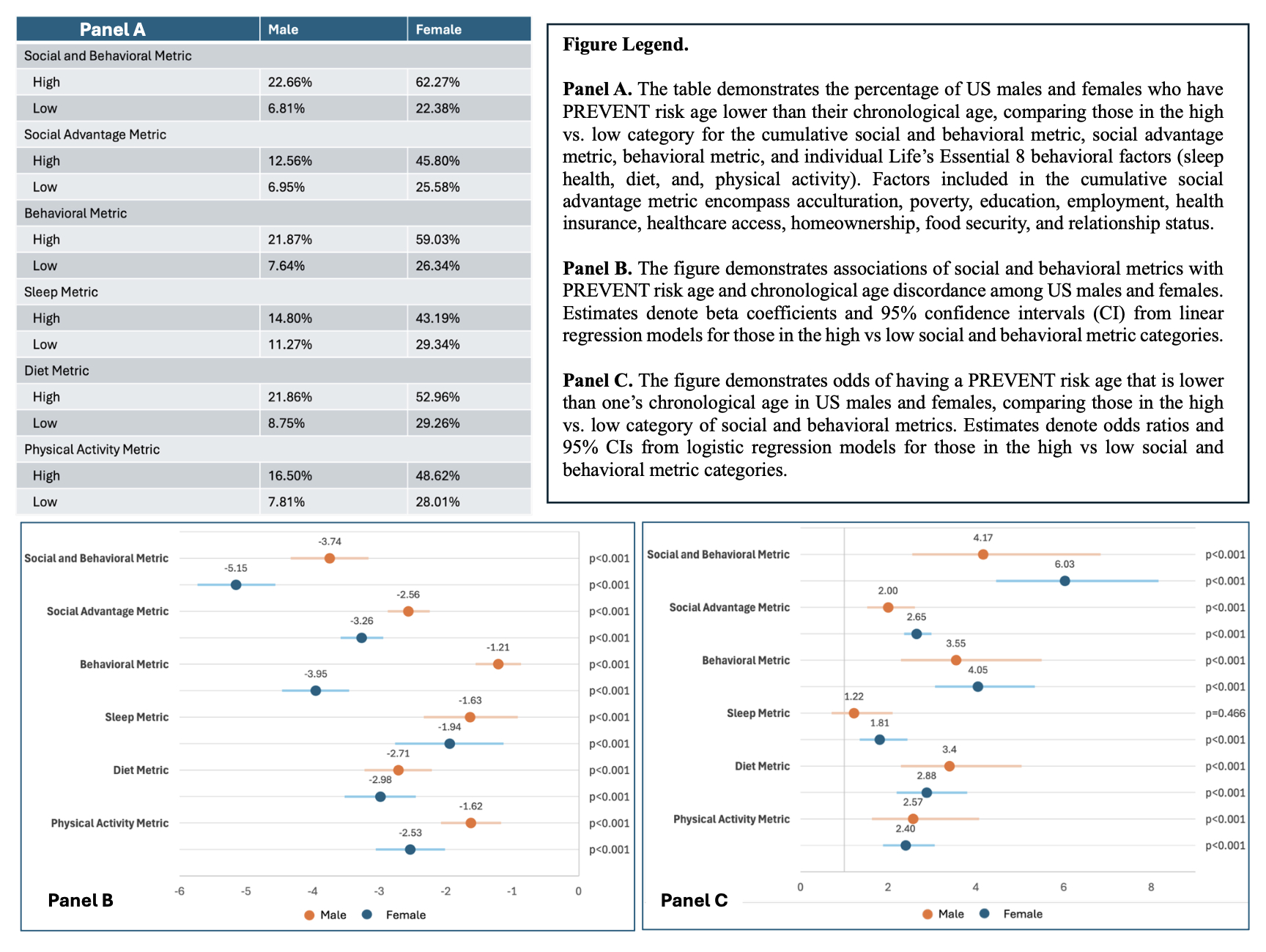
Results: Mean SBM was 60 in males and 62 in females. The mean PREVENT risk age was higher than chronological age for both sexes, but those with high vs. low SBM, SAM, and BM were more likely to have a risk age lower than their chronological age (Figure Panel A). Having high vs. low SBM, SAM, and BM was associated with lower age discordance (Figure Panel B). Similar associations were observed for all LE8 behavioral factors, with the strongest effect sizes being observed for diet. In logistic models, high vs. low SBM and its components were associated with up to 4- and 6-fold higher odds of having a risk age that is lower than their chronological age among males and females, respectively (Figure Panel C). In stratified analyses, associations persisted in all racial and ethnic groups but were strongest among White females (p-interaction<0.01).
Conclusion: Healthier lifestyle behaviors and greater social advantage are associated with lower PREVENT risk age vs. chronological age discordance and up to 6 times higher odds of having a lower risk age than their chronological age. Public health messaging and interventions addressing lifestyle changes and structural factors should incorporate the PREVENT risk age construct.
Wood, Erica
(
Columbia University Irving Medical Center
, New York , New York , United States )
Abdalla, Marwah
(
COLUMBIA UNIVERSITY
, New York , New York , United States )
German, Charles
(
Georgetown
, Washington , District of Columbia , United States )
Makarem, Nour
(
COLUMBIA UNIVERSITY MEDICAL CENTER
, New York , New York , United States )
Jiang Chao, Dong Jianzeng, Cai Jun, Anderson Craig, Du Xin, Tang Yangyang, Han Rong, Song Yanna, Wang Chi, Lin Xiaolei, Yi Yang, Rodgers Anthony, Ma Changsheng