
Logo

American Heart Association

  18
  0


Final ID: MP2683

The Impact of Donor-Recipient Race Matching on Development of De Novo Donor-Specific Antibodies After Heart Transplantation

Abstract Body (Do not enter title and authors here): Background
Heart transplantation remains the definitive treatment for end-stage heart failure, but outcomes vary by race. Black patients demonstrate worse survival and race matching does not improve mortality. Various mechanisms have been posited to explain this discrepancy, including immunologic factors. Development of de novo donor-specific antibodies (dnDSA) is known to increase mortality. We sought to study the effect of donor-recipient race matching in heart transplantation on the development of dnDSA and mortality.
Methods
We conducted a retrospective cohort study of 426 adult heart transplant recipients admitted to a large tertiary healthcare system from 2011-2024. Races were categorized as White, Black, Asian, American Indian, and Hawaiian. Recipients were categorized as race-matched (n=315) or unmatched (n=111). The time to dnDSA detection was analyzed using the Fine-Gray method, with death treated as a competing risk. Mortality was estimated using Kaplan-Meier survival analysis. Multivariable Cox regression models using both donor and recipient variables were used to assess the impact of risk factors on dnDSA development and mortality. We calculated total HLA match based on HLA-A, B, and DR (score 0-6). Variable selection used stepwise regression (p<0.2 for inclusion), with race match forced into all models.
Results
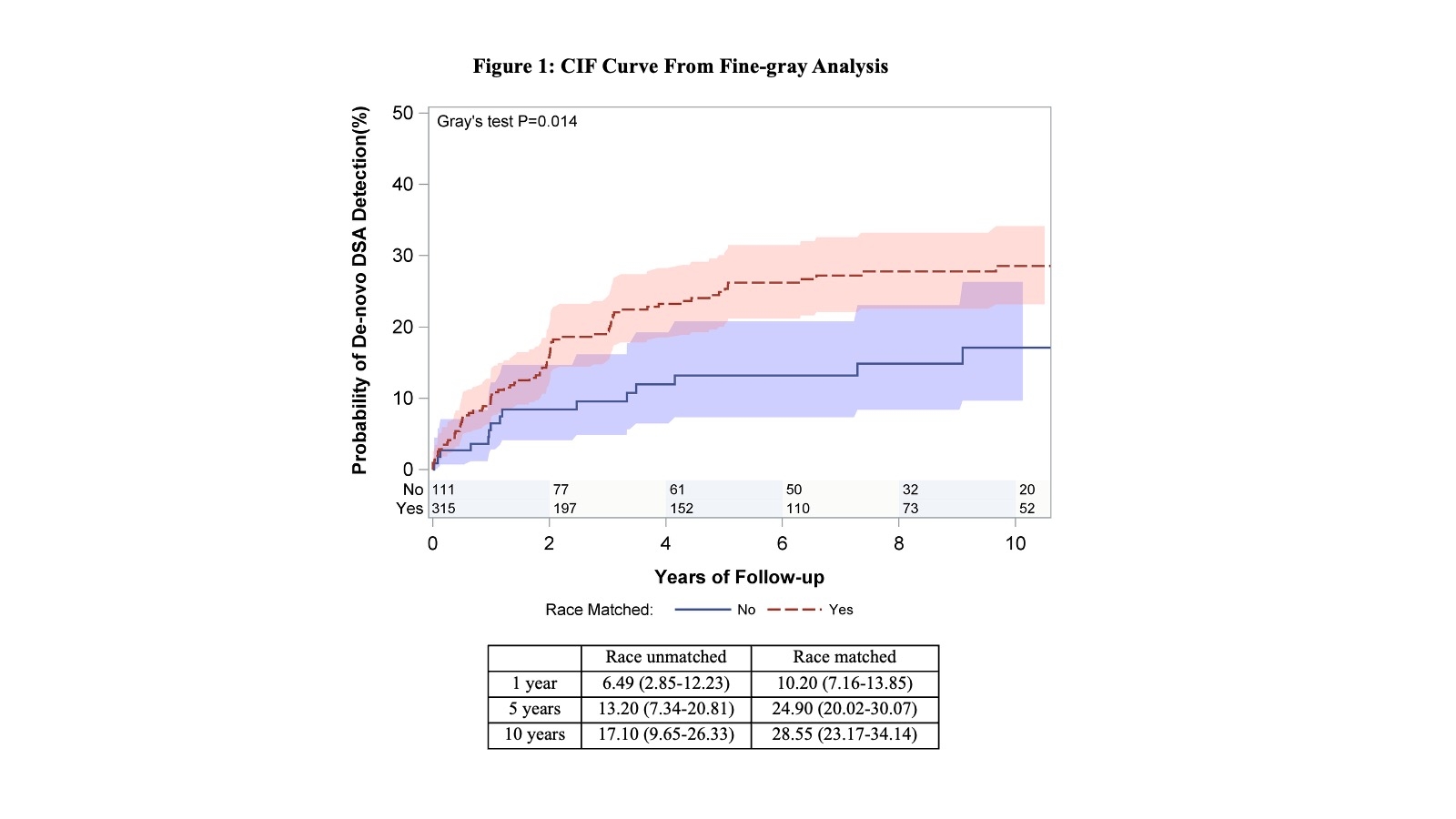
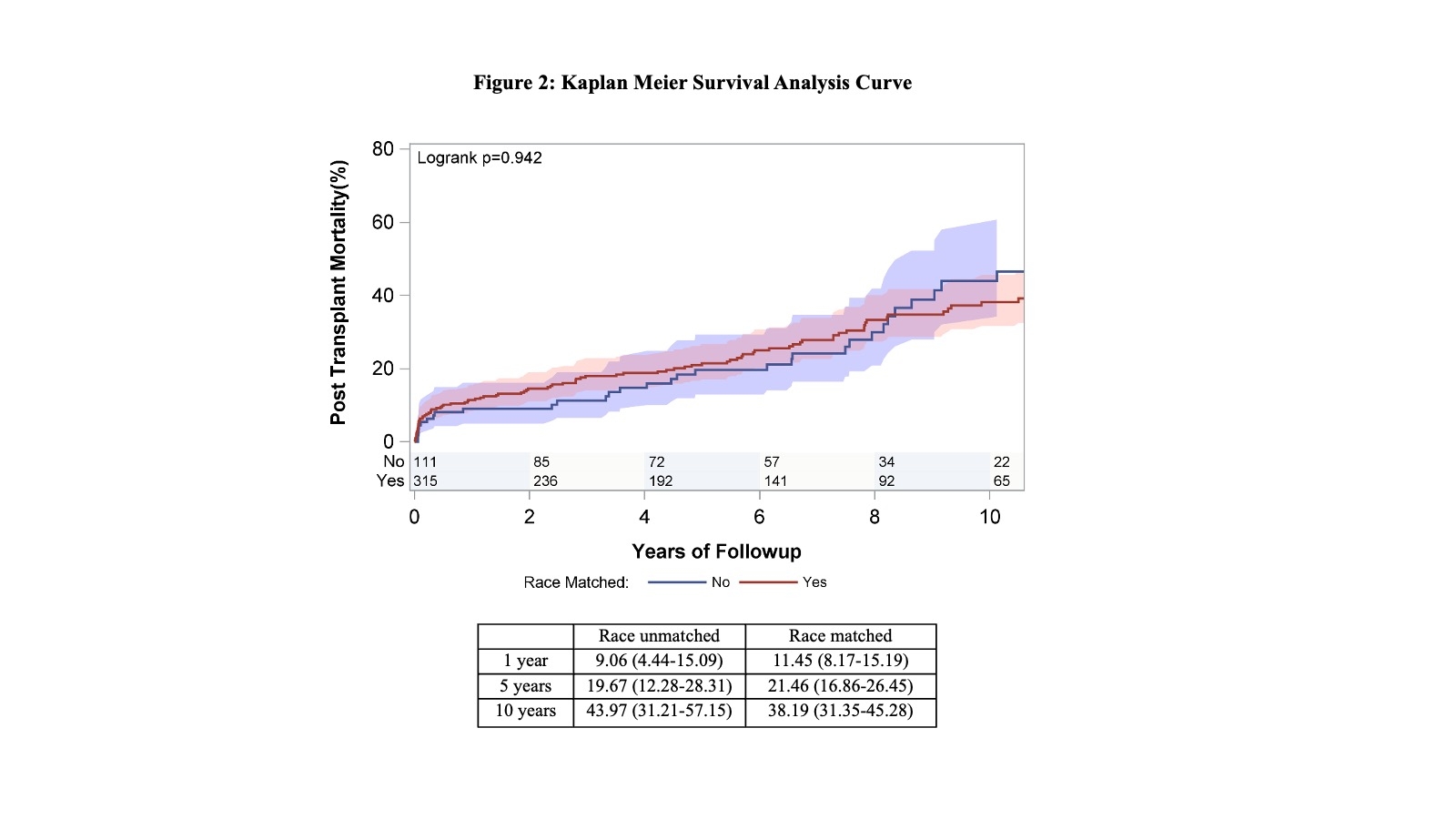
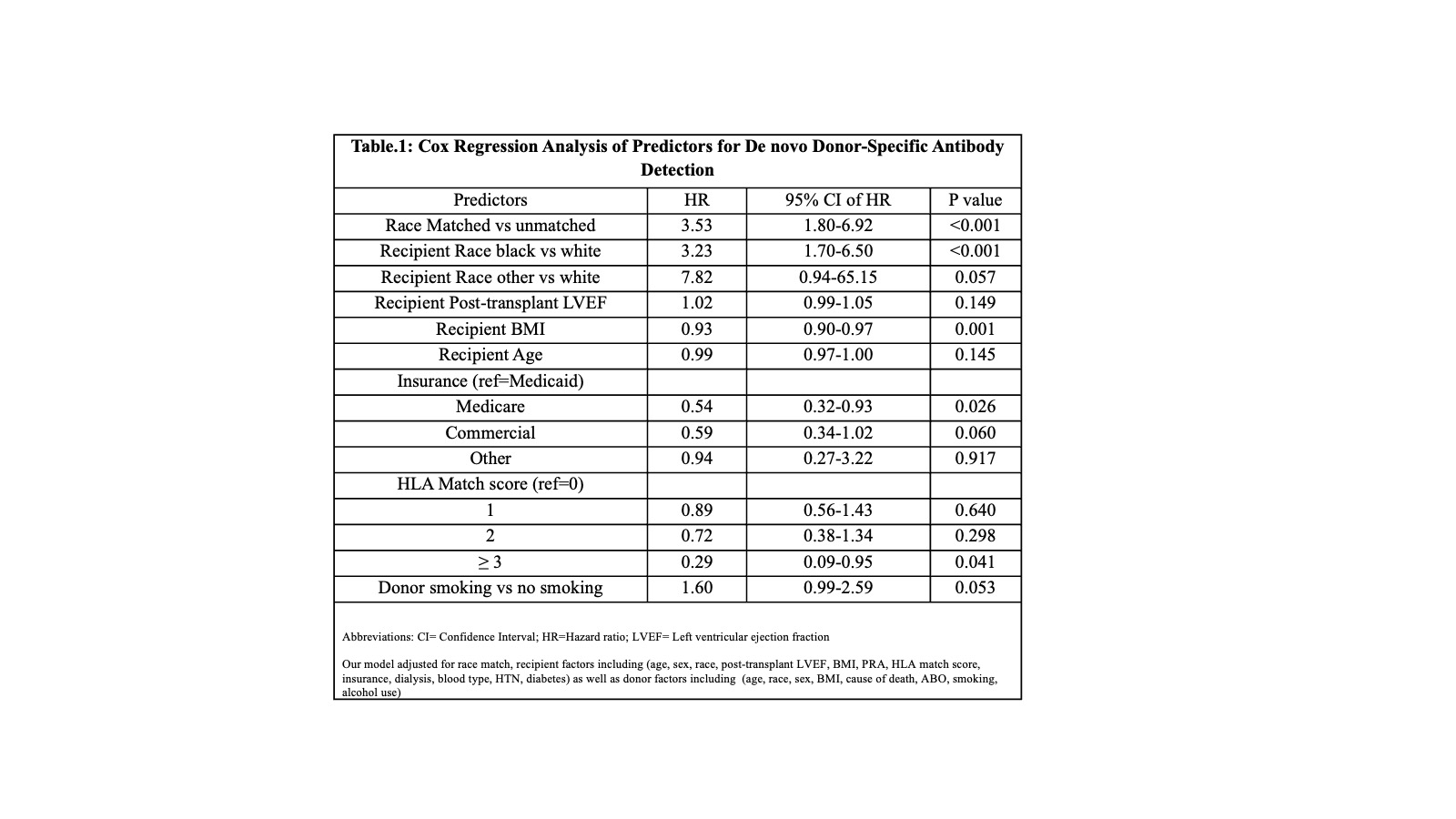
Race-matched recipients had a significantly higher cumulative incidence of dnDSA at year 1 and over the entire follow-up period (Figure 1). In our adjusted model, race matching (HR 3.64, 95% CI 1.88–7.06) remained a significant predictor of dnDSA development as did Black recipient race (HR 3.27, 95% CI 1.70–6.28), greater HLA mismatch score, recipient insurance and BMI (Table 1). In contrast, neither race matching (Figure 2) nor dnDSA were associated with all-cause mortality.
Conclusion
Our study demonstrates that donor-recipient race matching is independently associated with an increased risk of dnDSA development following heart transplantation even after controlling for recipient race and HLA matching. The mechanisms underlying this surprising finding remain unclear and underscore the genetic heterogeneity that exists within race. However, race matching and dnDSA were not associated with differences in mortality. Our findings highlight the complex immunologic interplay between race concordance and dnDSA development, warranting further investigation into individualized risk stratification beyond traditional HLA matching.
  • Kainat, Aleesha  ( University of Pittsburgh Medical Center, Mercy , Pittsburgh , Pennsylvania , United States )
  • Hurera, Abu  ( University Of Pittsburgh Medical Center, McKeesport , Pittsburgh , Pennsylvania , United States )
  • Shah, Neil  ( University of Pittsburgh Medical Center , Pittsburgh , Pennsylvania , United States )
  • Zhu, Jianhui  ( University of Pittsburgh Medical Center , Pittsburgh , Pennsylvania , United States )
  • Thoma, Floyd  ( University of Pittsburgh Medical Center , Pittsburgh , Pennsylvania , United States )
  • Horn, Edward  ( University of Pittsburgh Medical Center , Pittsburgh , Pennsylvania , United States )
  • Hickey, Gavin  ( University of Pittsburgh Medical Center , Pittsburgh , Pennsylvania , United States )
  • Sriwattanakomen, Roy  ( University of Pittsburgh Medical Center , Pittsburgh , Pennsylvania , United States )
  • Author Disclosures:
    Aleesha Kainat: DO NOT have relevant financial relationships | Abu Hurera: No Answer | Neil Shah: DO have relevant financial relationships ; Employee:UPMC:Active (exists now) | Jianhui Zhu: DO NOT have relevant financial relationships | Floyd Thoma: DO NOT have relevant financial relationships | Edward Horn: DO NOT have relevant financial relationships | Gavin Hickey: DO NOT have relevant financial relationships | Roy Sriwattanakomen: No Answer
Meeting Info:

Scientific Sessions 2025

2025

New Orleans, Louisiana

Session Info:

Failure to Launch--Clinical Research to Improve Heart Failure

Monday, 11/10/2025 , 10:45AM - 12:00PM

Moderated Digital Poster Session

More abstracts on this topic:
A Case Presentation of Severe Left Ventricular Dysfunction from Focal Myocarditis due to Immune Checkpoint Inhibitor

Patel Romil, Hussain Kifah, Gordon Robert

A Pressure-Volume Loops Approach Predicts Outcomes After Double Switch Operation For Congenitally Corrected Transposition Of The Great Arteries with Intact Ventricular Septum

Thatte Nikhil, Del Nido Pedro, Ghelani Sunil, Hammer Peter, Marx Gerald, Beroukhim Rebecca, Gauvreau Kimberlee, Callahan Ryan, Prakash Ashwin, Emani Sitaram, Hoganson David

More abstracts from these authors:
Aspirin Use for Primary Prevention of Cardiovascular Events in High Risk Patients with Diabetes: A Propensity Matched Analysis

Kainat Aleesha, Muluk Pallavi, Zhu Jianhui, Thoma Floyd, Marroquin Oscar, Mulukutla Suresh, Saeed Anum

Concomitant Infection in Cardiogenic Shock: Hospitalization Outcomes and Temporary Mechanical Circulatory Support Usage

Shah Neil, Hickey Gavin, Thoma Floyd, Kwak Eun Jeong, Rivosecchi Ryan

You have to be authorized to contact abstract author. Please, Login
Not Available