Logo

American Heart Association

  20
  0


Final ID: MP2770

Preservation of Acetyl-Coenzyme A Synthetase 2 Sustains Cytosolic Acetyl-CoA and Protects Against Heart Failure

Abstract Body (Do not enter title and authors here): Background:
Emerging evidence suggests that the homeostasis of cytosolic acetyl-coenzyme A (acetyl-CoA) is critical for maintaining cardiac function, especially under pathological stress. Acetyl-CoA serves as a central metabolic intermediate, linking nutrient catabolism to mitochondrial energy production and epigenetic regulation through protein acetylation. However, the enzymatic pathways that control cytosolic acetyl-CoA levels in the heart remain poorly defined. Acetyl-CoA synthetase 2 (ACSS2), which converts acetate into acetyl-CoA in the cytosol, may play a key role in regulating this metabolic pool. This study aimed to investigate the role of ACSS2 in cardiomyocyte metabolism and adaptation in response to isoproterenol.
Methods:
In vivo, mice were infused with isoproterenol via osmotic pump to induce heart failure, and cardiac function was assessed using echocardiography. In vitro, H9c2 cardiomyoblasts were treated with isoproterenol and subjected to either pharmacological inhibition or CRISPR/Cas9-mediated knockout of ACSS2. Cytosolic acetyl-CoA and mitochondrial respiration were measured using targeted metabolite assays and seahorse XF analysis. ACSS2 was overexpressed using lentiviral vectors. Short- and medium-chain fatty acids, specifically butyrate and octanoate, were supplemented to bypass mitochondrial transport steps and assess mitochondrial function.
Results:
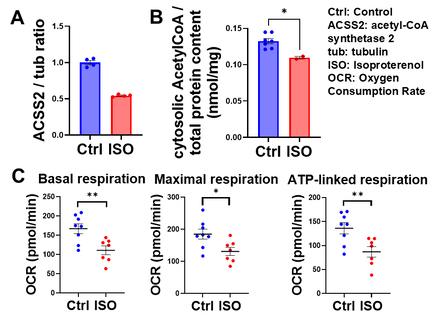
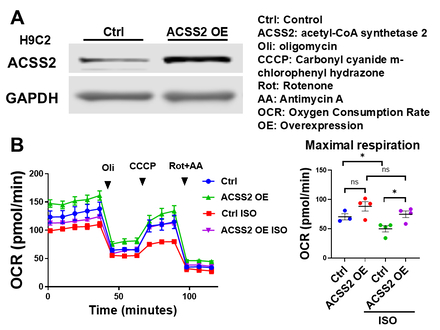
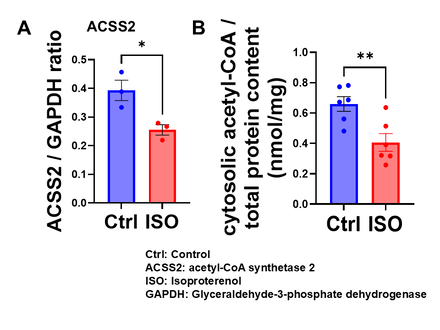
Western blot analysis showed that ACSS2 expression was significantly reduced in the myocardium of isoproterenol-treated mice (Fig. 1A), with a corresponding decrease in cytosolic acetyl-CoA levels (Fig. 1B). In H9c2 cells, isoproterenol similarly reduced ACSS2 expression (Fig. 2A) and cytosolic acetyl-CoA (Fig. 2B). Isoproterenol impaired mitochondrial respiration, with reductions in basal, maximal, and ATP-linked respiration (Fig. 2C). Both pharmacological inhibition and genetic deletion of ACSS2 impaired mitochondrial respiration. In contrast, ACSS2 overexpression preserved mitochondrial function under isoproterenol stress (Fig. 3). Supplementation with butyrate or octanoate partially improved mitochondrial respiration, but did not fully rescue mitochondrial function, suggesting that cytosolic acetyl-CoA depletion causes mitochondrial dysfunction beyond substrate limitation.
Conclusions:
ACSS2 is essential for maintaining cytosolic acetyl-CoA levels and mitochondrial function during cardiac stress. These findings support acetate metabolism as a therapeutic target for heart failure.
  • Sekine, Toranosuke  ( Fukushima Medical University , Fukushima , Japan )
  • Takeishi, Yasuchika  ( Fukushima Medical University , Fukushima , Japan )
  • Miura, Shunsuke  ( Fukushima Medical University , Fukushima , Japan )
  • Okochi, Satoshi  ( Fukushima Medical University , Fukushima , Japan )
  • Ogawara, Ryo  ( Fukushima Medical University , Fukushima , Japan )
  • Yokokawa, Tetsuro  ( Fukushima Medical University , Fukushima , Japan )
  • Misaka, Tomofumi  ( Fukushima Medical University , Fukushima , Japan )
  • Oikawa, Masayoshi  ( Fukushima Medical University , Fukushima , Japan )
  • Nakazato, Kazuhiko  ( Fukushima Medical University , Fukushima , Japan )
  • Ishida, Takafumi  ( Fukushima Medical University , Fukushima , Japan )
  • Author Disclosures:
    Toranosuke Sekine: DO NOT have relevant financial relationships | Yasuchika Takeishi: DO NOT have relevant financial relationships | Shunsuke Miura: DO NOT have relevant financial relationships | Satoshi Okochi: DO NOT have relevant financial relationships | Ryo Ogawara: DO NOT have relevant financial relationships | Tetsuro Yokokawa: DO NOT have relevant financial relationships | Tomofumi Misaka: DO NOT have relevant financial relationships | Masayoshi Oikawa: DO NOT have relevant financial relationships | Kazuhiko Nakazato: DO NOT have relevant financial relationships | Takafumi Ishida: DO have relevant financial relationships ; Other (please indicate in the box next to the company name):BIOTRONIK JAPAN (Endowed Course):Active (exists now) ; Other (please indicate in the box next to the company name):Abbott Medical Japan LLC (Endowed Course):Active (exists now)
Meeting Info:

Scientific Sessions 2025

2025

New Orleans, Louisiana

Session Info:

Metabolic Underworld: Mitochondria, Fibrosis, and Cardiac Stress

Monday, 11/10/2025 , 09:15AM - 10:30AM

Moderated Digital Poster Session

More abstracts on this topic:
More abstracts from these authors:
Alfa-tubulin detyrosination causes mitochondrial dysfunction through suppression of Parkin-mediated mitophagy linking to heart failure with preserved ejection fraction

Miura Shunsuke, Nakazato Kazuhiko, Ishida Takafumi, Takeishi Yasuchika, Sekine Toranosuke, Ogawara Ryo, Ichimura Shohei, Yokokawa Tetsuro, Misaka Tomofumi, Oikawa Masayoshi, Kobayashi Atsushi, Yamaki Takayoshi

Exacerbation of Doxorubicin-Induced Mitochondrial Dysfunction by the Inhibition of Voltage -Dependent Anion Channel 1 Oligomerization

Miura Shunsuke, Suzuki Yoshinori, Sekine Toranosuke, Okochi Satoshi, Ogawara Ryo, Yokokawa Tetsuro, Misaka Tomofumi, Oikawa Masayoshi, Ishida Takafumi, Takeishi Yasuchika

You have to be authorized to contact abstract author. Please, Login
Not Available