Patient-Reported Outcomes in Patients with Symptomatic, Obstructive Hypertrophic Cardiomyopathy Treated with Mavacamten: Real-world Observations through Week 30 from the COMPASS-HCM Study
Abstract Body (Do not enter title and authors here): Background: Clinical trials have demonstrated mavacamten’s efficacy in improving health status of patients with obstructive hypertrophic cardiomyopathy (oHCM), but real-world data remain limited.
Research Question: What is mavacamten’s impact on health status changes in patients with oHCM in real-world settings?
Methods: The COMPASS-HCM study (NCT06551129) prospectively recruited US adults with oHCM prescribed mavacamten, excluding those with moderate lung disease, recent hospitalization (≤ 2 weeks), recent heart/lung surgery or stroke/transient ischemic attack (≤ 6 months), or mavacamten treatment ≥7 days prior to enrollment. Participants completed the Kansas City Cardiomyopathy Questionnaire (KCCQ; higher scores are better) and HCM Symptom Questionnaire (HCMSQ; lower scores are better) at baseline, weeks 2, 4, 8, 12, 24, and 30 after initially starting mavacamten. Patient characteristics and health status changes from baseline through week 30 were described.
Results: A total of 108 patients (mean [± SD] age 66.7 ± 12.5 years, 61.1% women, and 94.4% White) completed baseline surveys and initiated mavacamten following enrollment. Baseline mean scores were 60.3 ± 20.9 for KCCQ Overall Summary Score (KCCQ-OSS), 65.9 ± 19.3 for KCCQ Clinical Summary Score (KCCQ-CSS), 6.9 ± 3.5 for HCMSQ Shortness of Breath (SoB) domain, and 4.5 ± 2.0 for HCMSQ Total score. At baseline, 85.2% of patients were on background oHCM therapy.
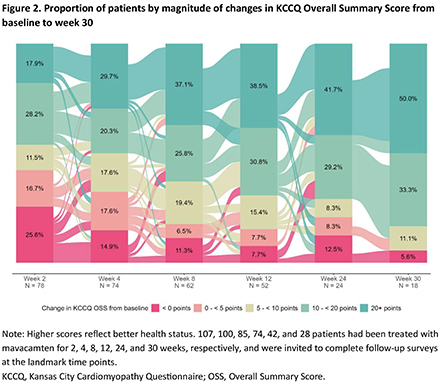
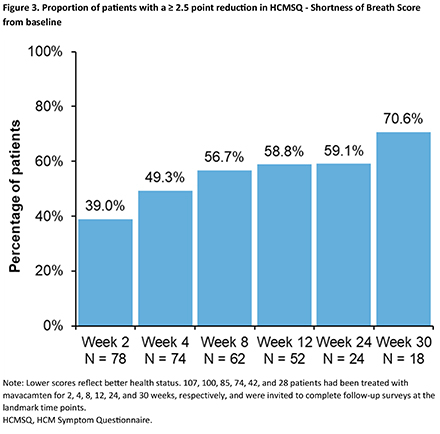
Follow-up surveys were completed by 78, 74, 62, 52, 24, and 18 patients treated with mavacamten for 2, 4, 8, 12, 24, and 30 weeks, respectively. At last follow-up, daily mavacamten dose was 2.5 mg in 16.7%, 5 mg in 38.9%, 10 mg in 22.2%, and 15 mg in 22.2% of patients. Mean improvements from baseline to week 30 were 20.7 ± 17.1 for KCCQ-OSS (Figure 1), 16.4 ± 12.8 for KCCQ-CSS, -3.9 ± 3.5 for HCMSQ SoB domain, and -2.0 ± 2.0 for HCMSQ Total score. At week 12, 69.2% and 38.5% of patients achieved large (≥10 points) and very large (≥20 points) improvements in KCCQ-OSS, respectively, increasing to 83.3% and 50.0% at week 30 (Figure 2). A ≥ 2.5 point reduction in HCMSQ-SoB score was observed in 58.8% of patients at week 12, increasing to 70.6% at week 30 (Figure 3).
Conclusion(s): Real-world mavacamtentreatment led to rapid and substantial health status improvements that appear to accrue through week 30 in oHCM, highly consistent with the EXPLORER-HCM findings in a more restricted population.
Wang, Andrew
(
Duke University
, Durham , North Carolina , United States )
Han, Eileen
(
Bristol Myers Squibb
, Princeton , New Jersey , United States )
Zhong, Yue
(
Bristol Myers Squibb
, Princeton , New Jersey , United States )
Schuler, Patricia
(
Bristol Myers Squibb
, Princeton , New Jersey , United States )
Wang, Yan
(
Analysis Group
, Boston , Massachusetts , United States )
Yang, Min
(
Analysis Group
, Boston , Massachusetts , United States )
Martins, Bruno
(
Analysis Group
, Boston , Massachusetts , United States )
Spertus, John
(
University of Missouri-Kansas City’s Healthcare Institute for Innovations in Quality and Saint Luke's Mid America Heart Institute
, Kansas City , Missouri , United States )
Author Disclosures:
Andrew Wang:DO have relevant financial relationships
;
Consultant:Bristol Myers Squibb:Past (completed)
; Independent Contractor:ICON:Active (exists now)
; Research Funding (PI or named investigator):Abbott Vascular:Active (exists now)
; Research Funding (PI or named investigator):Edgewise:Expected (by end of conference)
; Research Funding (PI or named investigator):Lexicon:Expected (by end of conference)
; Speaker:Bristol Myers Squibb:Past (completed)
; Research Funding (PI or named investigator):Cytokinetics:Active (exists now)
; Research Funding (PI or named investigator):Bristol Myers Squibb:Active (exists now)
| Eileen Han:No Answer
| Yue Zhong:DO have relevant financial relationships
;
Employee:Bristol Myers Squibb:Active (exists now)
| Patricia Schuler:DO have relevant financial relationships
;
Employee:Bristol Myers Squibb:Active (exists now)
; Individual Stocks/Stock Options:Bristol Myers Squibb:Active (exists now)
| Yan Wang:No Answer
| Min Yang:No Answer
| Bruno Martins:DO have relevant financial relationships
;
Employee:Analysis Group, Inc:Active (exists now)
| John Spertus:DO have relevant financial relationships
;
Consultant:BioHaven, Janssen, Bristol Meyers Squibb, Terumo, Cytokinetics, BridgeBio, VentricHealth, and Imbria:Active (exists now)
; Executive Role:Blue Cross Blue Shield of Kansas City:Active (exists now)
; Royalties/Patent Beneficiary:SAQ, KCCQ, PAQ:Active (exists now)