Real-world treatment patterns of mavacamten and associated background therapies in patients with obstructive hypertrophic cardiomyopathy (HCM) in the United States
Abstract Body (Do not enter title and authors here): Background: There are limited data on the treatment patterns of mavacamten and background therapies in real-world patients with obstructive HCM.
Aims: To describe posology, discontinuation, adherence to mavacamten, and the use of HCM background therapies in real-world patients.
Methods: This was a retrospective cohort study of adult patients using the Symphony Integrated Dataverse from Apr 28, 2022 to Jan 18, 2024. Patients were included if they had ≥ 1 approved claim for mavacamten and had continuous claims activity during the 12 months (baseline) before the first claim (index date). The stable dose (defined as the dose used for 6 months consecutively), discontinuation (defined as a treatment gap ≥ 95 days without restarting), and adherence (measured as proportion of days covered [PDC]) were described for mavacamten. The use of background therapies (beta blockers, calcium channel blockers and disopyramide) was described at index and during the follow-up.
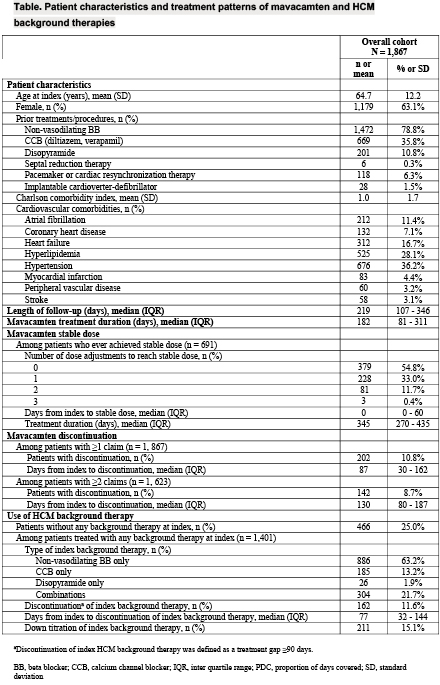
Results: A total of 1867 patients (mean ± SD age 64.7 ± 12.2 years, 63.1% female, median [interquartile range, IQR] follow-up 219 [107, 346] days) were included (Table). Among patients with ≥ 6 (n = 993), ≥ 9 (n = 640), and ≥12 (n = 394) months of treatment, 67.3%, 86.1%, and 93.7% reached stable dose, respectively. Among patients who reached stable dose (n = 691, median [IQR] treatment duration 345 [270, 435] days), 54.8% did not require any dose adjustment, and 33.0% required only one adjustment from treatment initiation. The most commonly used stable dose was 5 mg (49.6%), followed by 2.5 mg (25.0%), 10 mg (20.5%) and 15 mg (4.8%). The discontinuation rate for mavacamten was 10.8% and 8.7% among patients with ≥1 and ≥2 claims, respectively. Mean PDC for mavacamten was 93.7 ± 9.1%. Overall, 25% of patients did not have any claim for background therapy at index. For the remaining patients (n = 1401), 11.6% discontinued and 15.1% down titrated the index HCM background therapy.
Conclusions: The vast majority of patients treated with mavacamten reached stable dose with no or only one dose adjustment. Discontinuation rate was 8.7-10.8% and adherence to mavacamten was high. A substantial proportion of patients discontinued or down titrated HCM background therapy.
Masri, Ahmad
(
, Hypertrophic Cardiomyopathy Center, School of Medicine, Oregon Health & Science University
, Portland , Oregon , United States )
Maksabedian Hernandez, Ervant
(
Bristol Myers Squibb
, Princeton , New Jersey , United States )
Schuler, Patricia
(
Bristol Myers Squibb
, Princeton , New Jersey , United States )
Wang, Yan
(
Analysis Group
, Los Angeles , California , United States )
Gao, Weihua
(
Bristol Myers Squibb
, Princeton , New Jersey , United States )
Wu, Aozhou
(
Analysis Group
, Los Angeles , California , United States )
Han, Xu
(
Bristol Myers Squibb
, Princeton , New Jersey , United States )
Author Disclosures:
Ahmad Masri:DO have relevant financial relationships
;
Research Funding (PI or named investigator):Pfizer; Attralus; Cytokinetics:Active (exists now)
; Other (please indicate in the box next to the company name):Akros; Prothena; Tenaya (fees):Past (completed)
; Other (please indicate in the box next to the company name):Cytokinetics; BMS; BridgeBio; Pfizer; Ionis; Lexicon; Attralus; Alnylam; Haya; Alexion; BioMarin; AstraZeneca (fees):Active (exists now)
; Research Funding (PI or named investigator):Ionis:Past (completed)
| Ervant Maksabedian Hernandez:DO have relevant financial relationships
;
Employee:Bristol Myers Squibb:Active (exists now)
; Individual Stocks/Stock Options:Amgen:Active (exists now)
; Individual Stocks/Stock Options:Bristol Myers Squibb:Active (exists now)
; Employee:Amgen:Past (completed)
| Patricia Schuler:DO have relevant financial relationships
;
Employee:Bristol Myers Squibb:Active (exists now)
| Yan Wang:No Answer
| Weihua Gao:DO NOT have relevant financial relationships
| Aozhou Wu:DO have relevant financial relationships
;
Employee:Analysis Group:Active (exists now)
| Xu Han:DO NOT have relevant financial relationships