Trends and Disparities in Coronary Artery Disease Related Mortality Among Adults with Sepsis in the United States, 1999–2023
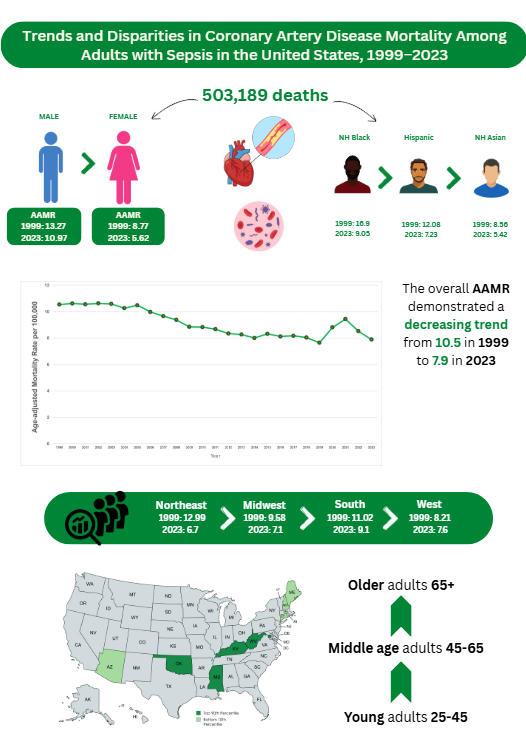
Abstract Body (Do not enter title and authors here): Background: Coronary artery disease and sepsis are common conditions, and both contribute significantly to mortality among adults in the United States. This study investigates trends and demographic disparities in mortality rates due to CAD in septic patients from 1999 to 2023. Methods: A retrospective analysis was conducted using CDC WONDER data to investigate the trends in mortality associated with CAD (ICD codes: I20-I25) in patients with sepsis (ICD A02.1, A20.7, A22.7, A26.7, A32.7, A42.7, A40–A41, B37.7) among adults aged ≥ 25 years. Joinpoint regression was used to calculate age-adjusted mortality rates (AAMR) per 100,000 individuals and corresponding annual percentage changes (APC) with 95% confidence intervals. Data were stratified by year, sex, race, age, region, and state. Results: From 1999 to 2023, CAD in septic individuals caused 503,189 deaths. The overall AAMR declined from 10.5 to 7.9 (AAPC: -1.2%, 95% CI: -2.0 to -0.4, p < 0.003). Men had higher AAMRs than women (men: 13.3; women: 8.8) in 1999 to (men: 11.0; women: 5.6) in 2023, with decline for both sexes (Men: AAPC: -1.2%, p < 0.006; Women: AAPC: -1.8%, p<0.001). AAMRs by race decreased from 1999 to 2023: NH Blacks (16.9 to 9.1), NH American Indians (9.2 to 9.3), Hispanics (12.1 to 7.2), NH Asians (8.6 to 5.4), NH Whites (9.9 to 8.0), with NH Blacks showing the largest decline (AAPC: -2.63%, p < 0.001). AAMRs remained stable in adults 25–44 (0.2 to 0.3) and declined modestly in ages 45–64 (3.7 to 3.1) but dropped significantly in those ≥65 (47.1 to 34.3; AAPC: -1.33%, p = 0.002). Regionally, AAMR declined in the Northeast (13.0 to 6.7), Midwest (9.6 to 7.1), South (11.0 to 9.1), and West (8.2 to 7.6), with the steepest decline in the Northeast (AAPC: -2.7%, p < 0.000001). State-level AAMRs ranged from 1.4 (Maine) to 14.4 (Kentucky) in 2023. Conclusion: This analysis reveals significant demographic and racial disparities in mortality due to CAD among adults with sepsis in the United States. Despite an overall decline in AAMR over the past two decades, the burden remains disproportionately high among older adults, men, and NH Black individuals, with striking regional variation. These findings underscore the urgent need for targeted, equity-focused interventions to address these disparities and improve coronary health outcomes in vulnerable septic populations.
Ahmed, Muhammad
(
Dow University of Health Sciences
, Karachi , Pakistan )
Sajid, Maryam
(
Dow University of Health Sciences
, Karachi , Pakistan )
Sajjad, Asim
(
Dow University of Health Sciences
, Karachi , Pakistan )
Salim, Hussain
(
Dow University of Health Sciences
, Karachi , Pakistan )
Qureshi, Shaheer
(
Dow University of Health Sciences
, Karachi , Pakistan )
Imran, Zahra
(
Dow University of Health Sciences
, Karachi , Pakistan )
Bilal, Abdur Rafay
(
Ziauddin Medical College
, Karachi , Pakistan )
Gaba, Hateem
(
Ziauddin Medical College
, Karachi , Pakistan )
Ahmad, Reja
(
Ziauddin Medical College
, Karachi , Pakistan )
Ahmed, Mannal
(
Aga Khan University
, Karachi , Pakistan )
Waqas, Saad Ahmed
(
Dow University of Health Sciences
, Karachi , Pakistan )
Author Disclosures:
Muhammad Ahmed:DO NOT have relevant financial relationships
| Mannal Ahmed:DO NOT have relevant financial relationships
| Saad Ahmed Waqas:DO NOT have relevant financial relationships
| Maryam Sajid:DO NOT have relevant financial relationships
| Asim Sajjad:DO NOT have relevant financial relationships
| Hussain Salim:DO NOT have relevant financial relationships
| Shaheer Qureshi:DO NOT have relevant financial relationships
| Zahra Imran:DO NOT have relevant financial relationships
| Abdur Rafay Bilal:DO NOT have relevant financial relationships
| Hateem Gaba:DO NOT have relevant financial relationships
| Reja Ahmad:DO NOT have relevant financial relationships