
A Case of Transient Cortical Blindness occurring during Percutaneous Transluminal Coronary Angiography for Acute Coronary Syndrome.
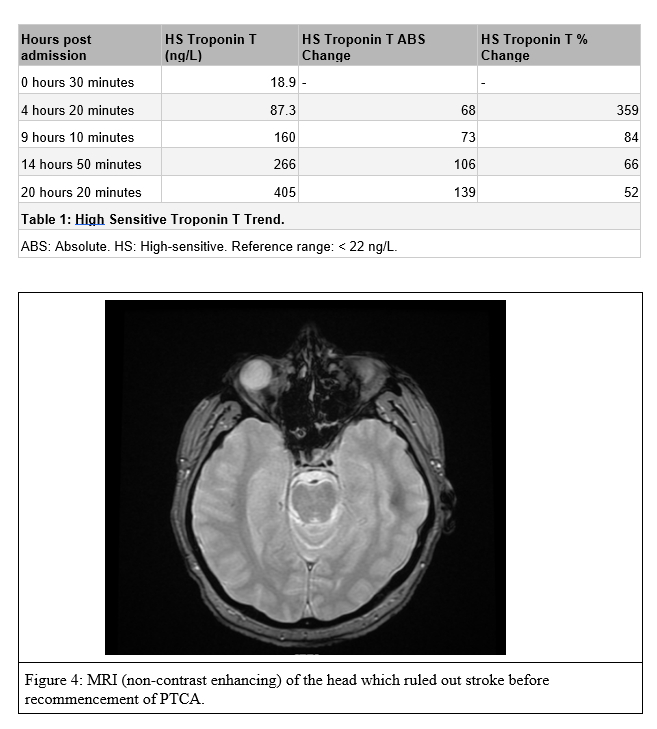
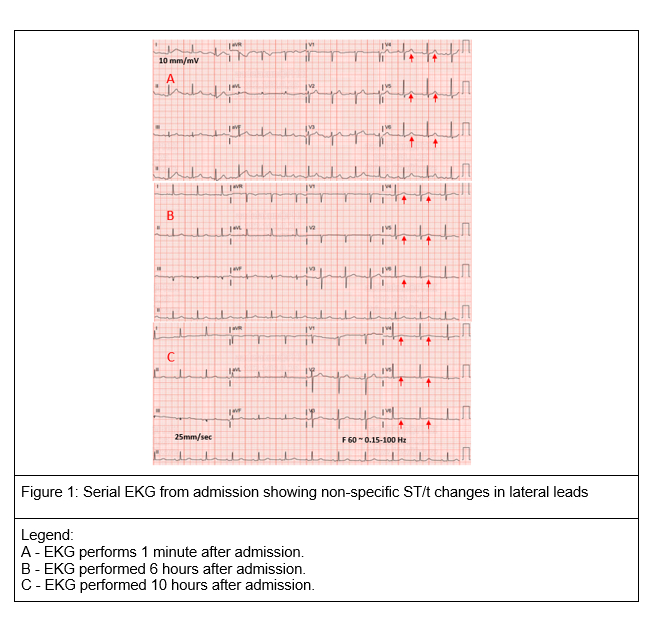
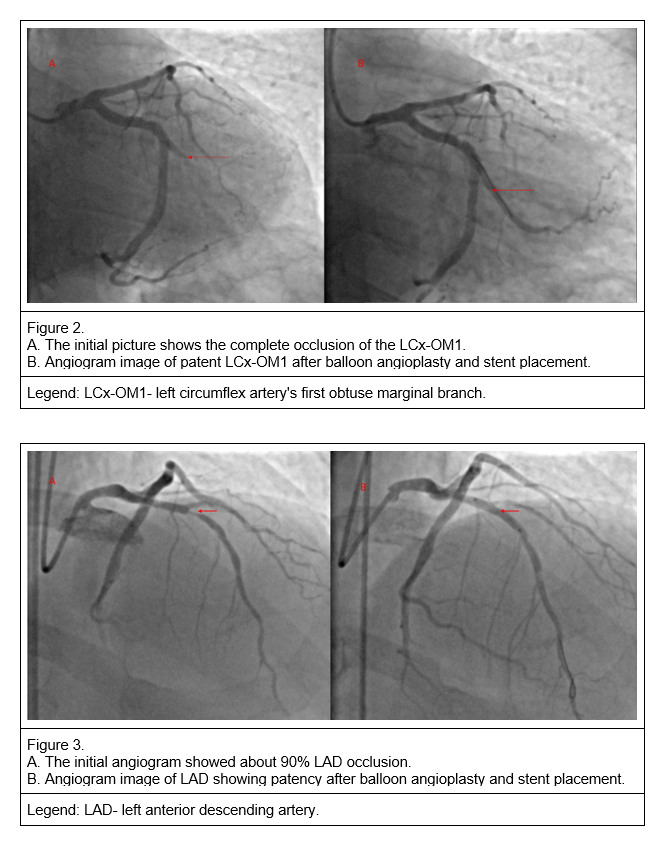
Abstract Body (Do not enter title and authors here): Description of case A 55 yo man with no PMHx presented with a few hours of intermittent left-sided chest tightness. Serial EKG revealed dynamic ST-T wave changes in lateral leads—Figure 1. His lipid panel was abnormal, and the High-Sensitive Troponin T trended up—table 1. Based on the hemoglobin A1C result of 10.6, he was newly diagnosed with DM. Coronary angiography shows two vessel diseases. The left circumflex artery's first obtuse marginal artery branch (LCX-OM1) received a stent in the first instance. During the planned PTCA for treatment of LAD 48 hours after, he developed sudden bilateral loss of vision while on the table just before stent deployment. In this case, with the emergence of the symptom of vision loss, PTCA was halted to allow the operator to rule out an acute cerebrovascular accident (CVA) through urgent CT head and MRI brain scans. He consented to complete the LAD PTCA the day after, which achieved the intended restenosis without complications.
Discussion Bilateral transient cortical blindness (TCB) is a reversible syndrome of vision loss affecting both eyes in the presence of normal visual pathways due to a brief disturbance in the occipital cortices. TCB is more commonly associated with cerebral angiography but has been rarely reported after coronary angiography. Angiographic contrast toxicity is one of the proposed pathophysiologic mechanisms. During our case, approximately 30 mL of iohexol was used before TCB, while about 120 mL of iodixanol was used for the repeat and conclusive procedure. We are not aware of a previous report in which PTCA was recommenced hours after being halted due to TCB in a patient suffering acute coronary syndrome. The absence of symptom recurrence when the PTCA was recommenced, which underscored the benign nature of TCB, enabled the patient to receive conclusive, definitive treatment for his acute coronary condition.
Adelakun, Adeniyi
( NYMC St Marys General Hospital
, Passaic
, New Jersey
, United States
)
Farouji, Iyad
( Saint Michaels Medical Center
, Newark
, New Jersey
, United States
)
Haddad, Ahmad
( Saint Michael's Medical Center.
, Newark
, New Jersey
, United States
)
Szwed, Stanley
( NYMC St Marys General Hospital
, Passaic
, New Jersey
, United States
)
Author Disclosures:
Adeniyi Adelakun:DO NOT have relevant financial relationships
| Iyad Farouji:DO NOT have relevant financial relationships
| ahmad haddad:DO NOT have relevant financial relationships
| Stanley Szwed:No Answer