
Logo

American Heart Association

  20
  0


Final ID: MP1500

Discordantly Elevated Small Dense LDL-C Increases Risk of Cardiovascular Events in Hypertensive Adults: Insights from SPRINT

Abstract Body (Do not enter title and authors here): Background: Small dense low-density lipoprotein cholesterol (sdLDL-C) is highly atherogenic, yet its role in predicting cardiovascular disease (CVD) among individuals with hypertension is not well characterized.
Objective: To examine the association of sdLDL-C, its discordance with low-density lipoprotein cholesterol (LDL-C) and CVD risk in adults with hypertension.
Methods: In this analysis of the Systolic Blood Pressure Intervention Trial (SPRINT), baseline sdLDL-C was estimated using Sampson’s method, calculated by subtracting large buoyant LDL-C (estimated from LDL-C and ln[triglycerides]) from total LDL-C. Participants were stratified by cohort percentiles of sdLDL-C and LDL-C. Discordance was defined as a ≥10 percentile point difference between sdLDL-C and LDL-C. Participants were categorized as discordantly high (sdLDL-C ≥10 points higher), discordantly low (sdLDL-C ≥10 points lower), or concordant. Multivariable Cox regression estimated hazard ratios (HRs) and 95% confidence intervals (CIs) for associations with the primary composite outcome: myocardial infarction, stroke, acute coronary syndrome, acute heart failure, and CVD death. Analyses were repeated using clinical cutoffs: LDL-C ≥130 mg/dL and an aligned sdLDL-C threshold of 40.1 mg/dL based on cohort percentiles.
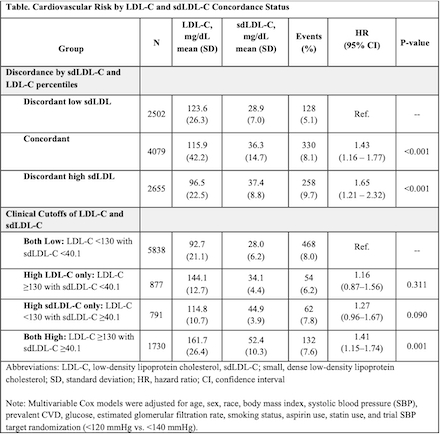
Results: Among 9,236 participants (mean age 67 years), 716 primary outcome events (7.8%) occurred over a median follow-up of 3.8 years. Each 1-SD increase in log-transformed sdLDL-C was independently associated with higher CVD risk (HR = 1.17; 95% CI: 1.08–1.26). Compared to the discordantly low group, concordant and discordantly high groups had 43% (HR = 1.43; 95% CI: 1.16–1.77) and 65% (HR = 1.65; 95% CI: 1.21–2.32) greater risk, respectively. Using clinical cutoffs, high sdLDL-C alone was associated with a 27% increased risk (HR = 1.27; 95% CI: 0.96–1.67), while those with both elevated LDL-C and sdLDL-C had a 41% higher risk (HR = 1.41; 95% CI: 1.15–1.74) compared to participants with both markers below threshold(Table).
Conclusion: In adults with hypertension, elevated sdLDL-C was associated with increased CVD risk. Discordantly high sdLDL-C conferred the highest risk. Using a clinical LDL-C threshold of 130 mg/dL, the greatest risk was seen in individuals with both high LDL-C and sdLDL-C, while those with low LDL-C but high sdLDL-C had a suggestive increase in risk. These findings highlight the potential role of sdLDL-C in identifying residual CVD risk not captured by LDL-C alone.
  • Sandesara, Uttsav  ( Wake Forest University , Winston Salem , North Carolina , United States )
  • Kazibwe, Richard  ( Wake Forest University , Winston Salem , North Carolina , United States )
  • Mirzai, Saeid  ( Wake Forest University , Winston Salem , North Carolina , United States )
  • Rikhi, Rishi  ( Wake Forest University , Winston Salem , North Carolina , United States )
  • Chevli, Parag  ( Wake Forest University , Winston Salem , North Carolina , United States )
  • Soliman, Elsayed  ( Wake Forest University , Winston Salem , North Carolina , United States )
  • Shapiro, Michael  ( Wake Forest University , Winston Salem , North Carolina , United States )
  • Author Disclosures:
    Uttsav Sandesara: DO NOT have relevant financial relationships | Richard Kazibwe: DO NOT have relevant financial relationships | Saeid Mirzai: DO NOT have relevant financial relationships | Rishi Rikhi: No Answer | Parag Chevli: DO NOT have relevant financial relationships | Elsayed Soliman: DO NOT have relevant financial relationships | Michael Shapiro: DO have relevant financial relationships ; Consultant:Ionis:Past (completed) ; Consultant:Arrowhead:Past (completed) ; Consultant:Regeneron:Past (completed) ; Researcher:New Amsterdam:Active (exists now) ; Researcher:Merck:Active (exists now) ; Researcher:Novartis:Active (exists now) ; Researcher:Esperion:Active (exists now) ; Researcher:Cleerly:Active (exists now) ; Researcher:Amgen:Active (exists now) ; Consultant:Novo Nordisk:Active (exists now) ; Consultant:Tourmaline:Active (exists now) ; Consultant:Merck:Active (exists now) ; Consultant:New Amsterdam:Past (completed) ; Consultant:Novartis:Active (exists now)
Meeting Info:

Scientific Sessions 2025

2025

New Orleans, Louisiana

Session Info:

Cholesterol Chronicles: Lipid Markers and Cardiovascular Disease

Sunday, 11/09/2025 , 11:50AM - 01:05PM

Moderated Digital Poster Session

More abstracts on this topic:
More abstracts from these authors:
Intensive Systolic Blood Pressure Lowering Reduces Cardiovascular Events in Hypertensive Adults Regardless of Metabolic Health Status: Insights from SPRINT

Sandesara Uttsav, Kazibwe Richard, Mirzai Saeid, Rikhi Rishi, Chevli Parag, Soliman Elsayed, Shapiro Michael

Association Between Creatinine-to-Cystatin C Ratio, Subclinical Myocardial Injury, and Mortality: National Health and Nutrition Examination Survey

Mirzai Saeid, Patel Vraj, Sandesara Uttsav, Chevli Parag, Mostafa Mohamed, Kazibwe Richard, Soliman Elsayed

You have to be authorized to contact abstract author. Please, Login
Not Available