A Community Health Worker-led Nutrition-Enhanced Hypertension Management Intervention: Randomized Pilot Feasibility Trial
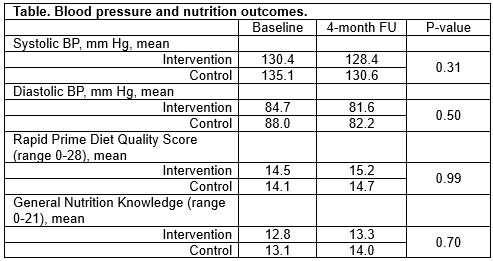
Abstract Body: Background: Diet modification is an AHA/ACC Class 1 recommendation for hypertension management. Few clinical dietary interventions for hypertension exist, particularly in low-income settings. Community health workers (CHWs) could fill this gap. This pilot trial assessed the feasibility and acceptability of a nutrition-enhanced CHW intervention embedded within an existing hypertension management program. Methods: Health center patients who enrolled in a CHW hypertension (Basic) program at a Boston, MA health system were eligible for this randomized pilot study if they were ≥21 years old and spoke English or Spanish. The Basic program included home blood pressure (BP) monitoring, hypertension education, and CHW communication with PCP about uncontrolled BP. Participants were randomized to the Basic program (Control) or the nutrition-enhanced Basic program, which included 4 modules on label reading, simplified nutrition guidance (e.g., traffic light categories, green=healthy), healthy eating on a budget, and meal planning, and accompanying worksheets/activities. Participants were followed for 4 months. Participants completed surveys at baseline and 4 months; BP measures were obtained from the electronic health record. Primary outcomes were feasibility and acceptability. Secondary outcomes, assessed with mixed models, compared intervention vs. control groups in 4-month changes in BP, diet quality (rapid Prime Diet Quality Score), and nutrition knowledge (General Nutrition Knowledge). Results: Of 108 adults potentially eligible, 60 (56%) enrolled in the study. Study participants were mostly female (66%) and Hispanic (68%) and had mean age of 57.7 (sd=12.6) years. At baseline, 90% were taking BP medications daily, and 38% had food insecurity. In the intervention group (N=31), 74% completed ≥3 of 4 nutrition modules, 81% completed ≥3 of 6 worksheets/activities, and 100% completed the home food/cooking assessment. All intervention components were acceptable (rated ≥7.5 of 10 points). At follow-up, systolic and diastolic BP decreased, and diet quality and nutrition knowledge increased in both groups; however, there were no between-group differences (Table). Conclusion: A CHW nutrition education and support intervention within a hypertension management program was feasible and acceptable but did not demonstrate short-term differences in diet or health. A larger trial with longer follow-up is needed to assess intervention effectiveness.
Cheng, Jessica
(
Mass Gen Hospital, Harvard SPH
, Boston , Massachusetts , United States )
Gelsomin, Emily
(
MGH Outpatient Nutrition
, Boston , Massachusetts , United States )
Gu, Kristine
(
MASSACHUSETTS GENERAL HOSPITAL
, Boston , Massachusetts , United States )
Bejarano, Oldy
(
MASSACHUSETTS GENERAL HOSPITAL
, Boston , Massachusetts , United States )
Mcgovern, Sydney
(
MASSACHUSETTS GENERAL HOSPITAL
, Boston , Massachusetts , United States )
Thorndike, Anne
(
MASSACHUSETTS GENERAL HOSPITAL
, Boston , Massachusetts , United States )