A Machine Learning-Derived Socio-Environmental Risk Score More Accurately Predicts Cardiovascular Events and Better Addresses Health Inequities than Social Deprivation Index
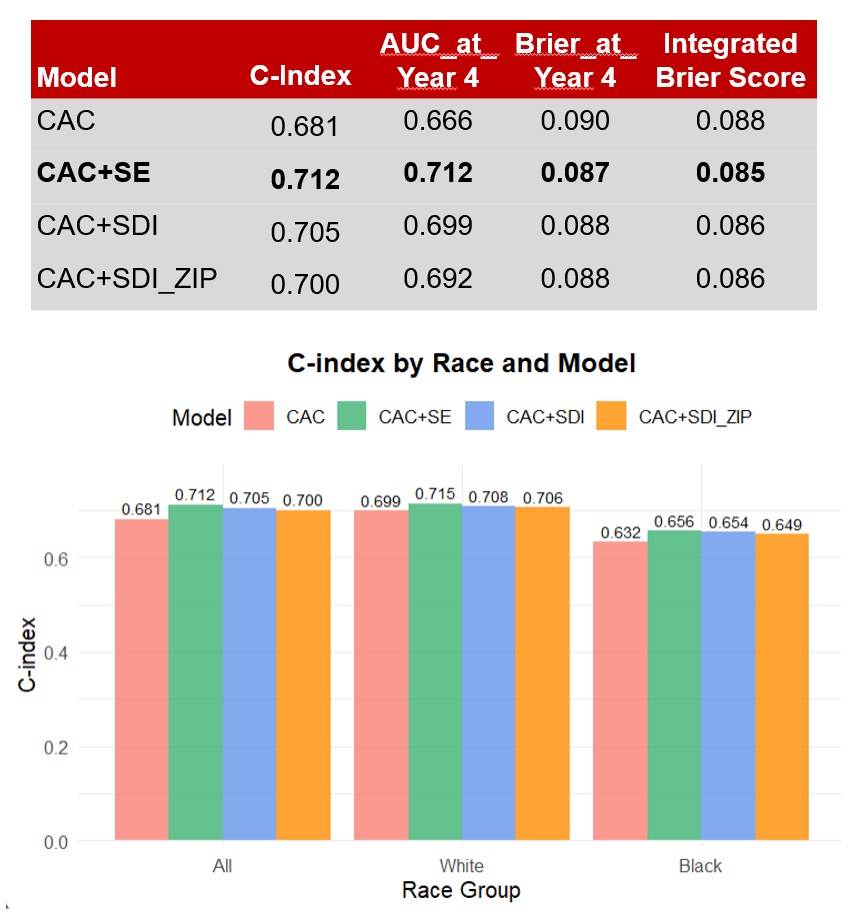
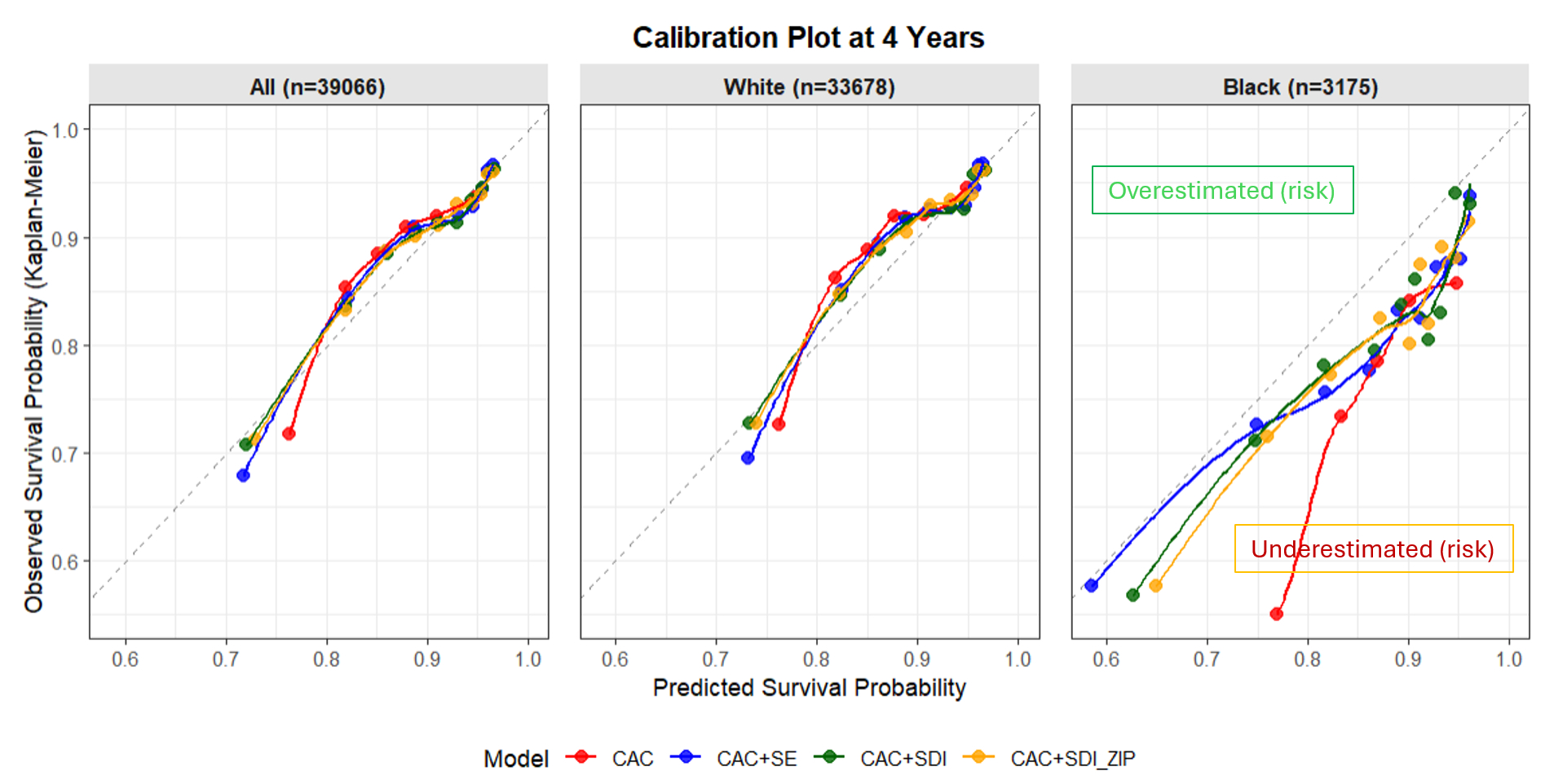
Abstract Body (Do not enter title and authors here): Introduction The American Heart Association’s PREVENT equation now includes zip-code level Social Deprivation Index (SDI), highlighting the growing role of socio-environmental (SE) factors in risk prediction. However, concerns remain about fully capturing the breadth of exposures, particularly those prevalent in disadvantaged populations, within existing tools. This study sought to develop and evaluate a novel SE Risk Score using machine learning, and to compare its utility against SDI in the context of Coronary Artery Calcium (CAC) screening. Research Questions Whether a novel machine learning-derived SE Risk Score incorporating more than 150 area level environmental pollution, social and economic variables, when added to CAC scores, improves Major Adverse Cardiovascular Events (MACE) prediction than SDI, in Blacks. Methods We analyzed CAC scores, MACE outcomes, demographics, and census-tract SE variables from the CLARIFY registry (NCT04075162), a large prospective study of no-charge CAC testing (84,233 White and 7,940 Black participants). A SE Score was derived using an XGBoost machine learning model. This SE Score was then compared to zip-code level SDI. Analyses included Cox proportional hazards models, mediation analysis, and model performance evaluation (Harrell’s C-index, area under the curve (AUC), calibration metrics, Net Reclassification Improvement [NRI]) for models including CAC alone, CAC+SE Risk Score, and CAC+SDI. Results Compared to Whites, Black participants had higher MACE (14.0% vs 6.4%), despite lower mean CAC (151.5 vs 175.5). Adding SE Score to CAC improved C-index from 0.681 to 0.712, while adding census-tract SDI yielded 0.705 and zip-code SDI 0.700 respectively. For Blacks, the AUC at Year 4 improved from 0.642 (CAC alone) to 0.669 (CAC+SE Risk Score), surpassing the 0.672 achieved with CAC+census-tract SDI (Figures 1 and 2). The improvement in risk reclassification was more pronounced for Black individuals (Net Reclassification Improvement: 0.153) than for White individuals (0.081). SE factors mediated 47.12% of the relationship between race and MACE. Conclusion The machine learning–derived SE Score outperformed SDI in predicting MACE, improving both discrimination and calibration. SE factors mediated the race–MACE link, and their inclusion with CAC scores significantly enhanced risk reclassification, particularly in Black individuals. More refined tools are needed to better assess and address risk in socially disadvantaged populations.
Chen, Zhuo
(
Case Western Reserve University
, Cleveland , Ohio , United States )
Ponnana, Sai Rahul
(
Case Western Reserve University
, Cleveland , Ohio , United States )
Dazard, Jean-eudes
(
Case Western Reserve University
, Cleveland , Ohio , United States )
Zhang, Tong
(
Case Western Reserve University
, Cleveland , Ohio , United States )
Dong, Weichuan
(
Houston Methodist
, Houston , Texas , United States )
Okyere, Robert
(
University Hospitals
, Cleveland , Ohio , United States )
Sirasapalli, Santosh
(
University Hospitals
, Cleveland , Ohio , United States )
Deo, Salil
(
Case Western Reserve University
, Cleveland , Ohio , United States )
Khraishah, Haitham
(
University Hospitals
, Cleveland , Ohio , United States )
Nasir, Khurram
(
Houston Methodist
, Houston , Texas , United States )
Al-kindi, Sadeer
(
Houston Methodist
, Houston , Texas , United States )
Rajagopalan, Sanjay
(
UNIV HOSP CLEVELAND MEDICAL CTR
, Cleveland , Ohio , United States )
Author Disclosures:
Zhuo Chen:DO NOT have relevant financial relationships
| Khurram Nasir:No Answer
| Sadeer Al-Kindi:No Answer
| Sanjay Rajagopalan:DO NOT have relevant financial relationships
| Sai Rahul Ponnana:DO NOT have relevant financial relationships
| Jean-Eudes Dazard:DO NOT have relevant financial relationships
| Tong Zhang:DO NOT have relevant financial relationships
| Weichuan Dong:DO NOT have relevant financial relationships
| Robert Okyere:DO NOT have relevant financial relationships
| Santosh Sirasapalli:No Answer
| Salil Deo:DO NOT have relevant financial relationships
| HAITHAM KHRAISHAH:No Answer