
Logo

American Heart Association

  20
  0


Final ID: MP96

Intensive Systolic Blood Pressure Lowering Reduces Cardiovascular Events in Hypertensive Adults Regardless of Metabolic Health Status: Insights from SPRINT

Abstract Body (Do not enter title and authors here): Background: Hypertension often coexists with metabolic abnormalities that increase cardiovascular disease (CVD) risk. While intensive systolic blood pressure (SBP) lowering reduces cardiovascular events, it is unclear whether this benefit varies by metabolic health status in primary prevention.
Objective: To examine whether metabolic health modifies the effect of standard (<140 mmHg) versus intensive (<120 mmHg) SBP lowering on CVD risk in adults in the Systolic Blood Pressure Intervention Trial (SPRINT).
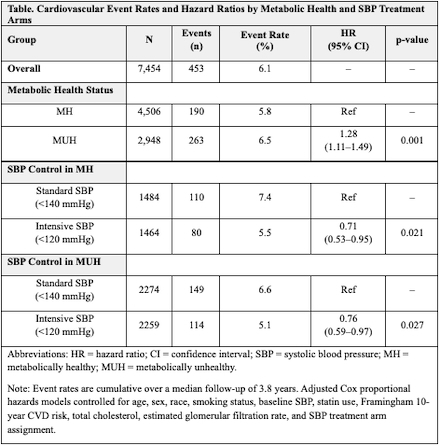
Methods: We included 7,454 SPRINT participants without baseline CVD and with complete metabolic health and outcome data. Metabolic health was defined using modified metabolic syndrome criteria: triglycerides ≥150 mg/dL, high-density lipoprotein cholesterol <40 mg/dL (men) or <50 mg/dL (women), glucose ≥100 mg/dL, and body mass index ≥30 kg/m2 (used in place of waist circumference due to data availability). Individuals with ≤1 abnormality were classified as metabolically healthy (MH) and those with ≥2 as metabolically unhealthy (MUH). The primary outcome was a composite of myocardial infarction, acute coronary syndrome, stroke, heart failure, or CVD death. Cox proportional hazards models were adjusted for covariates listed in the Table.
Results: Of 7,454 participants (mean age 67 years, 37.6% female), 2,948 (39.6%) were classified as MUH. Treatment arms were balanced within MH and MUH groups. Over a median follow-up of 3.8 years, 453 CVD events occurred, with a higher event rate in the MUH group compared to the MH group (6.5% vs. 5.8%). MUH group had a higher risk of CVD (HR 1.28; 95% CI 1.11–1.49; p=0.001) compared to the MH group. Intensive SBP lowering reduced CVD risk by 29% in MH (HR 0.71; 95% CI 0.53–0.95; ARR 1.9%; NNT ≈53) and by 24% in MUH (HR 0.76; 95% CI 0.59–0.97; ARR 1.5%; NNT ≈67) (Table). Multiplicative interaction term assessing effect modification between SBP treatment arm and metabolic health was not statistically significant (p=0.77).
Conclusions: In hypertensive adults without diabetes, unfavorable metabolic health was associated with a higher risk of incident CVD events. While absolute risk was greater in MUH individuals, both MH and MUH groups experienced significant relative risk reductions with intensive SBP lowering. Despite no significant interaction, intensive SBP lowering was associated with reduced CVD risk in both groups. These findings support intensive SBP treatment to reduce CVD risk regardless of metabolic health status.
  • Sandesara, Uttsav  ( Wake Forest University , Winston Salem , North Carolina , United States )
  • Kazibwe, Richard  ( Wake Forest University , Winston Salem , North Carolina , United States )
  • Mirzai, Saeid  ( Wake Forest University , Winston Salem , North Carolina , United States )
  • Rikhi, Rishi  ( Wake Forest University , Winston Salem , North Carolina , United States )
  • Chevli, Parag  ( Wake Forest University , Winston Salem , North Carolina , United States )
  • Soliman, Elsayed  ( Wake Forest University , Winston Salem , North Carolina , United States )
  • Shapiro, Michael  ( Wake Forest University , Winston Salem , North Carolina , United States )
  • Author Disclosures:
    Uttsav Sandesara: DO NOT have relevant financial relationships | Richard Kazibwe: DO NOT have relevant financial relationships | Saeid Mirzai: DO NOT have relevant financial relationships | Rishi Rikhi: No Answer | Parag Chevli: DO NOT have relevant financial relationships | Elsayed Soliman: DO NOT have relevant financial relationships | Michael Shapiro: DO have relevant financial relationships ; Consultant:Ionis:Past (completed) ; Consultant:Arrowhead:Past (completed) ; Consultant:Regeneron:Past (completed) ; Researcher:New Amsterdam:Active (exists now) ; Researcher:Merck:Active (exists now) ; Researcher:Novartis:Active (exists now) ; Researcher:Esperion:Active (exists now) ; Researcher:Cleerly:Active (exists now) ; Researcher:Amgen:Active (exists now) ; Consultant:Novo Nordisk:Active (exists now) ; Consultant:Tourmaline:Active (exists now) ; Consultant:Merck:Active (exists now) ; Consultant:New Amsterdam:Past (completed) ; Consultant:Novartis:Active (exists now)
Meeting Info:

Scientific Sessions 2025

2025

New Orleans, Louisiana

Session Info:

Intersections of Comorbidities with Hypertension Treatment

Saturday, 11/08/2025 , 10:45AM - 12:00PM

Moderated Digital Poster Session

More abstracts on this topic:
Absence of standard modifiable risk factors (SMuRF-less) among 5002 Middle Eastern patients with atherosclerotic cardiovascular disease: (Interim analysis from the Jo-SMuRF Study)

Aldalal'ah Mo'men, Hammoudeh Ayman, Hamza Ibrahem, Alqudah Mohammad, Khasawneh Hasan, Alomari Sawsan, Alomari Ahmad, H. Assaf Sarah, Zaqqa Ayah, Khatatbeh Moawiah

A Blood(y) Pressure Crisis: Diffuse Alveolar Hemorrhage as a Rare Manifestation of Severely Uncontrolled Hypertension

Nandyal Shreyas, Amdetsion Gedion Yilma, Varma Revati, Kohli Saksham, Hammo Hasan

More abstracts from these authors:
Discordantly Elevated Small Dense LDL-C Increases Risk of Cardiovascular Events in Hypertensive Adults: Insights from SPRINT

Sandesara Uttsav, Kazibwe Richard, Mirzai Saeid, Rikhi Rishi, Chevli Parag, Soliman Elsayed, Shapiro Michael

Additive Value of Lipoprotein(a), Remnant Cholesterol, and Inflammation for Risk Stratification of Myocardial Infarction: Evidence from the UK Biobank

Kazibwe Richard, Schaich Christopher, Kingsley Jeffrey, Rikhi Rishi, Namutebi Juliana, Chevli Parag, Mirzai Saeid, Shapiro Michael

You have to be authorized to contact abstract author. Please, Login
Not Available