
Logo

American Heart Association

  20
  0


Final ID: MP2774

The inhibition of ATP citrate lyase prevents pathological cardiac fibrosis via the regulation of de novo lipogenesis and histone acetylation

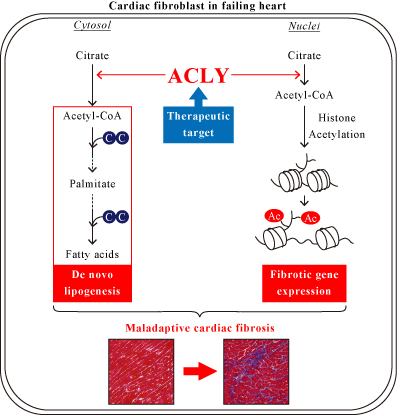
Abstract Body (Do not enter title and authors here): Background: Cardiac fibrosis is characterized by excessive extracellular matrix deposition in heart tissue that occurs early in heart failure (HF) and is caused not only by cardiac diseases such as ischemic heart disease and valvular diseases but also by lifestyle diseases such as hypertension and diabetes. Therefore, the inhibition of cardiac fibrosis has been considered an important therapeutic approach for treating HF. ATP citrate lyase (ACLY) is a key metabolic enzyme that converts mitochondria-derived citrate into acetyl-CoA. ACLY is essential for de novo lipogenesis (DNL) and histone acetylation, needs for cellular growth and organ fibrosis. Although fatty acids are required for energy production and biomass synthesis in the heart, the biological roles and regulatory mechanisms of ACLY-mediated DNL in pathological cardiac fibrosis remain largely unknown.
Hypothesis: The inhibition of ACLY reduces pathological cardiac fibrosis by suppress DNL and histone acetylation.
Methods: Adeno-associated virus serotype 9 (AAV9)-mediated shRNA targeting Acly was intravenously injected into C57BL/6J male mice from the retro-orbital sinus. The mice were subsequently continuously infused with a mixture of angiotensin II (AngII) and phenylephrine (PE) for two weeks. Cardiac phenotypes were evaluated via histological staining. Cell migration assays, stable isotope tracing with 13C-labeled glucose, and chromatin immunoprecipitation (ChIP) assays were performed using human cardiac fibroblasts (HCFs).
Results: ACLY expression was upregulated in the heart sections of mice treated with AngII/PE, especially in fibrotic areas. Masson’s trichrome staining and immunoblots revealed that gene silencing of Acly significantly reduced cardiac fibrosis and the expression of fibrous proteins in these mice. And gene silencing of Acly improves prognosis. SiRNA-mediated ACLY knockdown suppressed the proliferation and expression of fibrous proteins in cultured HCFs stimulated with transforming growth factor-β (TGF-β). Mechanistically, ACLY inhibition reduced DNL, limiting the fatty acid supply essential for cellular growth and proliferation; it also decreased H3K9 and H3K27 acetylation, in addition to the presence of acetylated H3K9 and H3K27 at the promoter regions of fibrotic genes.
Conclusion: Our findings demonstrated that ACLY plays pivotal roles in promoting pathological cardiac fibrosis. Targeting ACLY may emerge as a novel therapeutic strategy to prevent the progression of HF.
  • Kuwahara, Naoya  ( Kobe University , Kobe , Japan )
  • Nagao, Manabu  ( Kobe University , Kobe , Japan )
  • Shinohara, Masakazu  ( Division of Epidemiology , Kobe-city , Japan )
  • Kaneshiro, Kenta  ( Kobe University , Kobe , Japan )
  • Ishida, Tatsuro  ( KOBE UNIVERSITY , Kobe , Japan )
  • Otake, Hiromasa  ( Kobe University , Kobe , Japan )
  • Author Disclosures:
    Naoya Kuwahara: DO NOT have relevant financial relationships | Manabu Nagao: DO NOT have relevant financial relationships | Masakazu Shinohara: DO NOT have relevant financial relationships | Kenta Kaneshiro: DO NOT have relevant financial relationships | Tatsuro Ishida: No Answer | Hiromasa Otake: DO NOT have relevant financial relationships
Meeting Info:

Scientific Sessions 2025

2025

New Orleans, Louisiana

Session Info:

Metabolic Underworld: Mitochondria, Fibrosis, and Cardiac Stress

Monday, 11/10/2025 , 09:15AM - 10:30AM

Moderated Digital Poster Session

More abstracts on this topic:
More abstracts from these authors:
SVEP1 as a novel biomarker for cardiac fibrosis: Association with CT-derived extracellular volume and functional role in cardiac fibrosis

Kuwahara Naoya, Nagao Manabu, Izawa Yu, Kaneshiro Kenta, Hashimura Hiromi, Shinohara Masakazu, Ishida Tatsuro, Otake Hiromasa

Cardiac Branched-Chain Amino Acid Metabolic Dysfunction in a Novel Model of Diabetic Cardiomyopathy

Nagao Manabu, Asakura Junko, Hosooka Tetsuya, Kuwahara Naoya, Kaneshiro Kenta, Tanaka Hidekazu, Ishida Tatsuro, Otake Hiromasa, Shinohara Masakazu

You have to be authorized to contact abstract author. Please, Login
Not Available