SVEP1 as a novel biomarker for cardiac fibrosis: Association with CT-derived extracellular volume and functional role in cardiac fibrosis
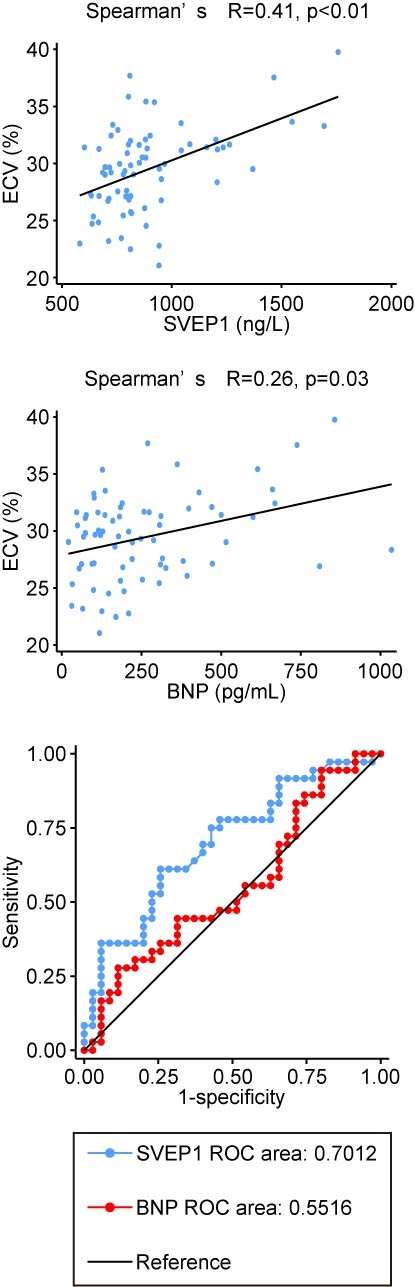
Abstract Body (Do not enter title and authors here): Background: Cardiac fibrosis is a key pathological form of ventricular remodeling that occurs early in heart failure. Myocardial extracellular volume fraction (ECV), measured by cardiac computed tomography (CT), can assess this fibrosis. However, there are few specific biomarkers for cardiac fibrosis. SVEP1 (Sushi, von Willebrand factor type A, EGF, and pentraxin domain containing 1) has been implicated in cancer-associated fibroblast activity, but its role in cardiac fibrosis is unclear. Hypothesis: We hypothesized that circulating levels of SVEP1 are positively associated with myocardial ECV measured by cardiac CT, reflecting its potential role as a novel biomarker for cardiac fibrosis. Methods: We retrospectively enrolled 72 consecutive patients (age: 83.7±4.1 years; 45% women) with chronic heart failure due to severe aortic stenosis who underwent preprocedural CT for transcatheter aortic valve replacement planning. ECV was measured using iodine density images obtained by delayed enhancement dual-energy CT, and patients were stratified into high and low ECV groups based on the median ECV value. SVEP1 levels were measured and compared with brain natriuretic peptide (BNP), echocardiographic parameters, and ECV. Multivariable linear regression was used to assess the independent association of SVEP1 with ECV. We also conducted in vitro experiments using human cardiac fibroblasts to explore SVEP1 expression and function. Results: SVEP1 showed a significant positive correlation with ECV (R=0.41, p<0.01), which was stronger than that of BNP (R=0.26, p=0.03). Receiver operating characteristic (ROC) analysis demonstrated that SVEP1 had superior diagnostic performance compared to BNP (AUC: 0.71, 95% CI: 0.59–0.83 vs. AUC: 0.68, 95% CI: 0.42–0.69; p=0.06). In a multivariable linear regression analysis, SVEP1 levels were significantly associated with ECV after adjusting for age, sex, hypertension, atrial fibrillation, and chronic kidney disease. Higher SVEP1 was independently correlated with increased ECV (β=0.0079, p<0.001). In vitro experiments showed that SVEP1 expression was upregulated in activated human cardiac fibroblasts, and its inhibition suppressed fibroblast activation including cell proliferation. Conclusions: SVEP1 is significantly associated with cardiac fibrosis and may serve as a novel and specific biomarker. Its functional role in fibroblast activation highlights its potential not only as a biomarker but also as a therapeutic target in heart failure.
Kuwahara, Naoya
(
Kobe University
, Kobe , Japan )
Nagao, Manabu
(
Kobe University
, Kobe , Japan )
Izawa, Yu
(
Kobe University
, Kobe , Japan )
Kaneshiro, Kenta
(
Kobe University
, Kobe , Japan )
Hashimura, Hiromi
(
Kobe University
, Kobe , Japan )
Shinohara, Masakazu
(
Division of Epidemiology
, Kobe-city , Japan )
Ishida, Tatsuro
(
KOBE UNIVERSITY
, Kobe , Japan )
Otake, Hiromasa
(
Kobe University
, Kobe , Japan )
Author Disclosures:
Naoya Kuwahara:DO NOT have relevant financial relationships
| Manabu Nagao:DO NOT have relevant financial relationships
| Yu Izawa:DO NOT have relevant financial relationships
| Kenta Kaneshiro:DO NOT have relevant financial relationships
| Hiromi HASHIMURA:DO NOT have relevant financial relationships
| Masakazu Shinohara:DO NOT have relevant financial relationships
| Tatsuro Ishida:No Answer
| Hiromasa Otake:DO NOT have relevant financial relationships