
Logo

American Heart Association

  23
  0


Final ID: MP2697

Coronary Microvascular Disease Modulates Long-Term Outcomes in Myocardial Infarction with Non-Obstructive Coronary Arteries

Abstract Body (Do not enter title and authors here): Background: Coronary microvascular dysfunction (CMD) is a common cause of angina with non-obstructive coronary arteries (ANOCA), but its role in patients with a history of myocardial infarction with non-obstructive coronary arteries (MINOCA) is much less understood. We investigated the incidence of major adverse cardiac and cerebrovascular events (MACCE) in patients undergoing invasive assessment for CMD, divided into patients with MINOCA versus patients with ANOCA. We hypothesized that CMD would be common in both groups.

Methods: Serial patients undergoing invasive coronary provocation testing between 2012 and 2022 were divided into MINOCA (n=76) or ANOCA (n=561). Doppler study was performed in the left anterior descending artery. CMD was defined as either coronary flow reserve (CFR) <2.5 with adenosine or <50% increase in flow with acetylcholine. Patients were followed prospectively through 2025. Incidence of MACCE (cardiac death, non-fatal MI, hospitalization for heart failure, urgent revascularization, and stroke) was compared between MINOCA and ANOCA and further analyzed by CMD status. Kaplan-Meier curves were constructed and Cox proportional hazards models were used to estimate hazard ratios (HRs).

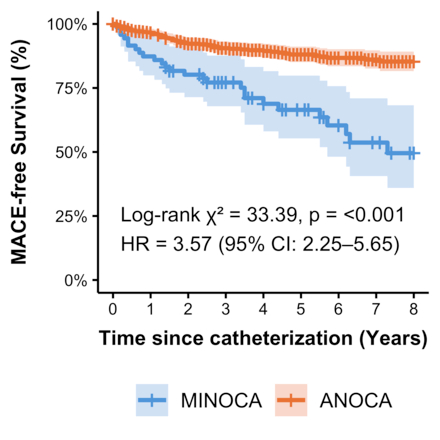
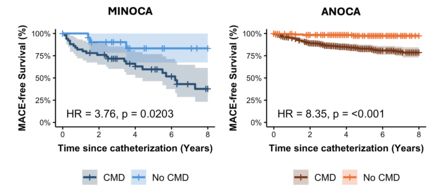
Results: Among patients with MINOCA, 53 of 76 (70%) had CMD, compared to 363 of 561 (65%) with ANOCA. Invasive provocation testing was performed a median of 163 days (IQR 13 – 255 days) after the MI in the MINOCA group. Patients were then followed for a median of 4.4 years (IQR 3.0 – 6.9 years). MACCE-free survival was significantly lower in patients with MINOCA compared to those with ANOCA (HR = 3.57, p < 0.001; Figure 1). The major contributor to MACCE was non-fatal MI in MINOCA (24%) and heart failure hospitalization in ANOCA (6%). The presence of CMD was associated with worse prognosis in both MINOCA (HR = 3.76, p = 0.02) and ANOCA (HR = 8.35, p < 0.001; Figure 2).

Conclusions: Patients with MINOCA experience significantly higher long-term risk of major adverse events compared to those with ANOCA. CMD is common in both groups and is independently associated with worse outcomes. Specifically, patients with CMD had higher rates of MACCE over time, regardless of whether they presented with MINOCA or ANOCA. Invasive assessment of CMD in patients with myocardial infarction and non-obstructive coronary arteries may improve risk stratification and inform management strategies in these understudied populations
  • Carrington, Justin  ( Mayo Clinic , Rochester , Minnesota , United States )
  • Nogami, Kai  ( Mayo Clinic , Rochester , Minnesota , United States )
  • Prasad, Abhiram  ( Mayo Clinic , Rochester , Minnesota , United States )
  • Gulati, Rajiv  ( MAYO CLINIC , Rochester , Minnesota , United States )
  • Lerman, Amir  ( Mayo Clinic , Rochester , Minnesota , United States )
  • Raphael, Claire  ( Mayo Clinic , Rochester , Minnesota , United States )
  • Author Disclosures:
    Justin Carrington: DO NOT have relevant financial relationships | Kai Nogami: No Answer | Abhiram Prasad: DO NOT have relevant financial relationships | Rajiv Gulati: DO NOT have relevant financial relationships | Amir Lerman: DO NOT have relevant financial relationships | Claire Raphael: No Answer
Meeting Info:

Scientific Sessions 2025

2025

New Orleans, Louisiana

Session Info:

Microvascular & Non-Obstructive Coronary Disease: Mechanisms to Management

Monday, 11/10/2025 , 01:45PM - 02:45PM

Moderated Digital Poster Session

More abstracts from these authors:
Comparison of Intra-coronary and Intra-aortic Pressure Recordings for Coronary Wave Intensity Analysis

Carrington Justin, Prasad Abhiram, Gulati Rajiv, Lerman Amir, Raphael Claire

Diastolic Dysfunction in Coronary Microvascular Disease is Linked to Impaired Diastolic Wave Intensity

Carrington Justin, Prasad Abhiram, Gulati Rajiv, Lerman Amir, Raphael Claire

You have to be authorized to contact abstract author. Please, Login
Not Available