
Logo

American Heart Association

  24
  0


Final ID: Su3102

Comparison of Intra-coronary and Intra-aortic Pressure Recordings for Coronary Wave Intensity Analysis

Abstract Body (Do not enter title and authors here): Background: Coronary wave intensity analysis (WIA) provides a mechanistic view of coronary hemodynamics and has been increasingly used to phenotype coronary microvascular disease (CMD). Standard WIA requires simultaneous pressure and flow measurements within the same vessel, but intra-coronary pressure measurement may be limited by hardware availability. In patients with non-obstructive coronary arteries, aortic pressure may serve as a surrogate for intra-coronary pressure to enable broader feasibility of WIA. We aimed to determine whether wave profiles derived from intra-aortic and intra-coronary pressure measurements are comparable when paired with intracoronary Doppler flow in patients with non-obstructive coronary artery disease.

Methods: Patients undergoing invasive coronary physiology assessment of the left anterior descending artery were included. Intracoronary flow velocity and intra-coronary pressure were simultaneously recorded using a ComboWire (Philips Volcano) in the proximal LAD. Aortic pressure was concurrently measured via the guide catheter to allow comparison of pressure sources. In the intra-aortic pressure group, pressure and flow data were aligned using the R wave of the ECG trace. WIA was performed using conventional methods to quantify the dominant waves: forward compression wave (FCW), backward compression wave (BCW), and backward expansion wave (BEW). Agreement between wave intensity was assessed using Bland-Altman analysis and Pearson correlation.

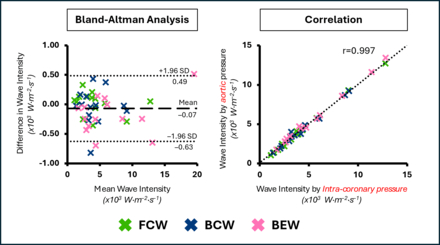
Results: A total of 14 paired waveforms were analyzed with a total of 42 coronary waves compared. Wave intensities calculated using intra-coronary versus intra-aortic pressure showed excellent agreement across all wave types. Mean bias between methods was −0.07 x 10³ W×m-2×s-1 with limits of agreement from −0.63 to +0.49. The correlation between intra-coronary and intra-aortic wave intensities was strong (r = 0.997, p < 0.001), with minimal dispersion and consistent agreement across the full range of wave intensities (Figure 1).

Conclusions: In patients with non-obstructive coronary arteries, wave intensity analysis using guide-catheter aortic pressure yields results nearly identical to those obtained with intra-coronary pressure. These findings support the use of aortic pressure as a reliable surrogate for intra-coronary pressure in WIA for the calculation of microvascular coronary hemodynamics, reducing technical barriers and enabling broader clinical and research utilization.
  • Carrington, Justin  ( Mayo Clinic , Rochester , Minnesota , United States )
  • Prasad, Abhiram  ( Mayo Clinic , Rochester , Minnesota , United States )
  • Gulati, Rajiv  ( MAYO CLINIC , Rochester , Minnesota , United States )
  • Lerman, Amir  ( Mayo Clinic , Rochester , Minnesota , United States )
  • Raphael, Claire  ( Mayo Clinic , Rochester , Minnesota , United States )
  • Author Disclosures:
    Justin Carrington: DO NOT have relevant financial relationships | Abhiram Prasad: DO NOT have relevant financial relationships | Rajiv Gulati: DO NOT have relevant financial relationships | Amir Lerman: DO NOT have relevant financial relationships | Claire Raphael: No Answer
Meeting Info:

Scientific Sessions 2025

2025

New Orleans, Louisiana

Session Info:

Next-Generation Biomarkers & Omics-Driven Risk Stratification

Sunday, 11/09/2025 , 03:15PM - 04:15PM

Abstract Poster Board Session

More abstracts on this topic:
A Novel Cardiac Simulator "ped UT-Heart" to Support Decision-Making in Surgical Procedures for Complex Congenital Heart Disease

Shiraishi Isao, Kurosaki Kenichi, Iwai Shigemitsu, Washio Takumi, Sugiura Seiryo, Hisada Toshiaki

A Diagnosis Dilemma of Positional Hypoxia: Scoliosis-Mediated Platypnea-Orthodeoxia Syndrome

Ademuwagun Christianah, Arjoon Roy, Seth Paula, Chang Gene, Ibe Oby

More abstracts from these authors:
Coronary Microvascular Disease Modulates Long-Term Outcomes in Myocardial Infarction with Non-Obstructive Coronary Arteries

Carrington Justin, Nogami Kai, Prasad Abhiram, Gulati Rajiv, Lerman Amir, Raphael Claire

Diastolic Dysfunction in Coronary Microvascular Disease is Linked to Impaired Diastolic Wave Intensity

Carrington Justin, Prasad Abhiram, Gulati Rajiv, Lerman Amir, Raphael Claire

You have to be authorized to contact abstract author. Please, Login
Not Available