
Logo

American Heart Association

  20
  0


Final ID: MP2698

Diastolic Dysfunction in Coronary Microvascular Disease is Linked to Impaired Diastolic Wave Intensity

Abstract Body (Do not enter title and authors here): Background: Coronary microvascular disease (CMD) may be endothelium-independent (coronary flow reserve, CFR < 2.5) or endothelium-dependent (<50% increase in coronary blood flow in response to acetylcholine). CMD has been implicated in abnormal myocardial relaxation and impaired diastolic function. Wave intensity analysis (WIA) is a hemodynamic method that quantifies the energy of pressure-flow waves driving coronary blood flow. The backward expansion wave (BEW) is the dominant distally originating wave, generated by microvascular suction during ventricular relaxation. Thus, the BEW may offer mechanistic insight into the link between CMD and diastolic dysfunction.

Hypothesis: We hypothesized that diastolic dysfunction would be more common in patients with CMD, and that the backward expansion wave (BEW) intensity would be lower in those with diastolic dysfunction compared to those without.

Methods: Patients with non-obstructive coronary artery disease undergoing invasive coronary physiology assessment of the left anterior descending artery were included (n = 113). Pressure and Doppler flow were recorded at rest, with adenosine, and with acetylcholine for categorization of CMD as endothelium-independent (CMD-Ei) and/or endothelium-dependent (CMD-Ed). Wave intensity analysis was used to calculate cumulative BEW (J×m-2) at rest in CMD, CMD-Ei (endothelium-independent), and CMD-Ed (endothelium-dependent) subgroups. Diastolic dysfunction was diagnosed by transthoracic echocardiogram using the 2016 American Society of Echocardiography (ASE) guidelines.

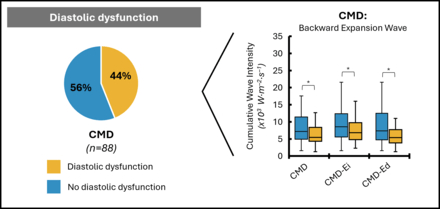
Results: Of the 113 study patients, 88 (77.9%) had CMD and 25 (22.1%) did not. Among those with CMD, 39 patients (44.3%) had diastolic dysfunction (Figure 1). In the patients with CMD, the BEW intensity was significantly lower in patients with diastolic dysfunction compared to those without (6.5 vs. 9.0 × 10³ W×m-2×s-1, p < 0.05). The same trend was observed for the CMD-Ei (7.2 vs. 9.7 × 10³ W×m-2×s-1, p < 0.05) and CMD-Ed (6.2 vs. 9.1 × 10³ W×m-2×s-1, p < 0.05) subtypes.

Conclusions: Diastolic dysfunction is frequent in patients with invasively diagnosed CMD. Patients with CMD who have diastolic dysfunction have comparatively lower BEW intensity, regardless of endothelial subtype. Since the BEW is the major driver of coronary flow during diastole, this suggests a mechanism by which CMD may lead to diastolic dysfunction.
  • Carrington, Justin  ( Mayo Clinic , Rochester , Minnesota , United States )
  • Prasad, Abhiram  ( Mayo Clinic , Rochester , Minnesota , United States )
  • Gulati, Rajiv  ( MAYO CLINIC , Rochester , Minnesota , United States )
  • Lerman, Amir  ( Mayo Clinic , Rochester , Minnesota , United States )
  • Raphael, Claire  ( Mayo Clinic , Rochester , Minnesota , United States )
  • Author Disclosures:
    Justin Carrington: DO NOT have relevant financial relationships | Abhiram Prasad: DO NOT have relevant financial relationships | Rajiv Gulati: DO NOT have relevant financial relationships | Amir Lerman: DO NOT have relevant financial relationships | Claire Raphael: No Answer
Meeting Info:

Scientific Sessions 2025

2025

New Orleans, Louisiana

Session Info:

Microvascular & Non-Obstructive Coronary Disease: Mechanisms to Management

Monday, 11/10/2025 , 01:45PM - 02:45PM

Moderated Digital Poster Session

More abstracts on this topic:
Accumulation of Epicardial Adipose Tissue as a Marker of Diastolic Dysfunction in Patients With Preserved Left Ventricular Ejection Fraction Undergoing Coronary Computed Tomography Angiograph

Ishikawa Hirotoshi, Kasayuki Noriaki, Fukuda Daiju, Otsuka Kenichiro, Sugiyama Takatoshi, Yamaura Hiroki, Hojo Kana, Kawa Yoshinori, Shintani Ako, Ito Asahiro, Yamazaki Takanori

A Case of Dilated Cardiomyopathy and Systemic Thromboembolism in a Young Patient on Testosterone Replacement Therapy

Sabri Muhammad, Ijaz Naila, Nadeem Ramsha, Checchio Lucy, Riaz Faiza

More abstracts from these authors:
Comparison of Intra-coronary and Intra-aortic Pressure Recordings for Coronary Wave Intensity Analysis

Carrington Justin, Prasad Abhiram, Gulati Rajiv, Lerman Amir, Raphael Claire

Coronary Microvascular Disease Modulates Long-Term Outcomes in Myocardial Infarction with Non-Obstructive Coronary Arteries

Carrington Justin, Nogami Kai, Prasad Abhiram, Gulati Rajiv, Lerman Amir, Raphael Claire

You have to be authorized to contact abstract author. Please, Login
Not Available