Coronary Microvascular Dysfunction Endotypes are Associated with Increased Pro-Inflammatory State in Angina with Non-Obstructive Coronary Arteries
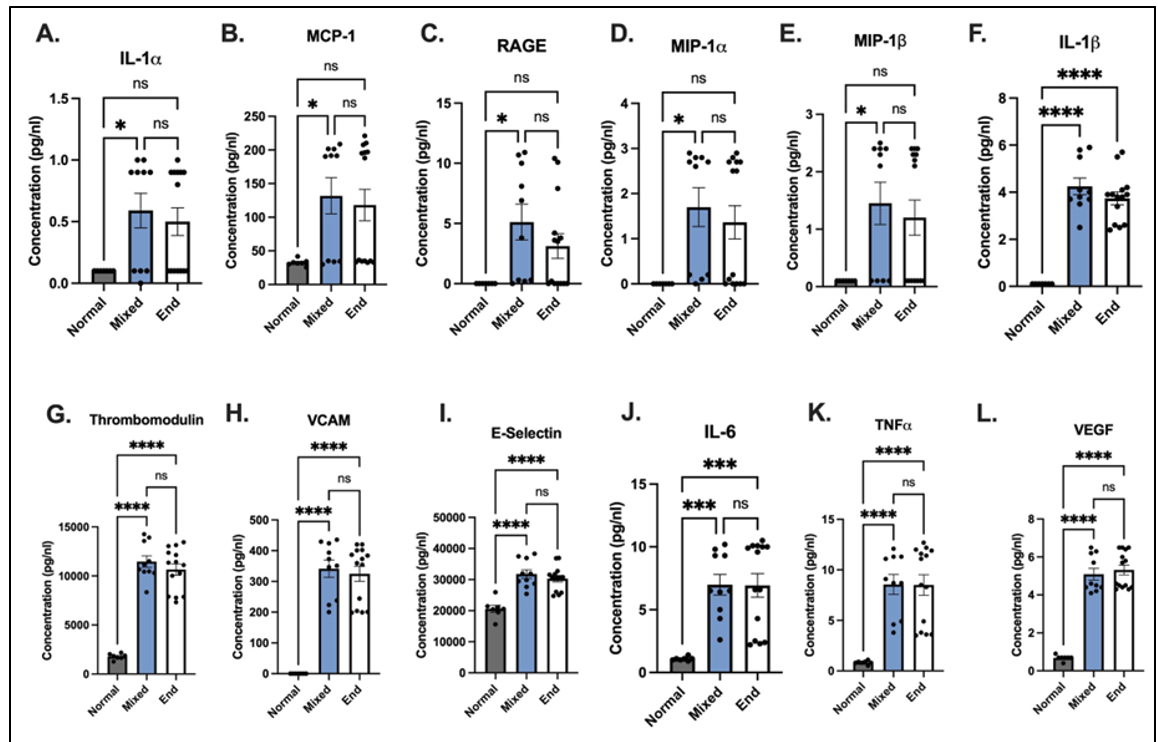
Abstract Body (Do not enter title and authors here): Introduction: Coronary microvascular dysfunction (CMD) is the primary pathophysiological mechanism in Angina with Non-Obstructive Coronary Arteries (ANOCA), a prevalent yet understudied condition. CMD manifests as distinct endotypes—endothelial-dependent and -independent dysfunction—with many patients exhibiting both (mixed disease). Although evidence suggests a pro-inflammatory state contributes to CMD, differences across endotypes remain unclear. This study examined inflammatory cytokine profiles across CMD endotypes in ANOCA patients. Methods: Cytokines were analyzed using a 40-plex Immune Response Array ELISA (RayBiotech, QAH-IMR-1-1). We used a subset of the prospective Coronary Microvascular Dysfunction (CMVD) registry of ANOCA patients (N=31, ~20% of biorepository) undergoing invasive coronary functional testing (ICFT) with thermodilution to evaluate CMD. Patients were classified into CMD endotypes based on ICFT: 1) Endothelial-dependent CMD (EnD-CMD), defined by failure to vasodilate or paradoxical vasoconstriction to intracoronary acetylcholine (N=14); 2) Mixed-CMD, with both endothelial dysfunction and abnormal coronary flow reserve to adenosine (CFR <2.5, N=10); and 3) Normal, with no ICFT abnormalities (N=7). Results: The average age was 55.1 (±14.25) years, and most participants were female (93%). Compared to ANOCA patients without CMD, those with CMD showed upregulation of 12 out of 40 cytokines (Figure 1). In both EnD-CMD and Mixed-CMD groups, IL-1β, Thrombomodulin, VCAM, E-selectin, IL-6, TNF-α, and VEGF were significantly elevated (p<0.05 for all, Figure 1). Additionally, Mixed-CMD patients had unique upregulation of IL-1α, MCP-1, RAGE, MIP-1α, and MIP-1β (p<0.05), suggesting a distinct inflammatory profile. While both CMD groups showed elevated cytokines versus controls, there were no significant differences between EnD-CMD and Mixed-CMD themselves. Conclusion: Elevated cytokines in both EnD-CMD and Mixed-CMD indicate shared inflammatory mechanisms in ANOCA-associated CMD. The unique upregulation of five cytokines in Mixed-CMD suggests a distinct pro-inflammatory signature that may reflect specific pathophysiology. These findings highlight the need for further studies into cytokine-mediated inflammation in CMD and may inform the development of targeted therapies.
Almanzar, Anibelky
(
The Christ Hospital Heart and Vascular Institute
, Cincinnati , Ohio , United States )
Tapp, Danielle
(
The Christ Hospital Heart and Vascular Institute
, Cincinnati , Ohio , United States )
Tipler, Paxson
(
The Christ Hospital Heart and Vascular Institute
, Cincinnati , Ohio , United States )
Ashokprabhu, Namrita
(
The Christ Hospital Heart and Vascular Institute
, Cincinnati , Ohio , United States )
Midkiff, Jeff
(
The Christ Hospital Health Network
, Cincinnati , Ohio , United States )
Tzoumas, Andreas
(
The Christ Hospital Health Network
, Cincinnati , Ohio , United States )
Mohan, Ayushi
(
The Christ Hospital Heart and Vascular Institute
, Cincinnati , Ohio , United States )
Henry, Timothy
(
The Christ Hospital Heart and Vascular Institute
, Cincinnati , Ohio , United States )
Owens Iii, A. Phillip
(
University of Cincinnati
, Cincinnati , Ohio , United States )
Quesada, Odayme
(
The Christ Hospital Heart and Vascular Institute
, Cincinnati , Ohio , United States )
Author Disclosures:
Anibelky Almanzar:DO NOT have relevant financial relationships
| Odayme Quesada:DO NOT have relevant financial relationships
| Danielle Tapp:DO NOT have relevant financial relationships
| Paxson Tipler:No Answer
| Namrita Ashokprabhu:No Answer
| Jeff Midkiff:No Answer
| Andreas Tzoumas:No Answer
| Ayushi Mohan:No Answer
| Timothy Henry:DO NOT have relevant financial relationships
| A. Phillip Owens III:DO have relevant financial relationships
;
Research Funding (PI or named investigator):NIH:Active (exists now)
; Independent Contractor:AHA:Active (exists now)