
Association Between In-hospital Cardiac Arrest Incidence and Survival in Older Patients
Abstract Body: Background: Survival after an in-hospital cardiac arrest (IHCA) varies markedly across hospitals in the U.S. Whether hospitals with IHCA survival also excel in ‘preventing’ IHCA remains unclear.
Methods: Using 2013-2019 data from the Get-With-The-Guidelines–Resuscitation (GWTG-R) registry linked with Medicare and American Hospital Association data, we identified all patients >65 years with IHCA at participating hospitals. Using two-level hierarchical multivariable regression models, we calculated hospital rates of IHCA incidence, adjusted for case-mix index, and risk-standardized survival to discharge (RSSR) for IHCA, adjusted for patient and cardiac arrest variables. We also examined the association of IHCA incidence and RSSR with hospital variables.
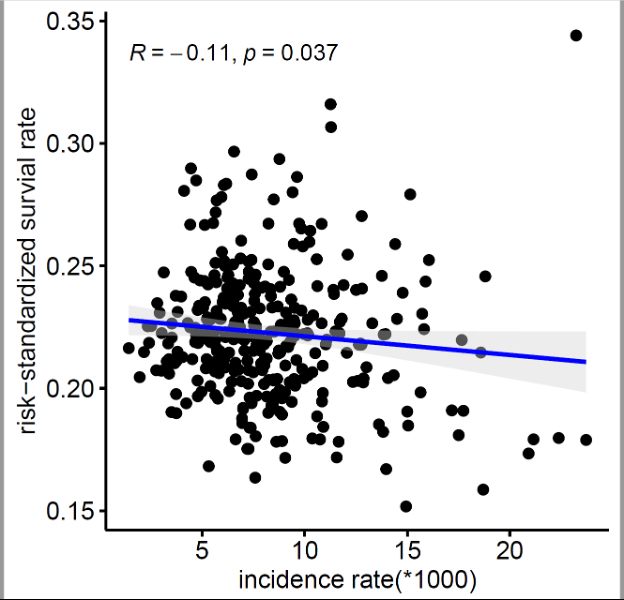
Results: Among >10 million admissions at 335 hospitals during 2013-2019, 77676 patients experienced an IHCA. The median hospital rate of IHCA incidence was 6.9 per 1000 admissions, and the median case-survival rate among those with IHCA was 21.9%. After case-mix adjustment, the median IHCA incidence was 7.9 per 1000 admissions with considerable variation across hospitals: IQR: 5.8-10.3 per 1000 admissions, range 1.2 to 25.4 per 1000 admissions. The median RSSR for IHCA was 22.3%, which varied from 11.5% to 35.7% across hospitals (IQR: 19.5%-24.9%). There was a weak negative correlation between risk-adjusted hospital IHCA incidence and its RSSR (rho = -0.11; p = 0.037) (Figure 1). Adjustment for hospital variables attenuated the negative association between IHCA incidence and RSSR (rho = -0.08; p = 0.13). The nurse-patient ratio was the only modifiable factor significantly associated with lower IHCA incidence (OR = 0.97; p = 0.004) and higher RSSR (OR = 1.05; p <.0001).
Conclusion: Even after case-mix adjustment, hospital IHCA incidence and survival rates varied markedly. Notably, hospitals with higher survival rates for IHCA did not have a higher incidence. Since case-survival rates for IHCA have plateaued in recent years, our findings highlight that efforts focused on reducing IHCA incidence may yield additional gains in reducing resuscitation deaths in hospitals.
Nathani, Rohit
( University of Texas Southwestern Medical Center
, Dallas
, Texas
, United States
)
Li, Qiang
( University of Texas Southwestern Medical Center
, Dallas
, Texas
, United States
)
Nguyen, Cathy
( University of Texas Southwestern Medical Center
, Dallas
, Texas
, United States
)
Koshy, Thomas
( UT SOUTHWESTERN
, Dallas
, Texas
, United States
)
Hall, Hurst
( UT SOUTHWESTERN
, Dallas
, Texas
, United States
)
Mentias, Amgad
( Cleveland Clinic
, Cleveland
, Ohio
, United States
)
Chan, Paul
( MID AMERICA HEART INSTITUTE
, Kansas City
, Missouri
, United States
)
Girotra, Saket
( University of Texas Southwestern
, Dallas
, Texas
, United States
)
Author Disclosures:
Rohit Nathani:DO NOT have relevant financial relationships
| Qiang Li:DO NOT have relevant financial relationships
| Cathy Nguyen:No Answer
| Thomas Koshy:No Answer
| Hurst Hall:DO NOT have relevant financial relationships
| Amgad Mentias:DO NOT have relevant financial relationships
| Paul Chan:DO have relevant financial relationships
;
Research Funding (PI or named investigator):NHLBI:Active (exists now)
; Consultant:AHA:Active (exists now)
| Saket Girotra:DO have relevant financial relationships
;
Research Funding (PI or named investigator):NIH:Active (exists now)