Logo

American Heart Association

  21
  0


Final ID: Mo3020

Impact of Tricuspid Regurgitation Severity on Clinical Outcomes Following Mitral Valve Interventions: A Meta-Analysis

Abstract Body (Do not enter title and authors here): Bachground:
Functional tricuspid regurgitation (TR) frequently develops secondary to mitral valve disease, but its impact on clinical outcomes after mitral valve interventions are not properly understood. The best management strategy for moderate to severe tricuspid regurgitation after mitral valve intervention still continues to be debated
Hypothesis
We hypothesized that moderate to severe TR at baseline is associated with more mortality and adverse cardiovascular events following mitral valve intervention, regardless of intervention type, compared with none/mild TR
Methods
We systematically searched PubMed, Embase, Google scholar for studies examining baseline TR severity impact on clinical outcomes, following Mitral valve interventions. Patients are stratified by baseline TR severity into Non-severe group(none/mild TR) and Severe group(moderate/severe TR). Inverse-variance weighting method was used and risk ratio’s along with their 95%CI was calculated by using Random effects model. All the analysis was done in R software version 4.5.0
Results
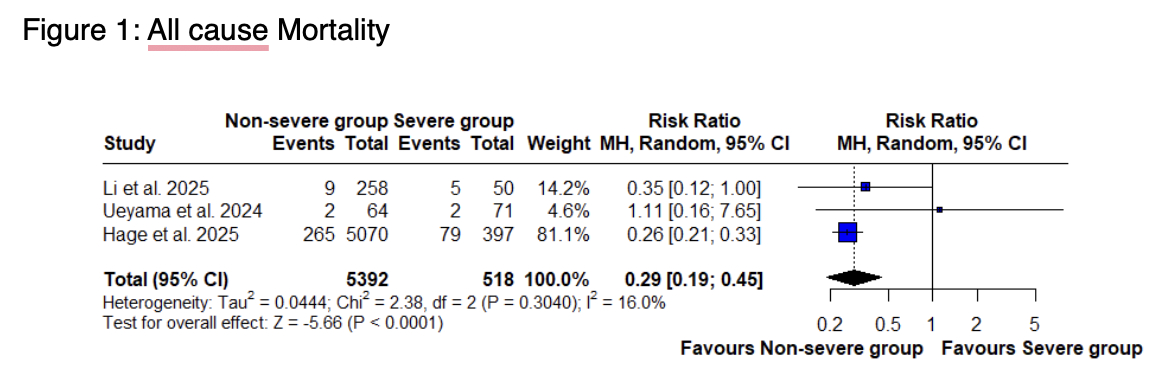
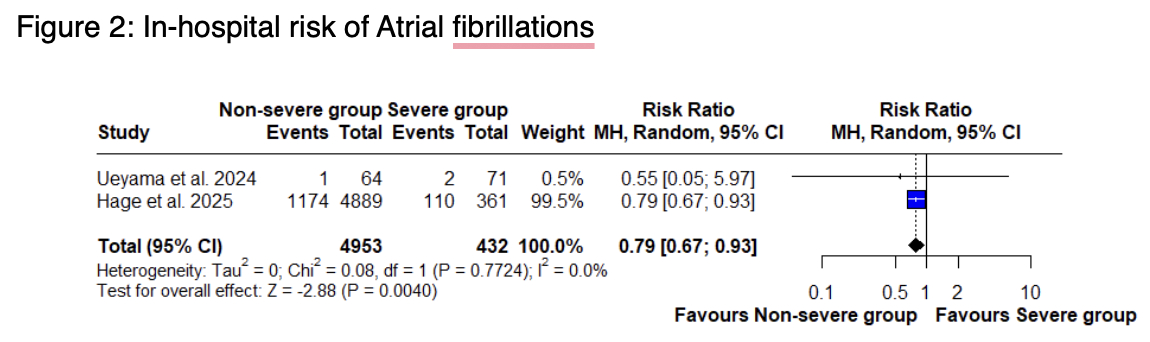
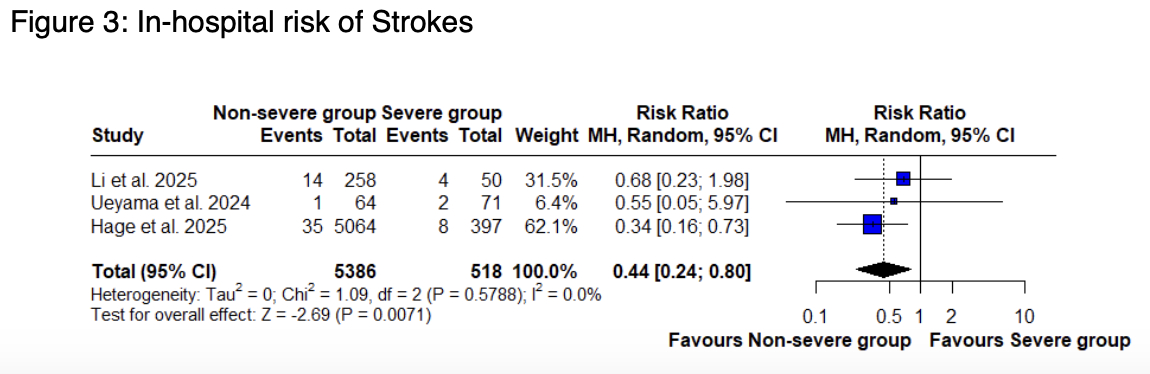
We included 3 studies with 5907 patients, who were divided into Non-severe and severe groups based on their baseline TR severity. Non-severe group demonstrated significantly less All cause mortality compared to severe group (RR= 0.29; 95%CI: 0.19, 0.45; p<0.0001). in-hospital stroke was significantly less in Non-severe group (RR= 0.44; 95%CI: 0.24, 0.80; p=0.0071) and risk of new onset in-hospital Atrial fibrillation was also significantly less in Non-severe group (RR= 0.79; 95%CI: 0.67, 0.93; p=0.004). Heterogeneity was negligible, indicating that outcomes were consistent across these studies.
Conclusion
Moderate to severe TR independently showed increased risk of mortality and in-hospital risk of new onset Atrial fibrillations and stroke compared to none/mild TR in patients who underwent mitral valve interventions. These findings suggest that early identification and management of TR during mitral valve procedures are important and therefore TR severity should be a key consideration for procedural planning during mitral valve interventions.
  • Mannam, Raam  ( NYMC - St. Mary's & St Clare's Health , Denville , New Jersey , United States )
  • Medarametla, Ravi  ( mamata medical college , KHAMMAM , India )
  • Patel, Nirmit  ( NYMC - St. Mary's & St Clare's Health , Denville , New Jersey , United States )
  • Konanur Srinivasa, Nithin Kumar  ( New York Medical College , Parsippany , New Jersey , United States )
  • Prakash, Atul  ( St Marys General Hospital, Passaic , Cedar Grove , New Jersey , United States )
  • Author Disclosures:
    Raam Mannam: DO NOT have relevant financial relationships | Ravi Medarametla: DO NOT have relevant financial relationships | Nirmit Patel: DO NOT have relevant financial relationships | Nithin Kumar Konanur Srinivasa: DO NOT have relevant financial relationships | Atul Prakash: DO NOT have relevant financial relationships
Meeting Info:

Scientific Sessions 2025

2025

New Orleans, Louisiana

Session Info:

Electrophysiology in Practice: Diverse Clinical Cases and Research Highlights

Monday, 11/10/2025 , 01:00PM - 02:00PM

Abstract Poster Board Session

More abstracts from these authors:
Branch vs septum: A meta analysis of ventricular synchrony in Left bundle branch pacing vs left ventricular septal pacing with subgroup analysis based on baseline LVEF.

Mannam Raam, Medarametla Ravi, Patel Nirmit, Patel Kaushal, Bogati Sunil, Patel Gaurav, Prakash Atul

Recent Advances in Hypertension Management: Systematic review and Meta-Analysis of Emerging Therapies (2023-2025).

Patel Nirmit, Patel Kaushal, Patel Gaurav, Gandhi Darshan, Prakash Atul, Cheriyath Pramil

You have to be authorized to contact abstract author. Please, Login
Not Available