
Logo

American Heart Association

  20
  0


Final ID: MP1269

A Novel ECG Time-Frequency Eyeball Method for Robust Detection of Myocardial Infarction from Single-Channel ECG: A Preclinical Study

Abstract Body (Do not enter title and authors here): Introduction: Myocardial infarction (MI) alters the heart’s electrophysiology, often seen as ST-segment deviation, T-wave inversion, or QRS distortion in electrocardiogram (ECG). While these features support diagnosis, they may miss early or subtle waveform changes in single-channel ECGs during ischemic injury. Capturing such changes could enhance MI detection, particularly in non-classical presentations. Here, we propose a new analytical approach that reveals advanced ECG morphology changes, to capture MI-related signatures not easily detectable by standard interpretation.
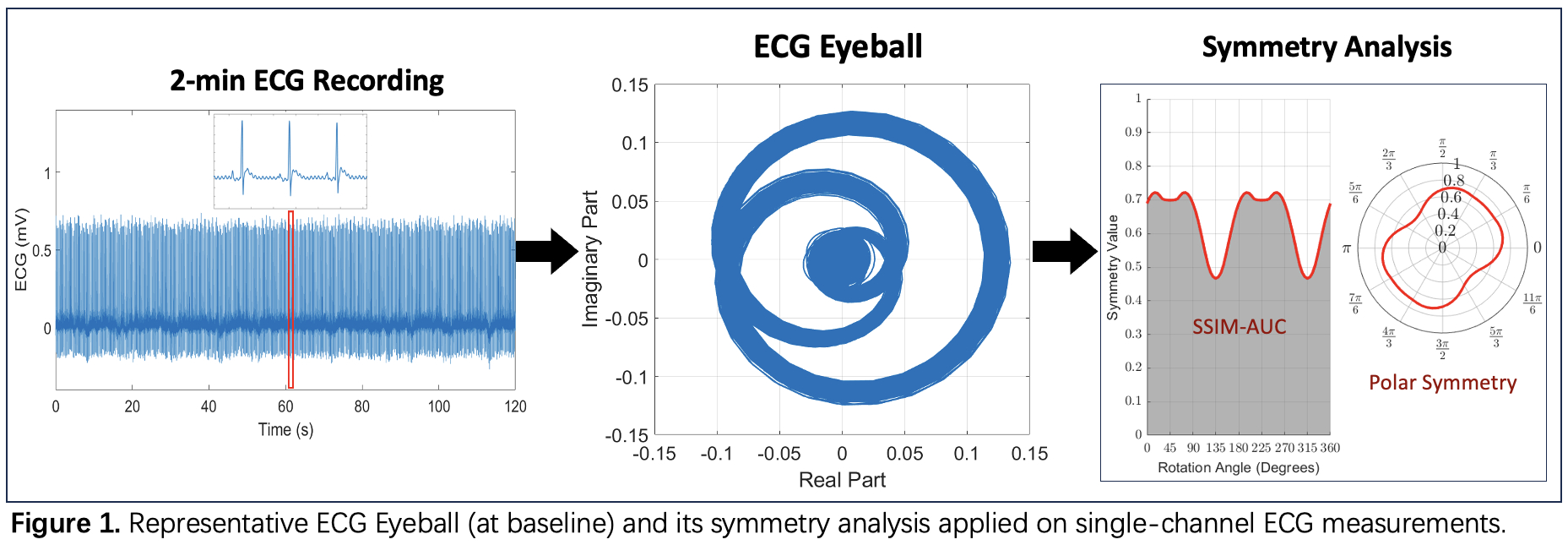
Methods: Acute MI was induced in SD rats (n=13; Male; ~300g) via 30 minutes of proximal left coronary artery occlusion, followed by 3 hours of reperfusion. Necrosis was confirmed post-surgery via triphenyl tetrazolium chloride (TTC) staining. ECG signals were continuously recorded via subcutaneous needle electrodes. The ECG time-frequency eyeball method involves: (1) empirical mode decomposition to extract intrinsic mode functions (IMFs) from ECG signal; (2) the Hilbert Transform to derive analytic signal of each IMF; (3) rotational mapping of the analytic signals onto the complex plane, where they exhibited a distinct eyeball-shaped pattern for IMF1 (ECG eyeball, Fig1). To quantify ECG dynamic changes, we performed symmetry analysis on the ECG eyeballs using the Structural Similarity Index Measurement (SSIM). Specifically, each eyeball was mirrored across incrementally rotated axes, and SSIM was calculated between the original and mirrored images at each angle. The normalized area under the SSIM curve over all rotation angles (SSIM-AUC) was used as a global symmetry metric (Fig1). SSIM-AUC was computed at three time points: baseline, pre-reperfusion (MI with occluded coronary), and 3 hours post-reperfusion (early recovery after MI). 2-minute ECG recordings were used at each time point for computing the eyeballs.
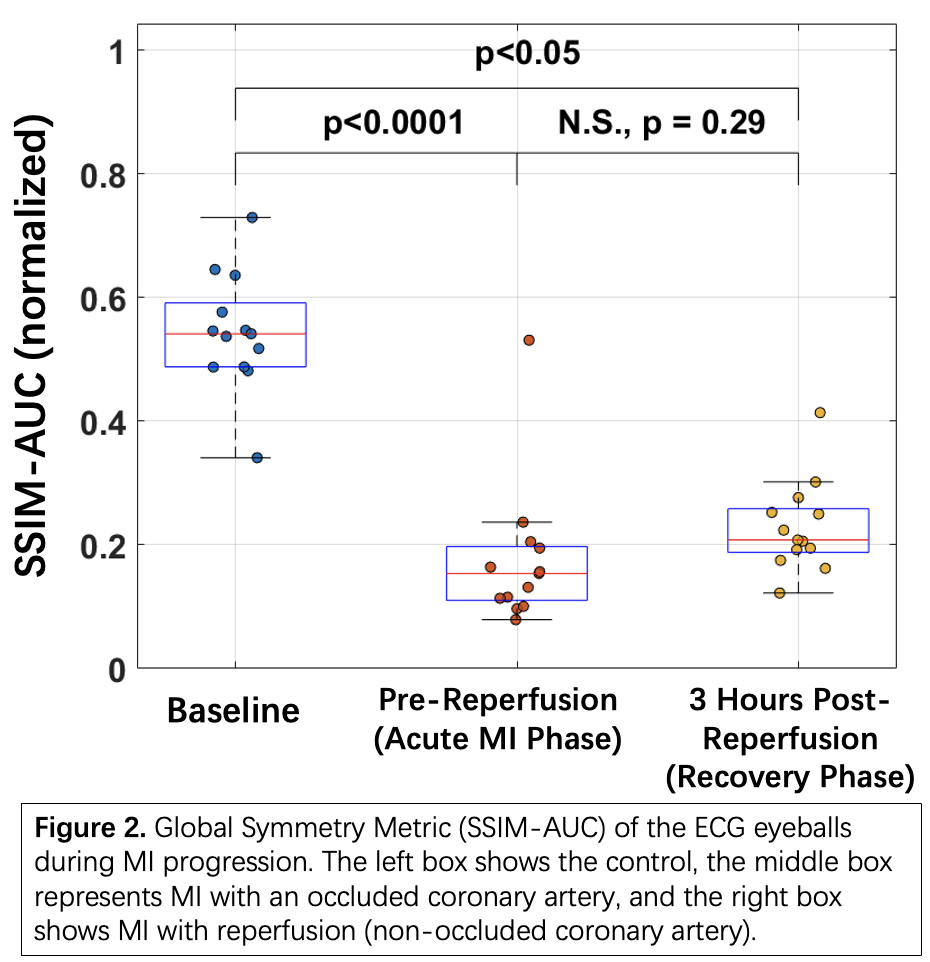
Results: SSIM-AUC significantly decreased after MI (P<0.05), from baseline to both pre-reperfusion and post-reperfusion (Fig2). A modest post-reperfusion increase vs. pre-reperfusion was observed but not significant.
Conclusion: We introduced a time-frequency-based analytics approach (ECG Eyeball) that maps multi-minute ECG data into a single interpretable pattern. Symmetry analysis of the ECG eyeball effectively captured MI-induced electrical changes. This method offers new directions for leveraging single-channel ECG data in noninvasive and interpretable tools for MI detection.
  • Alavi, Rashid  ( Caltech , Los Angeles , California , United States )
  • Li, Jiajun  ( University of Southern California , Los Angeles , California , United States )
  • Dai, Wangde  ( Huntington Medical Research Inst. , Pasadena , California , United States )
  • Matthews, Ray  ( USC , Los Angeles , California , United States )
  • Pahlevan, Niema  ( University of Southern California , Los Angeles , California , United States )
  • Kloner, Robert  ( Huntington Medical Research Inst. , Pasadena , California , United States )
  • Gharib, Morteza  ( California Institute of Technology , Pasadena , California , United States )
  • Author Disclosures:
    Rashid Alavi: DO NOT have relevant financial relationships | Jiajun Li: DO NOT have relevant financial relationships | Wangde Dai: No Answer | Ray Matthews: DO NOT have relevant financial relationships | Niema Pahlevan: DO have relevant financial relationships ; Consultant:Avicena LLC (Ventric Health):Active (exists now) ; Ownership Interest:Avicena LLC (Ventric Health):Active (exists now) | Robert Kloner: DO have relevant financial relationships ; Consultant:Hoskinson Health Clinic:Active (exists now) | Morteza Gharib: No Answer
Meeting Info:

Scientific Sessions 2025

2025

New Orleans, Louisiana

Session Info:

Unstable Angina, NSTEMI and STEMI: DX and Management

Sunday, 11/09/2025 , 03:15PM - 04:10PM

Moderated Digital Poster Session

More abstracts on this topic:
A 50% or Greater Reduction in LDL-Cholesterol Is Associated with Improved Long-Term Outcomes and Lower Health Care Utilization After Myocardial Infarction - a SWEDEHEART study

Reitan Christian, Watanabe Alexandre, Bash Lori, Galvain Thibaut, Arnet Urs, Jernberg Tomas

Cerebral endothelial cells generate ceramides that worsen outcomes of acute ischemic stroke in mice.

Mookherjee Sohom, Wilson Jack, Maschek J. Alan, Proia Richard, Summers Scott, Holland William, Campbell Robert, Denorme Frederik, Symons J David

More abstracts from these authors:
Deep Learning Segmentation for Automated Measurement of Infarct Size in Preclinical Myocardial Infarction Models

Alavi Rashid, Li Jiajun, Lin Jason, Dai Wangde, Pahlevan Niema, Gharib Morteza, Kloner Robert

Instantaneous Classification of Myocardial No-Reflow Size from a Carotid Pressure Waveform: A Physics-Based Machine Learning Approach

Li Jiajun, Alavi Rashid, Dai Wangde, Matthews Ray, Kloner Robert, Pahlevan Niema

You have to be authorized to contact abstract author. Please, Login
Not Available