
Logo

American Heart Association

  119
  0


Final ID: Mo4136

Differences in Health Care Utilization Prior to Cardiac Arrest Among Patients with Shockable versus Non-Shockable Rhythms

Abstract Body (Do not enter title and authors here): Background: Health care utilization has been shown to be high prior to out-of-hospital cardiac arrest (OHCA). However, differences in patterns of health care utilization between OHCA presenting with shockable and non-shockable rhythms have not been explored.
Hypothesis: Health care interactions prior to cardiac arrest are more common among those presenting with non-shockable rhythms, a large proportion of which may be a manifestation of chronic disease progression.
Aim: To examine health care utilization prior to OHCA and the differences between patients presenting with shockable and non-shockable rhythms, in comparison to population controls.
Methods: This was a matched case-control study. Cardiac arrests from 2009-2019 were identified in the British Columbia Cardiac Arrest Registry. Age, sex and geographic population controls were identified. We examined health care utilization in the 3 years prior to cardiac arrest.
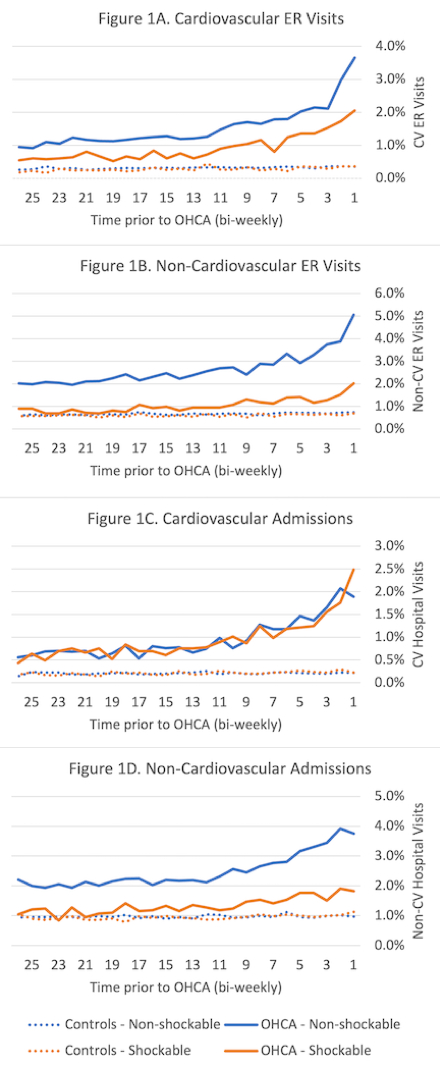
Results: A total of 3,461 shockable and 11,470 non-shockable OHCA patients were identified and matched 4:1 to 45,871 controls. The rate of hospitalization in the 3 years prior was 57% in the shockable group (39.5% in controls, OR 1.66, 95% CI 1.53-1.79) and 61.5% in the non-shockable group (39.5% in controls, OR 2.67, 95% CI 2.55-2.79). Overall hospitalizations were more common in both OHCA compared to controls, while non-cardiovascular (CV) admissions were greater for the non-shockable versus shockable groups (Figure). When examining bi-weekly rates of hospital and ER visits leading up to OHCA, both groups had increased CV encounters arising at 10 weeks prior to arrest, whereas the non-shockable group had greater non-CV encounters as compared to the shockable group.
Conclusion: Shockable and non-shockable OHCA show high rates of health care utilization leading up to cardiac arrest, which may provide opportunities for intervention. Differences between the shockable and non-shockable groups may reflect underlying pathophysiology, which has implications for prevention of OHCA.
  • Burden, Elizabeth  ( University of British Columbia , Vancouver , British Columbia , Canada )
  • Deyell, Marc  ( University of British Columbia , Vancouver , British Columbia , Canada )
  • Hawkins, Nathaniel  ( University of British Columbia , Vancouver , British Columbia , Canada )
  • Guan, Meijiao  ( University of British Columbia , Vancouver , British Columbia , Canada )
  • Helmer, Jennie  ( BC Emergency Health Services , Pemberton , British Columbia , Canada )
  • Grunau, Brian  ( University of British Columbia , Vancouver , British Columbia , Canada )
  • Fordyce, Christopher  ( University of British Columbia , Vancouver , British Columbia , Canada )
  • Author Disclosures:
    Elizabeth Burden: DO NOT have relevant financial relationships | Marc Deyell: No Answer | Nathaniel Hawkins: No Answer | Meijiao Guan: No Answer | Jennie Helmer: DO NOT have relevant financial relationships | Brian Grunau: DO NOT have relevant financial relationships | Christopher Fordyce: No Answer
Meeting Info:

Scientific Sessions 2024

2024

Chicago, Illinois

Session Info:

Critical Care Cardiology Medley Reprise

Monday, 11/18/2024 , 10:30AM - 11:30AM

Abstract Poster Session

More abstracts from these authors:
Impact of Supraventricular Tachycardia on Pregnancy Outcomes

Ardehali Arya, Kiess Marla, Rychel Valerie, Barlow Amanda, Oakes Jennifer, Deyell Marc, Grewal Jasmine

Lower Survival After Out-of-Hospital Cardiac Arrest in Older Females: The Joint Effect of Age and Sex

Awad Emad, Grunau Brian, Christenson Jim, Humphries Karin, Helmer Jennie

You have to be authorized to contact abstract author. Please, Login
Not Available