A Nationwide Analysis of Mortality Trends and Disparities in Patients With Diabetes Mellitus and Ischemic Heart Disease in the United States From 1999 to 2023
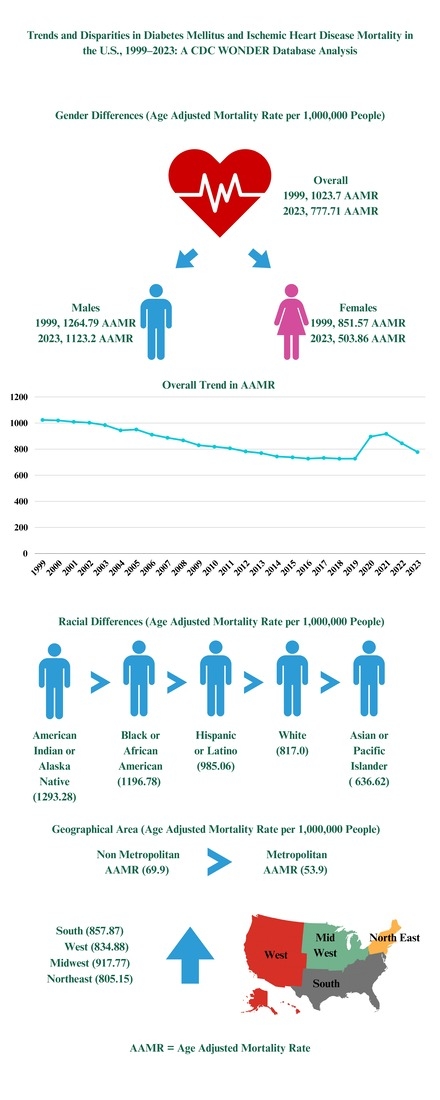
Abstract Body: Background: In the United States (U.S.), diabetes mellitus (DM) and ischemic heart disease (IHD) are among the biggest causes of disability and mortality. Their overlapping pathophysiologies have a combined and unfortunate effect on cardiovascular outcomes. There also exist differences in these outcomes based on race, sex, location and socioeconomic status, reflecting persistent inequities, despite advancements in public health initiatives. Hypothesis: We hypothesized that the COVID-19 pandemic had a negative but temporary effect, rolling back previous gains in DM and IHD mortality reduction, with notable differences persisting across race, sex, location and urban/rural areas, despite an overall decreasing trend. Objective: To assess demographic differences and time-based trends in DM and IHD-related mortality, from 1999 to 2023, using the Centers for Disease Control and Prevention Wide-Ranging Online Data for Epidemiologic Research (CDC WONDER) database. Methods: In this retrospective observational study, ICD-10 codes for DM (E10–E14) and IHD (I20–I25) were used to extract data on patients aged ≥45 from the CDC WONDER database. We calculated and stratified age-adjusted mortality rates (AAMR) per 1,000,000 by U.S. Census regions, sex, race/ethnicity, and urbanization. Joinpoint regression was used to assess trends. Results: Between 1999 and 2023, a staggering 2,564,346 deaths were associated with DM and IHD. Still, AAMR declined from 1999 to 2018 (APC: -2.12%), but increased significantly from 2018 to 2021 (APC: 10.15%), before declining again through 2023 (APC: -8.93%). Males had a consistently higher mortality than female patients. Interestingly, there were notable racial disparities; Black people and American Indian/Alaska Natives had the highest AAMRs, with disproportionately sharp rises during the COVID-19 pandemic. The South and Midwest also had the highest mortality rates, while non-metropolitan areas had higher mortality rates than metropolitan areas. Conclusions: Mortality rates associated with DM and IHD have been in a continuous decline for a long time, with considerable but temporary recent reversals during the pandemic. The point of concern is the ongoing difference in these rates across race, location and urbanization, pointing to gaps in access to and provision of care. Reducing the cardiometabolic load in these high-risk socio-demographic groups necessitates focused interventions and public health initiatives on fair and equitable grounds.
Patel, Tirath
(
Trinity Medical Sciences University School of Medicine
, Kingstown , Saint Vincent and the Grenadines )
Qureshi, Ahmar Jan
(
CMH Multan Institute of Medical Sciences
, Multan , Pakistan )
Tariq Tagga, Muhammad Riyyan
(
CMH Multan Institute of Medical Sciences
, Multan , Pakistan )
Memon, Sibgha Fawad
(
Peoples University of Medical and Health sciences for women
, Nawabshah , Pakistan )
Shah, Syeda Simrah
(
Dow Medical College
, Karachi , Pakistan )
Memon, Zauha Fawad
(
Peoples University of Medical and Health sciences for women
, Nawabshah , Pakistan )
Memon, Matia Fawad
(
Peoples University of Medical and Health sciences for women
, Nawabshah , Pakistan )
Faisal, Abdul Rafae
(
CMH Multan Institute of Medical Sciences
, Multan , Pakistan )
Hafeez, Ali Shan
(
CMH Multan Institute of Medical Sciences
, Multan , Pakistan )
Zaman, Asad
(
CMH Multan Institute of Medical Sciences
, Multan , Pakistan )
Saeed, Muhammad Usama
(
CMH Multan Institute of Medical Sciences
, Multan , Pakistan )
Anand, Nikhilesh
(
University Of Texas Rio Grande Valley
, Edinburg , Texas , United States )
Author Disclosures:
Tirath Patel:DO NOT have relevant financial relationships
| Ali Shan Hafeez:DO NOT have relevant financial relationships
| Asad Zaman:No Answer
| Muhammad Usama Saeed:DO NOT have relevant financial relationships
| Nikhilesh Anand:DO NOT have relevant financial relationships
| Ahmar Jan Qureshi:DO NOT have relevant financial relationships
| Muhammad Riyyan Tariq Tagga:No Answer
| Sibgha Fawad Memon:No Answer
| Syeda Simrah Shah:No Answer
| Zauha Fawad Memon:No Answer
| Matia Fawad Memon:No Answer
| Ramish Hannat:DO NOT have relevant financial relationships
| Abdul Rafae Faisal:No Answer
Buhadur Ali Muhammad Khan, Shahzaib Muhammad, Qureshi Muhammad Ahmad, Ammar Ur Rahman Mohammad, Munir Luqman, Khalid Amna, Hayat Malik Saad, Shoaib Muhammad Mukarram