Logo

American Heart Association

  14
  0


Final ID: Mo4082

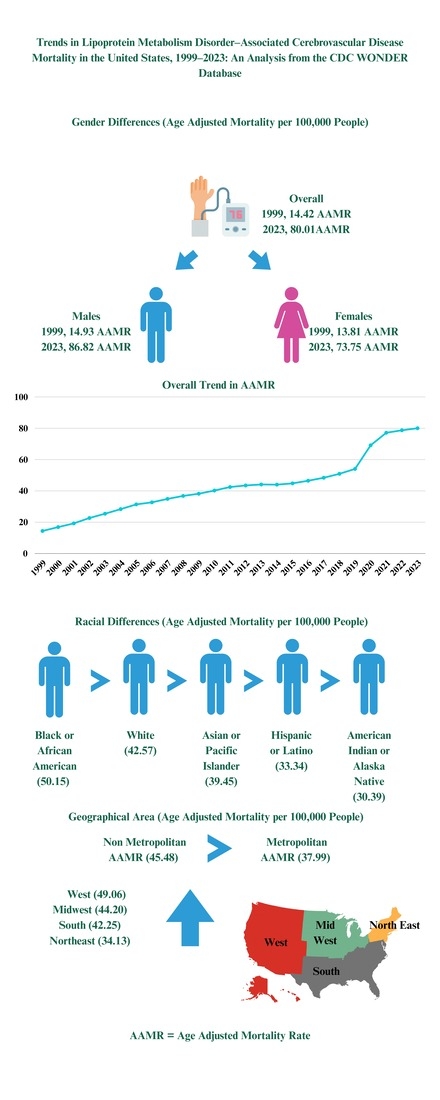
Trends in Lipoprotein Metabolism Disorder–Associated Cerebrovascular Disease Mortality in the United States, 1999–2023: An Analysis from the CDC WONDER Database

Abstract Body (Do not enter title and authors here): Abstract
Background:
Cerebrovascular disease (CVD) mortality is considerably influenced by disorders of lipoprotein metabolism (LMD). While hypercholesterolemia is a recognised risk factor for coronary heart disease, there is, now, a greater appreciation of its connection to cerebrovascular disease outcomes, especially ischemic stroke. Little, however, is published about the trends and the differences in those trends for LMD-associated CVD mortality at a nation-wide population level.
Methods: From 1999 to 2023, mortality statistics from the Centers for Disease Control and Prevention Wide-Ranging Online Data for Epidemiologic Research (CDC WONDER) database were used for this descriptive study. Wherever LMD (ICD-10: E78.0–E78.9) and CVD (ICD-10: I60–I69) were identified as either underlying or contributory cause for death among adults aged ≥25 years were included. The United States (U.S.) population in year 2000 was used to standardize the age-adjusted mortality rates (AAMRs) per 1,000,000. Joinpoint regression analysis was utilized to stratify results by sex, race/ethnicity, census regions and urban-rural classification, to estimate annual percent change (APC) with 95% confidence intervals.
Results: Between 1999 to 2004 (APC 14.83*) and 2018 to 2021 (APC 16.52*), there were especially notable upswings in the total AAMR for LMD-associated CVD, which notably increased from 14.42 in 1999 to 80.01 in 2023. AAMRs were also consistently higher for males. Among races, the greatest mortality rates were recorded for non-Hispanic (NH) Black people (50.16) and NH White people (42.58). Regional data revealed that the West and South experienced the most notable recent increases in AAMRs. Moreover, the rural areas had higher AAMRs than metropolitan regions. These differences reflect the effects of long-standing inequities that are rooted in lifestyle risk factors, socioeconomic determinants of health and even access to healthcare.
Conclusion: Over the last 20 years, the death rate from LMD-associated CVD has exploded, with considerable socioeconomic, demographic and regional differences. These results are a cause for concern and underline the need for policy changes and focus on targeted public health initiatives. Furthermore, future initiatives ought to focus on the incorporation of more detailed statistics and make use of newly discovered and readily available biomarkers.
  • Zaman, Asad  ( CMH Institute of Medical Sciences Multan , Multan , Punjab , Pakistan )
  • Faizan, Muhammad  ( Hammad medical corporation , Doha , Qatar )
  • Ashraf, Usama  ( Allied hospital faislabad , Providnce , Rhode Island , United States )
  • Singh, Pramod  ( Barabise primary health care center , Barabise , Nepal )
  • ., Abdullah  ( Rawalpindi Medical University , Rawalpindi , Pakistan )
  • Aamir, Zoya  ( Dow University of Health Sciences , Karachi , Pakistan )
  • Butt, Usamah  ( Detroit Medical Center, Wayne State University , Detroit , Michigan , United States )
  • Qureshi, Ahmar Jan  ( CMH Institute of Medical Sciences Multan , Multan , Punjab , Pakistan )
  • Ashraf, Saad  ( Dow University of Health Sciences , Karachi , Pakistan )
  • Tariq Tagga, Muhammad Riyyan  ( CMH Institute of Medical Sciences Multan , Multan , Punjab , Pakistan )
  • Hafeez, Ali Shan  ( CMH Institute of Medical Sciences Multan , Multan , Punjab , Pakistan )
  • Faisal, Abdul Rafae  ( CMH Institute of Medical Sciences Multan , Multan , Punjab , Pakistan )
  • Author Disclosures:
    Asad Zaman: DO NOT have relevant financial relationships | Muhammad Faizan: DO NOT have relevant financial relationships | usama ashraf: No Answer | pramod singh: No Answer | Abdullah .: DO NOT have relevant financial relationships | Zoya Aamir: DO NOT have relevant financial relationships | Usamah Butt: DO NOT have relevant financial relationships | Ahmar Jan Qureshi: DO NOT have relevant financial relationships | Saad Ashraf: DO NOT have relevant financial relationships | Muhammad Riyyan Tariq Tagga: DO NOT have relevant financial relationships | Ali Shan Hafeez: DO NOT have relevant financial relationships | Abdul Rafae Faisal: DO NOT have relevant financial relationships
Meeting Info:

Scientific Sessions 2025

2025

New Orleans, Louisiana

Session Info:

Emerging Topics In Cardiometabolic and Vascular Diseases

Monday, 11/10/2025 , 01:00PM - 02:00PM

Abstract Poster Board Session

More abstracts on this topic:
ANGPTL3 Targeting Monoclonal Antibodies Lead to Robust Reductions in LDL-C, Triglycerides, ApoB, and Non-HDL-C in Dyslipidemic Patients: A Meta-Analysis of 5 Randomized Controlled Trials

Daid Simranpreet Singh, Sharma Anubhuti, Sharma Arundhati, Pannu Sagal, Asnani Heena, Bhanushali Karan, Choudhary Khushal, Sharma Saurabh

Association Between Antiphospholipid Antibody and Ischemic Stroke: A Systematic Review and Meta-Analysis

Watson Nathan, Kanthi Yogen, Secemsky Eric, Connors Jean, Barnes Geoffrey, Goldhaber Samuel, Weitz Jeffrey, Costenbader Karen, Piazza Gregory, Krumholz Harlan, Cushman Mary, Bukhari Syed, Bikdeli Behnood, Rashedi Sina, Weber Brittany, Anderson Christopher, Elkind Mitchell, Pfeferman Mariana, Ujueta Francisco, Zarghami Mehrdad

More abstracts from these authors:
Mortality Trends in Hypertensive Older Adults with Stroke: A CDC WONDER-Based Analysis (2000–2023)

Kumar Laksh, Ullah Irfan, Hafeez Ali Shan, Ali Talha, Ashraf Saad, Sakarwala Aasiya Shahbaz, Zaman Asad, Tagga Muhammad Riyyan, Qureshi Ahmar Jan, Khan Abdul Wali

Twenty-Five-Year Trends in Stroke-Related Mortality Among Chronic Kidney Disease Patients in the United States: A Nationwide Analysis Using CDC WONDER (1999–2023)

Qureshi Ahmar Jan, Saleem Sehar, Butt Usamah, Ashraf Usama, Singh Pramod, Tariq Tagga Muhammad Riyyan, Athar Maryam, Shuja Hafsa, Wamiq Umer, Faisal Abdul Rafae, Hafeez Ali Shan, Zaman Asad, Fatima Waliya

You have to be authorized to contact abstract author. Please, Login
Not Available