
Macrophage-Targeted Oxygen-Generating Theranostic Photoactivation Facilitates Inflammation Resolution and Stabilization of Hypoxic Atherosclerotic Plaques
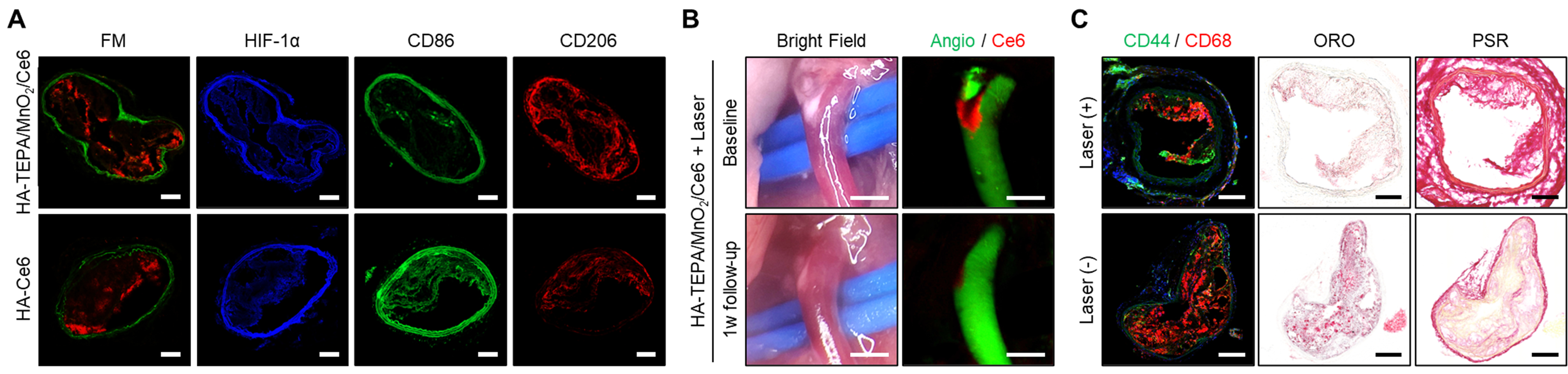
Abstract Body: Introduction: Atherosclerosis is a chronic inflammatory disease driven by the dense infiltration of immune cells, particularly M1-polarized macrophages, within arterial plaques. Photoactivation presents a promising theranostic strategy by generating reactive oxygen species to eliminate inflammatory cells and promote healing. However, as lesions advance, the localized hypoxic microenvironment stabilizes hypoxia-inducible factor-1α (HIF-1α), which not only exacerbates pro-inflammatory signaling and M1 polarization but also severely limits the efficacy of oxygen-dependent treatment. We hypothesized that macrophage-targeted, oxygen-generating theranostic photoactivation could alleviate hypoxia, driving inflammation resolution and stabilizing hypoxic atherosclerotic plaques. Method and results: We synthesized a macrophage-targeted, oxygen-generating, photoactivatable agent comprising hyaluronic acid for CD44 ligand, manganese dioxide (MnO2) for in situ oxygen generation via H2O2 decomposition, and chlorin e6 (Ce6) for near-infrared fluorescence (NIRF) imaging and phototherapy (HA-TEPA/MnO2/Ce6). In hypoxic atherosclerotic murine models, we intravenously administered a multifunctional agent at a Ce6-equivalent dose of 3 mg/kg. In vivo NIRF imaging confirmed that the agents selectively accumulated in CD68+ macrophage-rich regions within the plaques. Notably, the MnO2-mediated oxygen generation significantly attenuated HIF-1α expression and triggered a phenotypic shift from M1 to M2 macrophages (p < 0.01). Serial intravital imaging revealed that oxygenation-enhanced photoactivation exhibited a remarkable reduction in inflammatory NIRF signals within plaques at 1-week post-laser irradiation. Histologically, oxygen-generating photoactivation induced inflammation resolution and stabilization (p < 0.01). Together, these findings demonstrated the synergistic effect of the MnO2-mediated mechanism and oxygenation-enhanced phototherapy enabled effective plaque regression and stabilization. Conclusion: Macrophage-targeted oxygen-generating theranostic photoactivation effectively reverses the hypoxic-inflammatory milieu of advanced plaques. By alleviating hypoxia and driving M1-to-M2 polarization, this agent enables oxygen-augmented photoactivation that not only resolves inflammation but also stabilizes hypoxic atherosclerotic plaques. This study highlights a transformative theranostic approach for personalized management of coronary artery disease.
Kim, Jin Hyuk
(
Korea University Guro Hospital
, Seoul , Korea (the Republic of) )
Lim, Yong Geun
(
Chung-Ang University
, Anseong , Korea (the Republic of) )
Kim, Ryeong Hyun
(
Korea University Guro Hospital
, Seoul , Korea (the Republic of) )
Park, Ye Hee
(
Korea University Guro Hospital
, Seoul , Korea (the Republic of) )
Shin, Seung Ho
(
Korea University Guro Hospital
, Seoul , Korea (the Republic of) )
Yoo, Hongki
(
KAIST
, Daejeon , Korea (the Republic of) )
Park, Kyeongsoon
(
Chung-Ang University
, Anseong , Korea (the Republic of) )
Kim, Jin Won
(
Korea University Guro Hospital
, Seoul , Korea (the Republic of) )
Author Disclosures:
Jin Hyuk Kim:DO NOT have relevant financial relationships
| Yong Geun Lim:No Answer
| Ryeong Hyun Kim:DO NOT have relevant financial relationships
| Ye Hee Park:No Answer
| Seung Ho Shin:DO NOT have relevant financial relationships
| Hongki Yoo:No Answer
| Kyeongsoon Park:DO NOT have relevant financial relationships
| Jin Won Kim:No Answer
Kim Jin Hyuk, Park Kyeongsoon, Kim Jin Won, Kim Yeon Hoon, Kim Hyun Jung, Kim Ryeong Hyun, Park Ye Hee, Nam Hyeong Soo, Shin Seung Ho, Kang Dong Oh, Yoo Hongki
4505019_File000000.jpg
You have to be authorized to contact abstract author. Please, Login