
Logo

American Heart Association

  2
  0


Final ID: Fri054

Chronic Psychological Stress Accelerates Pro-Inflammatory Macrophage Polarization Revealed by Intravital Cell Trafficking Imaging

Abstract Body: Introduction
Chronic mental stress accelerates atherosclerosis by amplifying macrophage-driven inflammation within the vasculature. Pro-inflammatory M1 macrophages play a central role in plaque instability and rupture; however, real-time in vivo assessment of pro-inflammatory macrophage activity within atherosclerotic plaques, particularly in the context of chronic stress, remains challenging. Given that M1 macrophages exhibit high surface expression of CD44 receptors with strong binding affinity for hyaluronic acid (HA), we hypothesized that an HA-targeted cellular trafficking imaging strategy could enable in vivo assessment of the dynamic biological behavior of pro-inflammatory macrophages within murine atheroma under chronic stress conditions.

Methods and Results
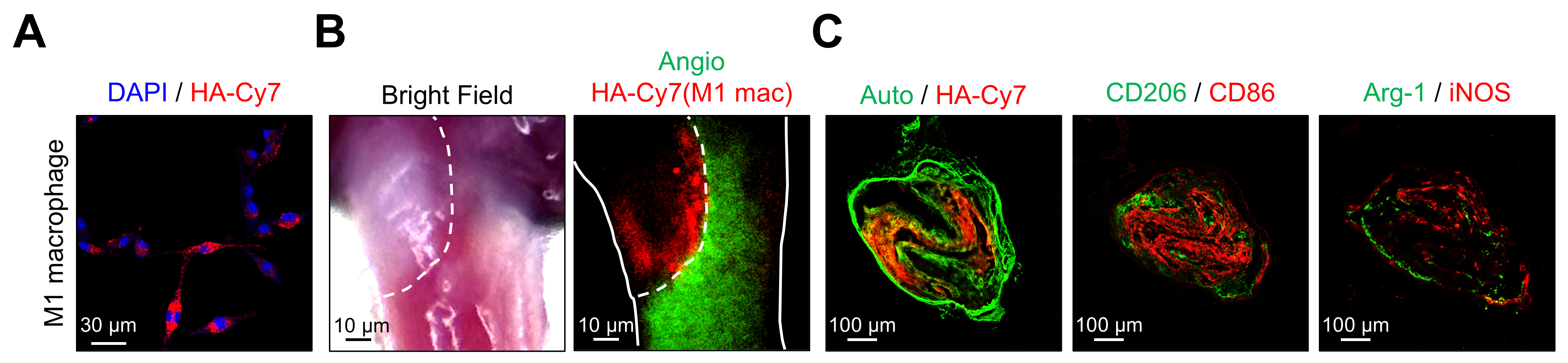
An M1 macrophage-targeted NIRF imaging agent was newly synthesized by conjugating HA with cyanine-7 (Cy7). In vitro studies using RAW264.7 macrophages polarized toward the M1 (LPS/IFN-γ) or M2 (IL-4) phenotype demonstrated selective uptake of HA-Cy7 by M1 macrophages, yielding a 7.2-fold higher fluorescence signal compared with M2 macrophages (p < 0.01), as quantified by custom fluorescence microscopy (Figure). For in vivo studies, ApoE-/- mice were subjected to a 4-week cyclic chronic variable stress (CVS) protocol. Forty-eight hours after intravenous administration of HA-Cy7 (equivalent to Cy7 0.5 mg/kg), selective accumulation of HA-Cy7 within plaque macrophages was prominently visualized using a novel heartbeat- and respiration-synchronized multispectral intravital imaging as compared to controls (p<0.01) (Figure). In vivo NIRF imaging revealed significantly enhanced M1-associated signals within carotid atheromata of stressed mice, accompanied by increased rolling and adherent cellular trafficking, providing real-time evidence of stress-augmented pro-inflammatory macrophage activity (p < 0.01). These findings were further corroborated by quantitative ex vivo fluorescence imaging and immunohistochemical analysis (p < 0.01).

Conclusions
This study provides robust in vivo evidence linking chronic psychological stress to heightened pro-inflammatory macrophage activity within atherosclerotic plaques. CD44-targeted intravital macrophage imaging represents a promising strategy for elucidating the mechanistic interplay between stress-associated plaque inflammation and high-risk vascular events, and could offer new opportunities for imaging-guided assessment of plaque vulnerability.
  • Shin, Seung Ho  ( Korea University Guro Hospital , Seoul , Korea (the Republic of) )
  • Jang, Minseok  ( KAIST , Daejeon , Korea (the Republic of) )
  • Song, Yeong Jun  ( Chung-Ang University , Anseong , Korea (the Republic of) )
  • Kim, Jin Hyuk  ( Korea University Guro Hospital , Seoul , Korea (the Republic of) )
  • Kim, Ryeong Hyun  ( Korea University Guro Hospital , Seoul , Korea (the Republic of) )
  • Park, Ye Hee  ( Korea University Guro Hospital , Seoul , Korea (the Republic of) )
  • Yoo, Hongki  ( KAIST , Daejeon , Korea (the Republic of) )
  • Park, Kyeongsoon  ( Chung-Ang University , Anseong , Korea (the Republic of) )
  • Kim, Jin Won  ( Korea University Guro Hospital , Seoul , Korea (the Republic of) )
  • Author Disclosures:
    Seung Ho Shin: DO NOT have relevant financial relationships | Minseok Jang: No Answer | Yeong Jun Song: No Answer | Jin Hyuk Kim: DO NOT have relevant financial relationships | Ryeong Hyun Kim: DO NOT have relevant financial relationships | Ye Hee Park: No Answer | Hongki Yoo: No Answer | Kyeongsoon Park: DO NOT have relevant financial relationships | Jin Won Kim: No Answer
Meeting Info:
Session Info:

15. Poster Session 3 & Reception

Friday, 05/15/2026 , 05:00PM - 07:00PM

Poster

More abstracts on this topic:
A major uremic toxin indoxyl sulfate impairs macrophage efferocytosis and accelerates atherogenesis: a potential mechanism for cardiovascular risk in chronic kidney disease

Jha Prabhash, Kasai Taku, Vromman Amelie, Holden Rachel, Libby Peter, Tabas Ira, Singh Sasha, Aikawa Elena, Aikawa Masanori, Lupieri Adrien, Sonawane Abhijeet, Le Thanh-dat, Becker-greene Dakota, Chelvanambi Sarvesh, Turner Mandy, Nakamura Yuto, Passos Livia

2-Deoxyuridine Associates with Recurrent Coronary Events

Pistritu Dan, Castano David, Liehn Elisa, Koh Cho Yeow, Gerszten Robert, Singaraja Roshni, Chan Mark, Shah Svati

More abstracts from these authors:
Macrophage-Targeted Theranostic Photoactivation Drives Inflammation Resolution and Stabilization of Atherosclerotic Plaques through Autophagy, Efferocytosis, and TGF-β-mediated Fibrotic Replacement

Kim Jin Hyuk, Park Kyeongsoon, Kim Jin Won, Kim Yeon Hoon, Kim Hyun Jung, Kim Ryeong Hyun, Park Ye Hee, Nam Hyeong Soo, Shin Seung Ho, Kang Dong Oh, Yoo Hongki

Macrophage-Targeted Oxygen-Generating Theranostic Photoactivation Facilitates Inflammation Resolution and Stabilization of Hypoxic Atherosclerotic Plaques

Kim Jin Hyuk, Lim Yong Geun, Kim Ryeong Hyun, Park Ye Hee, Shin Seung Ho, Yoo Hongki, Park Kyeongsoon, Kim Jin Won

You have to be authorized to contact abstract author. Please, Login
Not Available