
Logo

American Heart Association

  1
  0


Final ID: Fri005

The Histone Acetyltransferase MOF Regulates Macrophage Inflammation During Abdominal Aortic Aneurysm Development

Abstract Body: Objective: Abdominal aortic aneurysms (AAAs) are a life-threatening disease for which there is a lack of effective therapy preventing rupture. During AAA formation, pathological vascular remodeling is driven by macrophage infiltration, and the mechanisms regulating macrophage-mediated inflammation remain undefined. Recent evidence suggests that MOF, a histone acetyltransferase that acetylates histone 4 lysine 16 (H4K16), has been shown to regulate inflammatory gene transcription, however its role in macrophage inflammation and cardiovascular disease remains to be defined. The objective of this study was to determine the role of MOF in regulating macrophage inflammation and AAA development.
Methods: Single-cell RNA sequencing was performed on human AAA and non-aneurysmal control aortic tissue to analyze MOF expression in monocyte/macrophage populations (n=14). Two murine AAA models were utilized, including angiotensin II (AngII) infusion and topical elastase treatment. To investigate the role of MOF in AAA formation, mice underwent pharmacologic inhibition with MG-149 (1mg/kg) or macrophage-specific genetic deletion of MOF (Mof−/−MΦ). Macrophage inflammatory gene expression was analyzed by qPCR, ELISA, and flow cytometry. Chromatin immunoprecipitation was conducted to assess levels of H4K16ac in human and murine AAA macrophages.
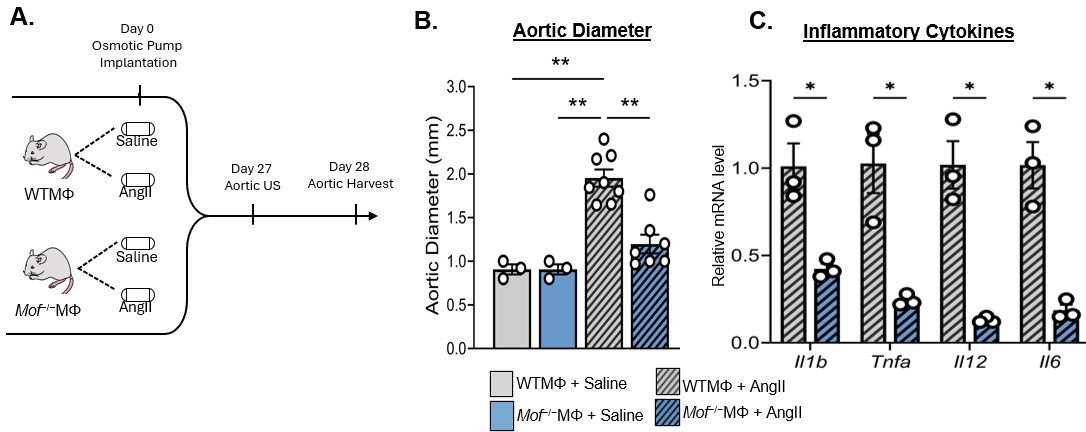
Results: Single-cell transcriptomic analysis demonstrated that MOF expression was increased in monocytes/macrophages from human AAA tissue compared to non-aneurysmal controls. MOF expression was similarly elevated in macrophages from both AngII- and elastase-induced murine AAAs. Increased MOF expression was associated with increased H4K16ac deposition on NF-κB–regulated inflammatory gene promoters, including Il1b and Tnfa, resulting in enhanced inflammatory gene transcription and altered macrophage phenotype. Pharmacologic inhibition or macrophage-specific genetic deletion of MOF (Mof−/−) significantly reduced H4K16ac levels within macrophages and promoted an anti-inflammatory phenotype (Figure 1A-C). Additionally, MOF inhibition reduced AAA formation, preserved aortic wall architecture, decreased elastin fragmentation, and attenuated macrophage-mediated inflammation.
Conclusions: MOF regulates macrophage inflammation during AAA development through epigenetic control of NF-κB–mediated inflammatory gene transcription. Targeting the MOF pathway may provide a therapeutic strategy to prevent AAA progression.
  • Salih, Sama  ( University of Michigan , Lake Orion , Michigan , United States )
  • He, Xiaobing  ( University of Michigan , Lake Orion , Michigan , United States )
  • Juriga, Nicholas  ( University of Michigan , Lake Orion , Michigan , United States )
  • Pierre-louis, Dominique  ( University of Michigan , Lake Orion , Michigan , United States )
  • Callow, Brennan  ( University of Michigan , Lake Orion , Michigan , United States )
  • Joshi, Amrita  ( University of Michigan , Lake Orion , Michigan , United States )
  • Wasikowski, Rachael  ( University of Michigan , Lake Orion , Michigan , United States )
  • Obi, Andrea  ( University of Michigan , Lake Orion , Michigan , United States )
  • Gudjonsson, Johann  ( University of Michigan , Lake Orion , Michigan , United States )
  • Gallagher, Katherine A  ( The University of Michigan , Ann Arbor , Michigan , United States )
  • Davis, Frank  ( The University of Michigan , Ann Arbor , Michigan , United States )
  • Author Disclosures:
    Sama Salih: DO NOT have relevant financial relationships | Katherine A Gallagher: No Answer | Frank Davis: DO NOT have relevant financial relationships | XIAOBING HE: No Answer | Nicholas Juriga: DO NOT have relevant financial relationships | Dominique Pierre-Louis: No Answer | Brennan Callow: No Answer | Amrita Joshi: No Answer | Rachael Wasikowski: No Answer | Andrea Obi: DO have relevant financial relationships ; Research Funding (PI or named investigator):Surmodics:Active (exists now) ; Research Funding (PI or named investigator):Medtronic:Active (exists now) | Johann Gudjonsson: No Answer
Meeting Info:
Session Info:

15. Poster Session 3 & Reception

Friday, 05/15/2026 , 05:00PM - 07:00PM

Poster

More abstracts on this topic:
A meta-analysis of RNA sequencing data to characterize immune cell activation among patients with cardiac sarcoidosis

Banga Natasha, Huang Yuhsin, Chou Harrison, Vitale Maria Rosaria, Baker Matthew, Witteles Ronald, Zhu Han

Active Screening in Black, Hispanic/LatinX, Asian/Pacific Islander, and Native American Individuals Reduces Racial Disparities in Abdominal Aortic Aneurysm Diagnosis

Miner Grace, Govindarajulu Usha, Smolock Christopher, Faries Peter, Marin Michael

More abstracts from these authors:
Mixed-Lineage Leukemia 1 (MLL1) Regulates T Cell Phenotype Signaling During Abdominal Aortic Aneurysm Development

Juriga Nicholas, Callow Brennan, He Xiaobing, Mangum Kevin, Bauer Tyler, Joshi Amrita, Obi Andrea, Gallagher Katherine, Davis Frank

The Histone Methyltransferase MLL1 Regulates Notch Signaling and T Cell Phenotype During Pathologic Abdominal Aortic Aneurysm Development

Callow Brennan, He Xiaobing, Mangum Kevin, Bauer Tyler, Joshi Amrita, Obi Andrea, Gallagher Katherine A, Davis Frank

You have to be authorized to contact abstract author. Please, Login
Not Available