Biaxial Mechanics of Murine Abdominal Aortic Aneurysm Tissue to Model Human Disease
Abstract Body: Objectives Murine models for infrarenal abdominal aortic aneurysms (AAAs) are desirable for evaluating mechanisms of disease and developing novel effective therapies. While various murine models for AAA formation have been developed, the vast majority lack aortic tissue bio-mechanical assessments that replicate human disease, notably tissue stiffness attributed to loss of elastin. We therefore hypothesized that in a novel murine model for AAA formation, designed to replication human pathology, biaxial mechanics can help confirm fidelity relative to histopathological characterizations.
Methods Ten mice underwent open laparotomy and infrarenal aortic exposure, followed by a 10-minute dwell time of 20mg/mL papain followed by 10.3mg/mL elastase, and were subsequently survived for 6 weeks. Aortic growth was monitored using abdominal ultrasound. Explanted descending thoracic aortas (DTAs) and AAAs were micro-cannulated, subjected to 4 cycles of pressure preconditioning (10-140mmHg), and biaxial mechanical assessment was conducted utilizing 3 pressure-diameter protocols from 10-140mmHg at 95%, 100%, and 105% in-vivo stretch, and 4 force-length protocols at 10, 60, 100, and 140mmHg. Aortic tissue were then sectioned and histopathologically evaluated.
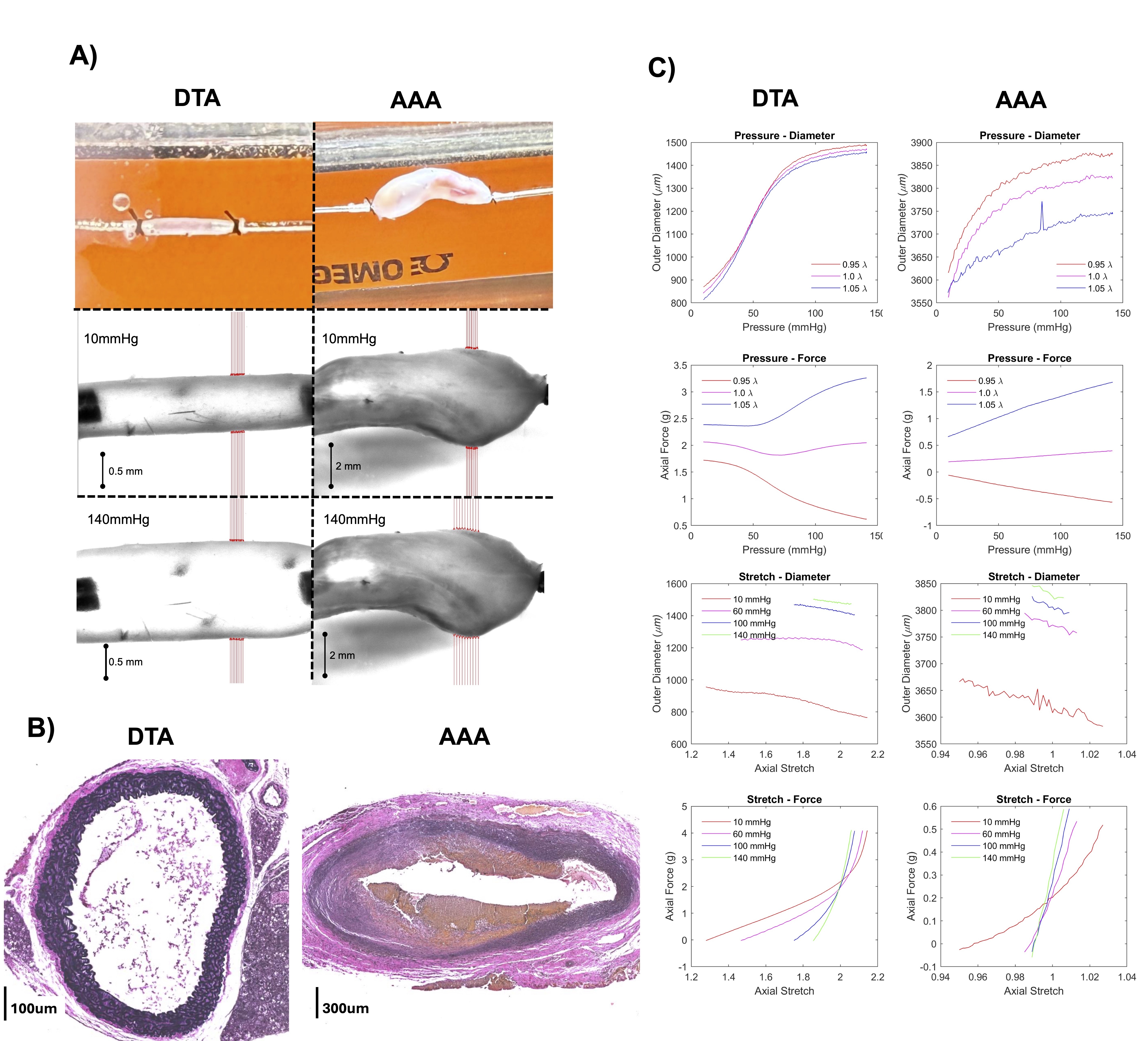
Results In week 1, 3 periprocedural mortalities occurred, and 3 AAA ruptured prior to the 6-week endpoint. In the remaining mice, AAAs expanded over the 6 weeks followup (baseline 0.58mm +/- 0.04, 3 weeks 2.91mm +/- 0.38, 6 weeks 4.29mm +/- 0.68; p < 0.01). Cannulation of the DTA and AAAs for mechanical assessment is presented in Figure 1A, under 10mmHg and 140mmHg intraluminal pressure respectively. Representative VVG stains of vessel cross-sections are presented in Figure 1B, demonstrating an increased wall thickness, increased collagen content, and reduced elastin in the AAA wall. Biaxial mechanics of AAAs demonstrated increased circumferential stiffness with associated loss of the sigmoid pressure-diameter relationship (Figure 1C) and increased axial stiffness.
Conclusions The novel murine combined elastase and papain infrarenal AAA model continues to expand over a 6 weeks. AAA disease pathology and biomechanics are highly consistent with human AAA disease pathology. Further studies using this unique model will facilitate genetic and molecular investigations that will improve our understanding of disease risk, progression, and mitigation strategies.
Wahidi, Ryan
(
Washington University School of Med
, St. Louis , Missouri , United States )
Otani, Brendan
(
Washington University
, St. Louis , Missouri , United States )
Elizondo Benedetto, Santiago
(
Washington University
, Saint Louis , Missouri , United States )
Arif, Batool
(
Washington University School of Med
, St. Louis , Missouri , United States )
Braasch, Maxwell
(
Washington University School of Med
, St. Louis , Missouri , United States )
Bersi, Matthew
(
Washington University in St. Louis
, Saint Louis , Missouri , United States )
Zayed, Mohamed
(
WASHINGTON UNIVERSITY SCHOOL M
, Saint Louis , Missouri , United States )
Author Disclosures:
Ryan wahidi:DO NOT have relevant financial relationships
| Brendan Otani:DO NOT have relevant financial relationships
| Santiago Elizondo Benedetto:DO NOT have relevant financial relationships
| Batool Arif:No Answer
| Maxwell Braasch:No Answer
| Matthew Bersi:DO NOT have relevant financial relationships
| Mohamed Zayed:DO have relevant financial relationships
;
Ownership Interest:Caeli Vascular, Inc:Active (exists now)
; Consultant:Glucotrack:Active (exists now)
; Consultant:Ascera Surgical:Active (exists now)
; Consultant:Medtronic, Inc:Active (exists now)
; Consultant:Amgen, Inc:Active (exists now)
; Ownership Interest:Vascorra, LLC:Active (exists now)
; Ownership Interest:AirSeal Cardiovascular, Inc:Active (exists now)