Renin Angiotensin System Inhibitors and Arterial Stiffness in Chronic Kidney Disease: Results from The Chronic Renal Insufficiency Cohort Study
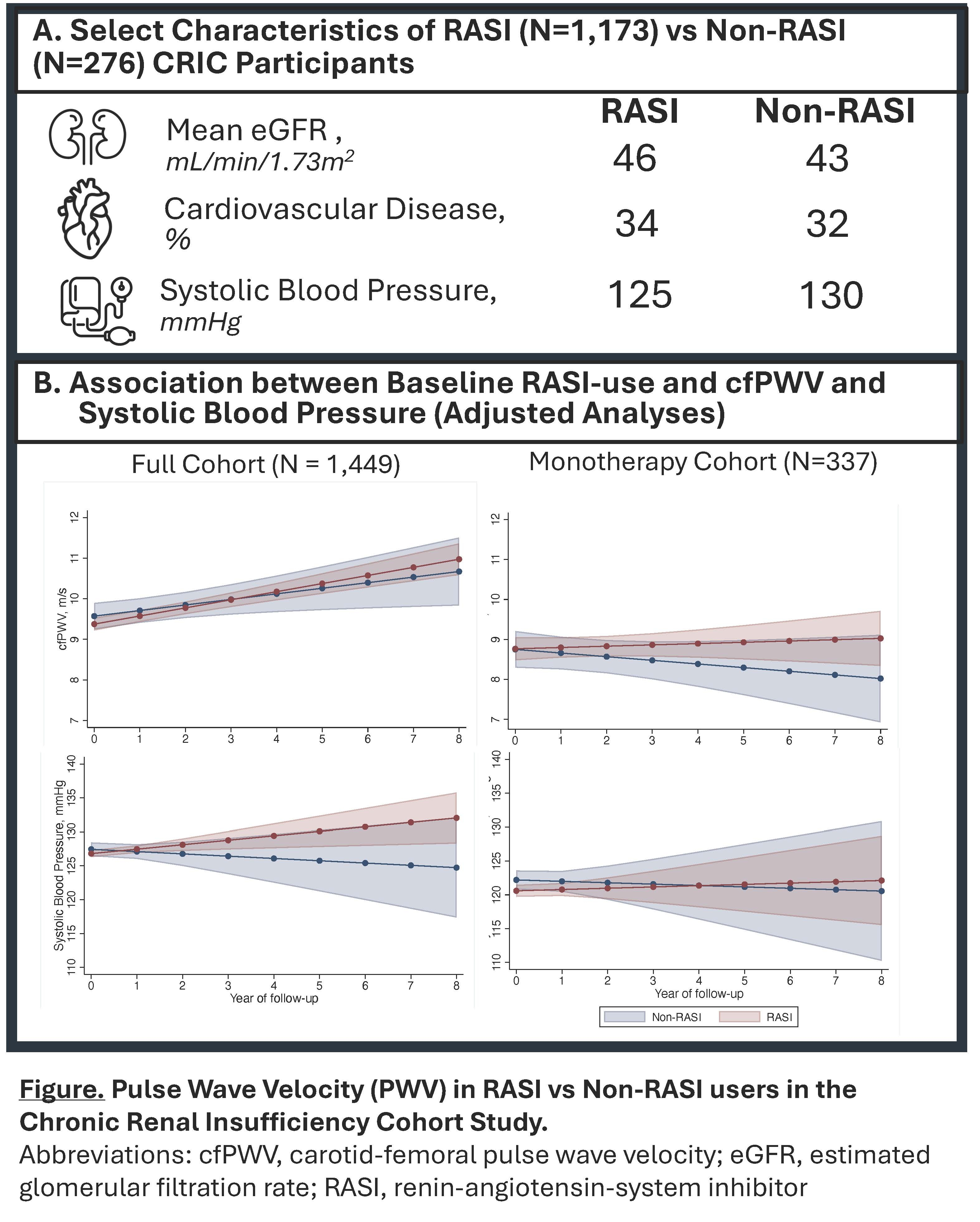
Abstract Body: BACKGROUND: Chronic kidney disease (CKD) is associated with accelerated arterial stiffness, which contributes to its high burden cardiovascular disease. There is conflicting evidence on whether renin-angiotensin system inhibitors (RASIs) prevent arterial stiffness. METHODS: We investigated the association between RASIs and yearly changes in carotid-femoral pulse wave velocity (cfPWV) – a measure of arterial stiffness – versus non-RASI antihypertensive medications using a linear mixed-effects model among participants in the Chronic Renal Insufficiency Cohort (CRIC) Study. We adjusted for baseline age, sex, race-ethnicity, education, eGFR, urine protein-to-creatinine ratio, systolic blood pressure, diastolic blood pressure, diabetes, statin use, aspirin use. As a secondary analysis, we restricted the cohort to participants on one antihypertensive medication at baseline. Lastly, we used a linear mixed-effects model to evaluate the relationship between RASI use and systolic blood pressure over time. RESULTS: Of the 1,449 participants who met inclusion criteria, 1,173 were on RASI and 276 were on a non-RASI medication. The average number of cfPWV measurements was 2.4 per participant, with a median follow up duration of 2 years. RASI users were more likely to be male (60% vs 45%), have diabetes (50% vs 33%), have a higher eGFR (46 vs 43 mL/min/1.73m2), and report statin use (66% vs 55%). Individuals on RASIs had a non-significant increase in cfPWV (adjusted cfPWV 0.13 m/s, 95% CI 0.08 to 0.19) and compared to non-RASI users (adjusted cfPWV 0.05 m/s, 95% CI -0.06 to 0.16; p=0.20. In the monotherapy cohort (N=337), there was no difference in yearly change in cfPWV between RASI (0.04 m/s, 95% CI -0.06 to 0.13) and non-RASI users (-0.09 m/s, 95% CI -0.25 to 0.06; p=0.17). In both cohorts, there was no difference in systolic blood pressure over time between RASI and non-RASI users. CONCLUSIONS: Our study did not find a significant difference between arterial stiffness in participants on RASIs vs non-RASIs over several years of follow up. To our knowledge, prior studies have not evaluated these relationships among individuals with CKD, who may have distinctively lower response to RASIs due to competing mechanisms driving their large artery stiffness. Future research should focus on identifying and testing treatments for alternative targetable mechanisms for the accelerated large artery stiffness in patients with CKD.
Shulman, Rachel
(
University of Pennsylvania
, Philadelphia , Pennsylvania , United States )
Cohen, Debbie
(
University of Pennsylvania
, Philadelphia , Pennsylvania , United States )
Townsend, Ray
(
University of Pennsylvania
, Philadelphia , Pennsylvania , United States )
Cohen, Jordana
(
University of Pennsylvania
, Philadelphia , Pennsylvania , United States )
Author Disclosures:
Rachel Shulman:DO NOT have relevant financial relationships
| Debbie Cohen:DO have relevant financial relationships
;
Research Funding (PI or named investigator):medtronic:Active (exists now)
; Research Funding (PI or named investigator):Mineralys:Active (exists now)
; Advisor:Kardigan:Active (exists now)
; Advisor:novartis:Active (exists now)
; Individual Stocks/Stock Options:recor:Active (exists now)
| Ray Townsend:No Answer
| Jordana Cohen:DO NOT have relevant financial relationships