Relationship Between Medication Class and Ambulatory Blood Pressure Profile in the Chronic Renal Insufficiency Cohort
Abstract Body: Introduction: Patients with chronic kidney disease (CKD) are at heightened risk for masked and nocturnal hypertension, conditions best identified through ambulatory blood pressure monitoring (ABPM). Our goal was to evaluate whether specific antihypertensive drug classes are associated with particular ABPM phenotypes.
Methods: We conducted a cross-sectional analysis of participants from the Chronic Renal Insufficiency Cohort (CRIC), enrolled in 2003–2008, with ABPM data from 2008–2012. Antihypertensive medications were categorized into four classes: renin-angiotensin-aldosterone system inhibitors (RASis), beta blockers, calcium channel blockers (CCBs), and thiazide/loop diuretics. We used nominal logistic regression to evaluate the association between medication class and ABPM phenotype: controlled hypertension, white coat effect, sustained hypertension, and masked uncontrolled hypertension (MUCH). Secondary outcomes included nocturnal hypertension, dipping status, and blood pressure (BP) variability, assessed using adjusted logistic and linear regression models. All analyses were adjusted for key sociodemographic and clinical factors.
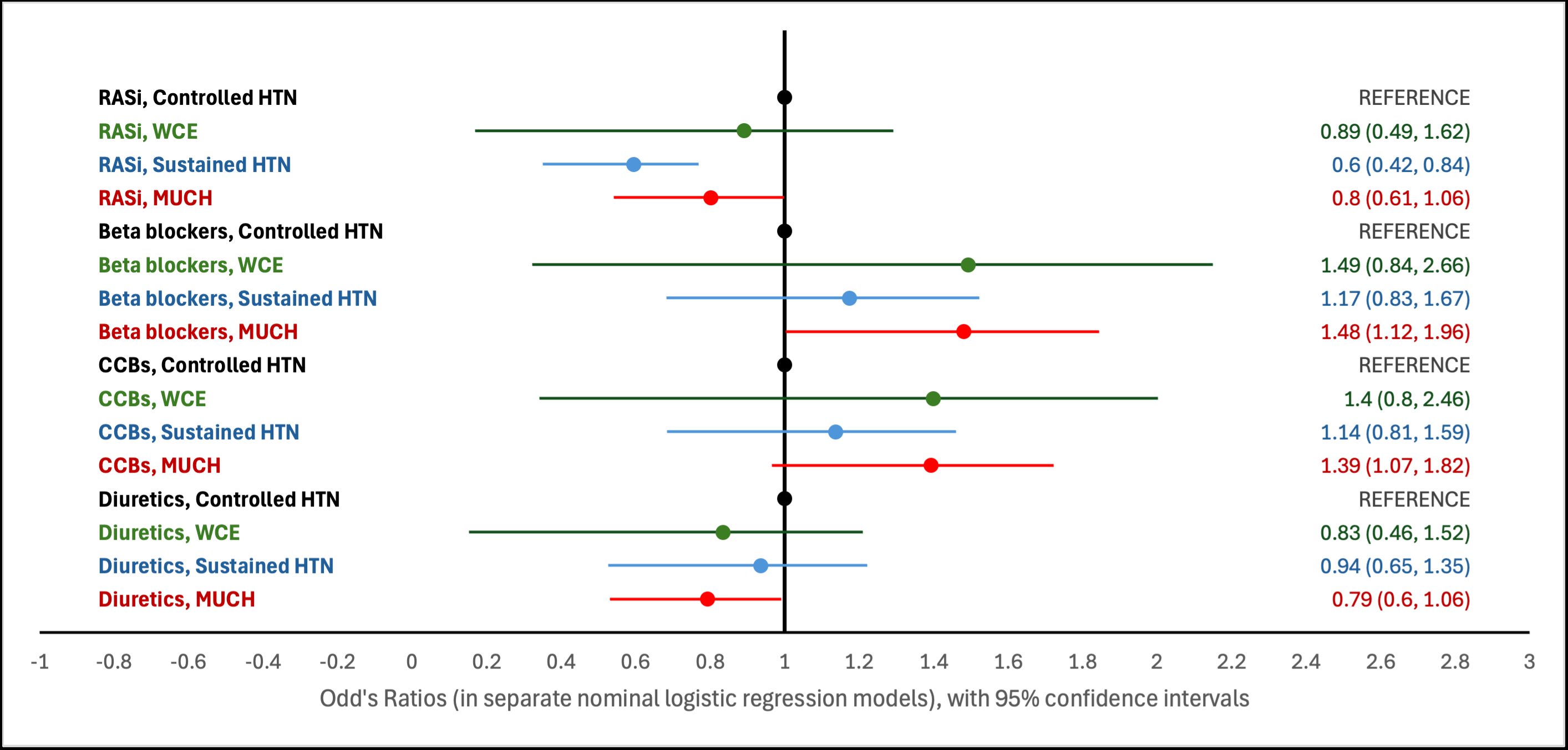
Results: Among 1,499 participants, 66% used RASis, 52% beta blockers, 43% CCBs, and 50% thiazide/loop diuretics. RASi use was inversely associated with sustained hypertension (OR 0.60, 95% CI 0.42 to 0.84), while beta blocker use was positively associated with MUCH (OR 1.48, 95% CI: 1.12 to 1.96). In secondary analyses, RASis were linked to lower odds of nocturnal hypertension (OR 0.71, 95% CI: 0.55 to 0.91), whereas CCBs were associated with higher odds of nocturnal hypertension (OR 1.36, 95% CI 1.07 to 1.73). CCB use was also inversely associated with BP variability.
Conclusion: In patients with CKD, beta blockers are associated with MUCH and CCBs with nocturnal hypertension. Patients on these antihypertensive classes may benefit from undergoing ABPM, even when office BP appears controlled. Further research to understand the reproducibility and mechanisms of these findings is warranted.
Pasricha, Sachin Vidur
(
University of Toronto
, Toronto , Ontario , Canada )
Cohen, Debbie
(
UNIV OF PENNSYLVANIA
, Philadelphia , Pennsylvania , United States )
Shulman, Rachel
(
University of Pennsylvania
, Philadelphia , Pennsylvania , United States )
Byfield, Rushelle
(
Columbia University
, New York , New York , United States )
Cohen, Jordana
(
University of Pennsylvania
, Philadelphia , Pennsylvania , United States )
Author Disclosures:
Sachin Vidur Pasricha:DO have relevant financial relationships
;
Consultant:AstraZeneca:Active (exists now)
| Debbie Cohen:DO have relevant financial relationships
;
Research Funding (PI or named investigator):medtronic:Active (exists now)
; Research Funding (PI or named investigator):Mineralys:Active (exists now)
; Advisor:Kardigan:Active (exists now)
; Advisor:novartis:Active (exists now)
; Individual Stocks/Stock Options:recor:Active (exists now)
| Rachel Shulman:DO NOT have relevant financial relationships
| Rushelle Byfield:DO NOT have relevant financial relationships
| Jordana Cohen:DO NOT have relevant financial relationships