The Higher Cost of Validated Extra-Large Cuff Compatible Home Blood Pressure Devices May Widen Hypertension Disparities
Abstract Body: Introduction: Hypertension is the leading risk factor for cardiovascular disease, affecting nearly half of US adults. Accurate diagnosis and management depends on out-of-office blood pressure (BP) monitoring with appropriately sized cuffs. The number of US adults requiring extra-large (XL) BP cuffs and the cost to purchase these cuffs compared to standard BP devices is not known. Further, the impact of cuff size and cost differences on various racial/ethnic groups has not been characterized.
Hypothesis: We hypothesize that XL cuff compatible home BP devices are significantly more expensive than standard cuff devices.
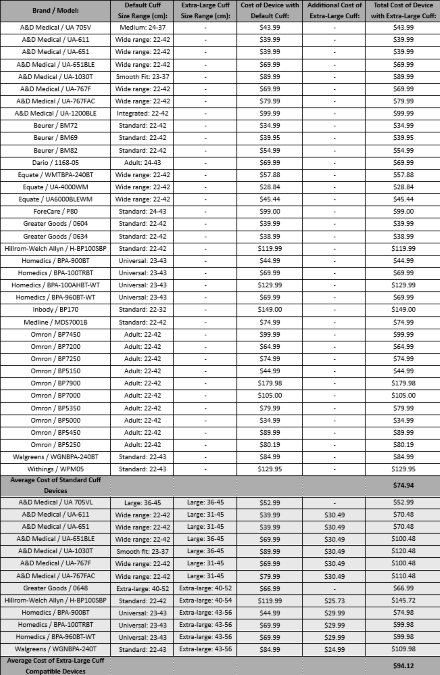
Methods: To evaluate population burden, we analyzed National Health and Nutrition Examination Survey (NHANES) 2021–2023 data using survey-weighted methods and defining hypertension as measured BP ≥130/80 mm Hg or self-reported hypertensive medication use. We categorized commercially available home BP devices from the US Validated Device Listing (VDL) website (www.validatebp.org) as standard (22–43 cm) or XL cuff compatible (>43 cm). To determine cost, we used manufacturer’s suggested retail price when available; otherwise, we used the list price from major online retailers (Amazon, CVS, Walgreens, and Walmart) as of May 2025. If sold separately, we included the cost of the XL cuff. We performed a two-sample t-test assuming unequal variances (p<0.05) to compare the mean costs.
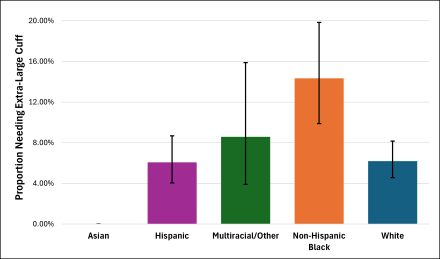
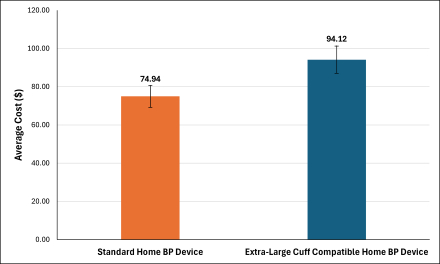
Results: Among hypertensive US adults, an estimated 7.1% (8.06 million) had an arm circumference >43 cm. The prevalence of hypertensive adults needing XL cuffs was highest among Non-Hispanic Black adults (14.3%; 95% confidence interval [CI], 9.9–19.8%), followed by Multiracial/Other adults (8.6%; 95% CI, 3.9–15.9%), White adults (6.2%; 95% CI, 4.6–8.2%), and Hispanic adults (6.1%; 95% CI, 4.0–8.7%). Estimates for Asian adults were suppressed per National Center for Health Statistics (NCHS) reporting standards. Of the 50 devices on the VDL, only 13 were XL cuff compatible. The average cost for the separately purchased XL cuff was $29.51, representing a 25.6% cost increase ([$94.12; standard error, $7.13] vs. [$74.94; standard error, $5.75]; p = 0.045).
Conclusion: BP devices that are XL cuff compatible are significantly more expensive than standard devices. This cost difference disproportionately affects non-Hispanic Black adults who have both higher rates of hypertension and poorer control and thus may exacerbate existing inequities in hypertension outcomes.
Sahoo, Sumit
(
Northeastern University
, Schenectady , New York , United States )
Brady, Tammy
(
Johns Hopkins University
, Baltimore , Maryland , United States )
Grobman, Benjamin
(
Harvard Medical School
, Boston , Massachusetts , United States )
Juraschek, Stephen
(
BIDMC-Harvard Medical School
, Boston , Massachusetts , United States )
Cluett, Jennifer
(
BIDMC-Harvard Medical School
, Boston , Massachusetts , United States )
Author Disclosures:
Sumit Sahoo:DO NOT have relevant financial relationships
| Tammy Brady:DO NOT have relevant financial relationships
| Benjamin Grobman:DO NOT have relevant financial relationships
| Stephen Juraschek:DO NOT have relevant financial relationships
| Jennifer Cluett:DO NOT have relevant financial relationships