Intensive Blood Pressure Control Reduces Subclinical Cardiac Injury among Adults with Orthostatic Hypotension or Orthostatic Hypertension: Secondary Analysis of the Systolic Blood Pressure Intervention Trial (SPRINT)
Abstract Body: Introduction SPRINT found that intensive hypertension treatment (HTN) reduces cardiovascular disease events (CVD) and death. Secondary analyses, however, found an association between orthostatic hypotension (OH) and acute coronary syndrome, and intensive therapy did not appear to benefit adults with orthostatic hypertension (OHTN). Subclinical cardiac injury may underlie these observations.
Objectives To examine associations of OH and OHTN with biomarkers of subclinical cardiac injury—high-sensitivity cardiac I (hs-cTnI, a marker of cardiac damage) and NT-terminal pro-naturetic peptide NT-proBNP, a marker of strain)—and to assess the effect of intensive blood pressure (BP) therapy on changes in these biomarkers over the first year of SPRINT, stratifying by OH or OHTN status.
Methods This is a secondary analysis of SPRINT. Participants were randomly assigned to standard (<140 mmHg systolic BP [SBP]) or intensive (<120 mmHg SBP) treatments. Hs-cTnI and NT-proBNP were measured at baseline and at 12-months. OH and OHTN were defined as a drop or rise respectively in SBP >20 mmHg or diastolic BP >10 mmHg upon standing. OHTN was also assessed using a consensus definition: SBP increase >20 mmHg with a standing SBP >140 mmHg. We used mixed-effects Tobit models adjusted for age, sex, Black race, and history of CVD to assess associations between OH or OHTN status and baseline biomarker levels, and the effects of treatment, overall and stratified by OH or OHTN, on changes in biomarkers.
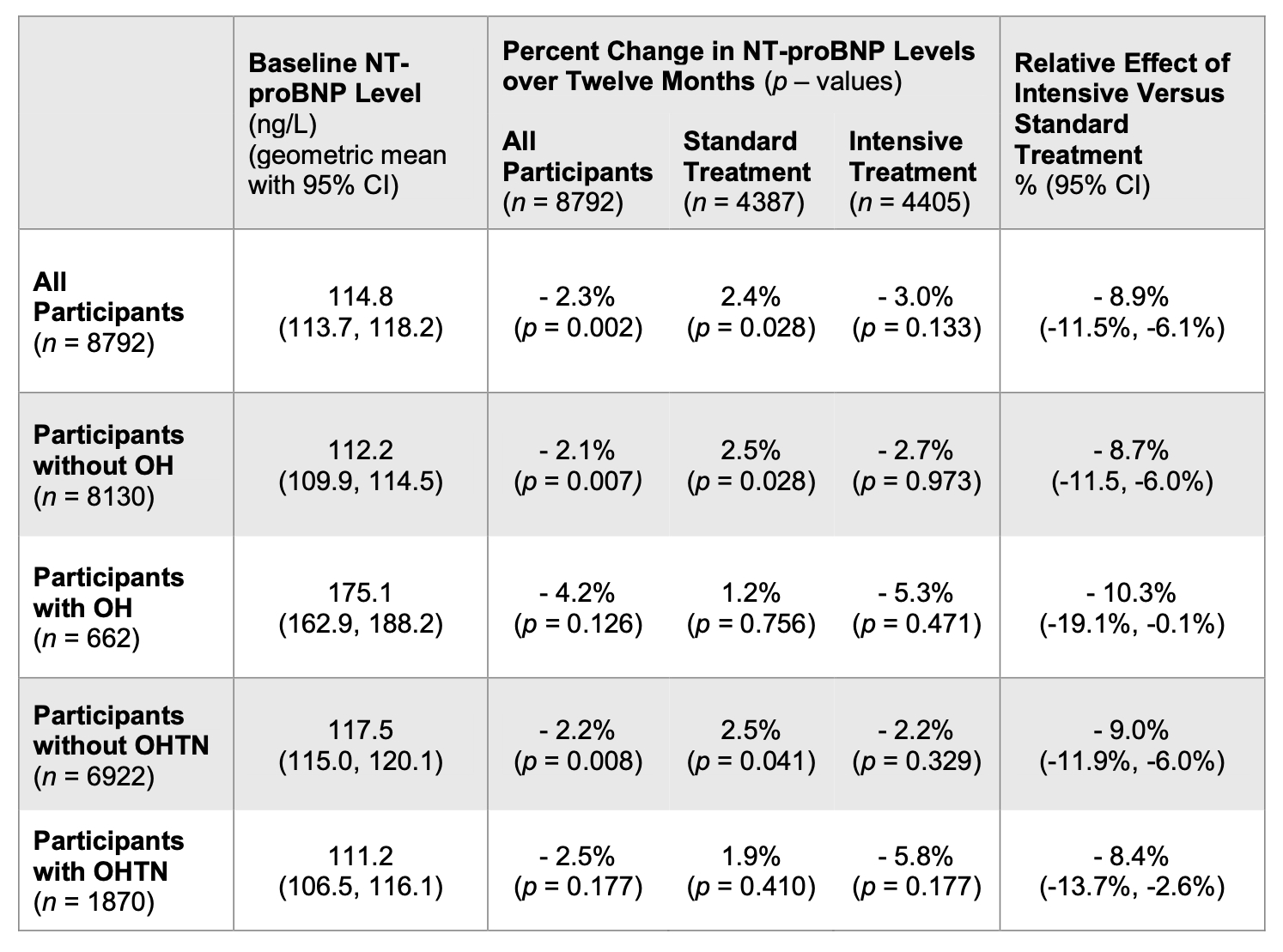
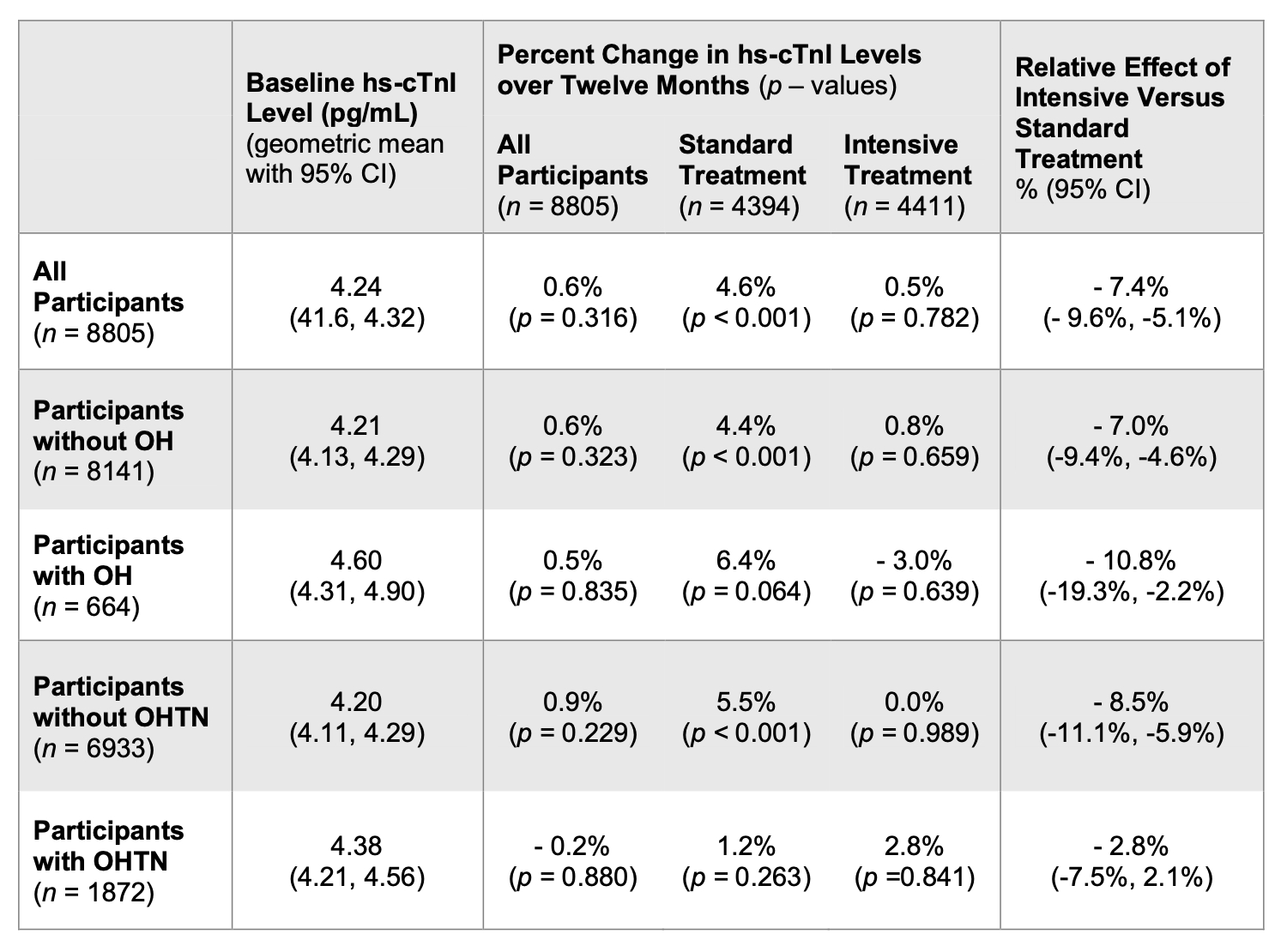
Results Of 9,329 participants (mean age 67.9 ± 9.4; 36% female; 31% Black), 7.3% had baseline OH, 21.3% had OHTN (standard definition), and 20.0% had prior CVD. Participants with OH at baseline had 56.3% higher NT-proBNP (p<0.001) and 9.2% higher hs-cTnI (p=0.013) levels than those without OH. OHTN was not associated with either biomarker. Intensive therapy reduced 12-month increases in NT-proBNP by 8.9% and hs-cTnI by 7.4% compared to standard therapy (p<0.001). When stratified by OH or OHTN status, intensive therapy was consistently associated with smaller increases in both biomarker levels (Tables 1-2). Results were similar using either OHTN definition.
Conclusion In this population of hypertensive adults at risk for CVD, OH, and not OHTN, was associated with subclinical injury. Nevertheless, on average, intensive BP therapy reduced cardiac injury in both groups. These findings support more aggressive HTN treatment among adults with OH or OHTN to reduce subclinical cardiac injury.
Rajesh, Shreyas
(
Harvard Medical School
, Boston , Massachusetts , United States )
Khan, Md Marufuzzaman
(
Beth Israel Deaconess Medical Cente
, Brookline , Massachusetts , United States )
Petriceks, Aldis
(
Beth Israel Deaconess Medical Center
, Boston , Massachusetts , United States )
Zhang, Mingyu
(
Beth Israel Deaconess Medical Center
, Boston , Massachusetts , United States )
Grobman, Benjamin
(
Harvard Medical School
, Boston , Massachusetts , United States )
Col, Hannah
(
Beth Israel Deaconess Medical Center
, Boston , Massachusetts , United States )
Ma, Yuan
(
Harvard University
, Boston , Massachusetts , United States )
Juraschek, Stephen
(
BIDMC-Harvard Medical School
, Boston , Massachusetts , United States )
Author Disclosures:
Shreyas Rajesh:DO NOT have relevant financial relationships
| Md Marufuzzaman Khan:DO NOT have relevant financial relationships
| Aldis Petriceks:No Answer
| Mingyu Zhang:DO NOT have relevant financial relationships
| Benjamin Grobman:DO NOT have relevant financial relationships
| Hannah Col:No Answer
| Yuan Ma:DO NOT have relevant financial relationships
| Stephen Juraschek:DO NOT have relevant financial relationships