Cardiac Rehabilitation In a Safety Net Population - Effects on Hypertension Management
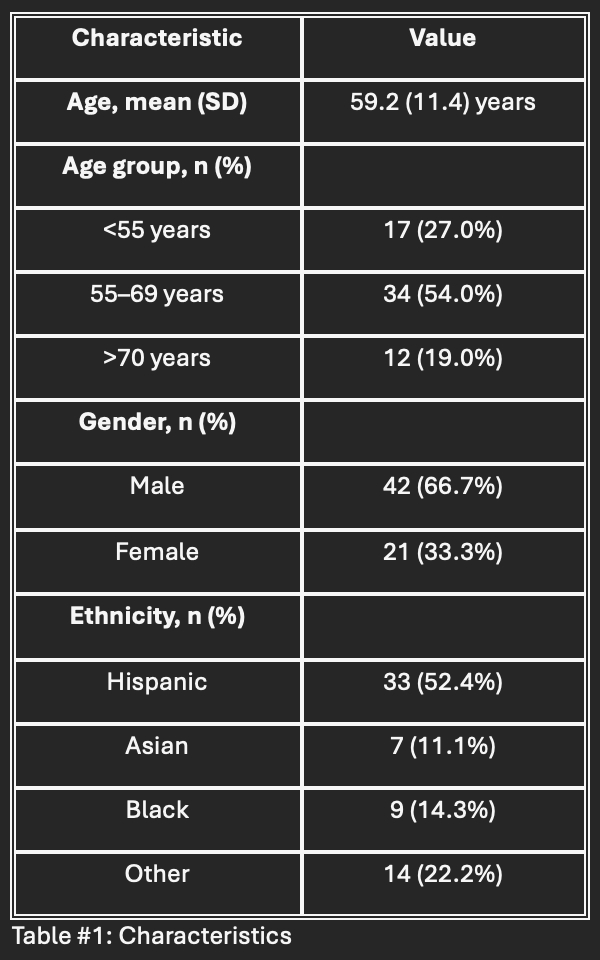
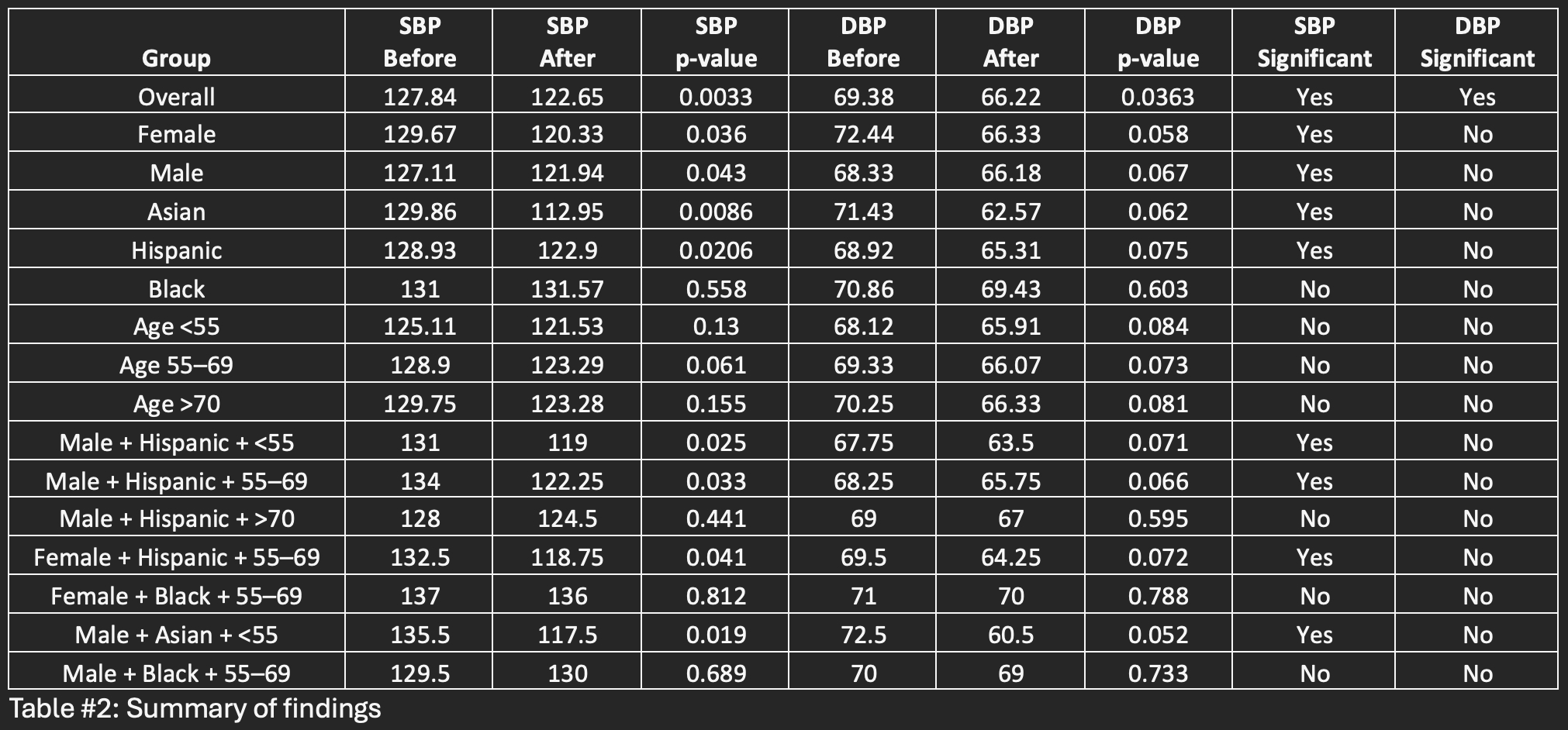
Abstract Body: Background: Cardiac rehabilitation (CR) is highly recommended for secondary prevention of coronary artery disease. While CR improves exercise tolerance and reduces morbidity, its impact on blood pressure (BP) is less well defined. This study evaluated BP changes following CR in an ethnically diverse, economically disadvantaged population within the Los Angeles County Department of Health Services (DHS). Objective: To assess the effect of CR on systolic and diastolic BP and determine whether gender, ethnicity, or age modified this response. Methods: This retrospective cohort study included 63 patients who completed the DHS CR program in 2024. Demographic data and resting BP before and after CR were extracted from medical records. Post-CR BP was averaged from the final three CR sessions. Age groups were defined as <55, 55–69, and ≥70 years. Gender and ethnicity were self-reported. Statistical Analysis: Paired t-tests compared pre- and post-CR systolic (SBP) and diastolic BP (DBP). Subgroup analyses were conducted by gender, ethnicity, age, and their combinations. Significance was set at p < 0.05. Results: In the full cohort, CR significantly reduced SBP from 127.84 to 122.65 mmHg (p = 0.0033) and DBP from 69.38 to 66.22 mmHg (p = 0.0363). Among females, SBP dropped from 129.67 to 120.33 mmHg (p = 0.036); among males, from 127.11 to 121.94 mmHg (p = 0.043). Significant SBP reductions occurred in Asian participants (129.86 to 112.95 mmHg, p = 0.0086) and Hispanic participants (128.93 to 122.90 mmHg, p = 0.0206). No significant SBP change was observed in Black participants (131.00 to 131.57 mmHg, p = 0.558). By age group, SBP reductions were not statistically significant: <55 (p = 0.13), 55–69 (p = 0.061), and ≥70 (p = 0.155). However, subgroup analysis showed significant SBP reductions in Male+Hispanic<55 (p = 0.025), Male+Hispanic 55–69 (p = 0.033), Female+Hispanic 55–69 (p = 0.041), and Male+Asian<55 (p = 0.019). DBP changes were not significant in any subgroup. Conclusion: CR significantly reduced SBP in a diverse safety-net population, with the greatest benefit observed in younger Hispanic and Asian males. DBP changes were modest. These findings highlight CR’s value for BP control in underserved groups.
Burke, Morgan
(
Los Angeles General Medical Center
, Los Angeles , California , United States )
Gan, Arnold
(
Los Angeles General Medical Center
, Los Angeles , California , United States )
Jinno, Stephanie
(
Los Angeles General Medical Center
, Los Angeles , California , United States )
Ge, Brandon
(
Los Angeles General Medical Center
, Los Angeles , California , United States )
Haq, Ubayd
(
Los Angeles General Medical Center
, Los Angeles , California , United States )
Balasubramanian, Satish
(
Rancho Los Amigos National Rehabilitation Center
, Los Angeles , California , United States )
Chen, Grace
(
Rancho Los Amigos National Rehabilitation Center
, Los Angeles , California , United States )
Gordon, Samuel
(
Los Angeles General Medical Center
, Los Angeles , California , United States )
Author Disclosures:
Morgan Burke:DO NOT have relevant financial relationships
| Arnold Gan:No Answer
| Stephanie Jinno:DO NOT have relevant financial relationships
| Brandon Ge:No Answer
| Ubayd Haq:No Answer
| Satish Balasubramanian:No Answer
| Grace Chen:No Answer
| Samuel Gordon:No Answer